New Ask Claude or ChatGPT about any stock, using Bullpen. Bullpen in Claude or ChatGPT. 7 days free

Monday, November 16, 2026

Back to the front page

From X

Serenity on X

Well, most of the time projections are noise and reactionary. Like right now, sky-high projections for $ANT $700-$800B ARR over next few years is stirring up hype that I'd argue gets revised down later. I do think it's important to model in capex forecasts dropping past 2028, due to the current reflexive nature of AI selloffs, rate hikes, etc. The drawn out duration of Iran War doesn't help, Jensen leaving $NVDA certainty draws concerns over Nvidia's ecosystem. But any catalyst, like if Iran War ends, can also change sentiment in a heartbeat (since bearish positioning is overwhelming). - It's also clear financing has been tightening, since OpenAI only managed to raise $11B of their original $30B target so far. - Markets are reacting enthusiastically to companies like $TE doing a $100M ATM today (nuking valuations) - Although the "guppy" sector is probably the most sensitive to financing + rate changes. On bright side... Neoclouds like $NBIS or $IREN seem to be adjusting by getting 100% capex prepayments or 90% GPU prepayments from their counterparties. What I'd argue though is lower aggregate capex does not apply uniformly in supply chains. - Mid-high range lasers for NPO/CPO are still sold out, as seen with $LITE now starting negotiations for 2030 capacity. - MLCCs are seeing further tightening as content usage goes up for AI servers - ABF substrates to InP substrates not really going anywhere. If content per system goes up 10X-15X, capacity expands at 2-3X Y/Y, and capex drops 28%. And content is so cheap that you can triple order and screw over competitors with wafer supply... I'm pretty confident you'll see acceleration upstream in bottlenecks from optical components to substrates despite potential aggregate capex dropping. Another rant is: -I keep seeing this argument that "low P/E is a warning for cyclical that's going to crash" but these are just clown takes Nobody seems to analyze duration scenarios like capacity expansion vs. content changes vs. demand. to actually see how long those earnings last. If everyone seems to be exiting DDR2 lines, there's probably going be more tightness in 2027 despite consume demand weakening, even if it looks like it's low P/E. - Also for concerns about CPO "delays", the same components like lasers are used for NPO. You'll still see 150-200mW NPO lasers or ELS NPO using the same 300–400+ mW lasers as CPO. We'll just see acceleration with NPO as a bridge if CPO gets delayed and higher range lasers likely to remain in a severe shortage. - Feels like markets have also completely discredited the merit of take/pay price floor LTAs as well that companies like SK Hynix to Samsung have. If contractual agreements hold up, memory players look very undervalued. TLDR: - I think it's important to model in capex decreasing to numbers like -30% in hypothetical downside sceanrios. Given AI profitability, it's clearly not sustainable for hyperscalers to aggregately increase capex $500B or $1T+ Y/Y, and that's never been a case I've argued. - This is also not the same thing as demand destruction that markets are overreacting to now (which haven't happened yet). - We can see demand revisions for GPUs, ASICs, and heavier cost parts of the supply chain, while acceleration increases elsewhere. The nuances market miss by indiscriminately selling everything is going to present compelling opportunities when the dust settles. I think in the end institutions are probably going to end up owning more of the same names retail discovered early on. Anyway, I think it's a good idea to try and survive until more earnings comes out.

Fajasy on X

QXO's $QXO Q3 10-Q lists 635.2M potential shares beyond its 1.04B shares outstanding, and 383M of them are in the money at $12.58/share. In my June 7 deep dive, I noted that none of $QXO's convertible preferred shows up in its diluted share count while it reports losses. All 383M come from the $1B investment CEO Brad Jacobs' firm led in June 2024: → Convertible preferred: 219.0M shares at $4.566. → Warrants: 219.0M shares, half at $4.566, a quarter at $6.849, and a quarter at $13.698 (out of the money). The Series C preferred converts into another 129.0M shares at $23.25, out of the money for now. $QXO sold the Series C to a fund managed by Apollo $APO and other investors to help pay for lumber distributor Kodiak and insulation installer TopBuild. By my math, $QXO has ~1.46B diluted shares at $12.58/share, not 1.04B. So its equity is worth ~$18.4B, not the ~$13.1B market cap on 1.04B shares. Add the $3.0B Series C and ~$8.45B of net debt, and its EV is ~$29.9B, ~17x the ~$1.75B of consensus adjusted EBITDA Jacobs used as $QXO's starting point on the Q3 call. Net debt of ~$8.45B lands within the $7-9B I expected in my deep dive, but it's ~4.8x the $1.75B, not the 3.3-4.3x I estimated on $2.1B. Interest (including a one-time $15M fee on an unused bridge loan) and preferred dividends took $229M in Q3, 41% of $QXO's $557M of adjusted EBITDA. Q3 operating cash flow was only ~$1M, down from $213M in Q3 2025. Operating cash flow was -$145M through September, including $332M the 10-Q says went into seasonal working capital, mostly inventory and receivables. Jacobs also said on the Q3 call that the $4B of adjusted EBITDA $QXO is targeting for 2030 assumes all free cash flow until then goes to paying down debt. Spending the same free cash flow on small acquisitions could lift 2030 adjusted EBITDA to ~$5.5B instead, he said. Neither path includes the $500M buyback $QXO authorized on November 12. $QXO also said CFO Ihsan Essaid will move to vice chairman in January to oversee M&A and capital raising, and Dev Ahuja, CFO of aluminum maker Novelis since 2016, will take his place. Two numbers in the FY2026 10-K will show whether $QXO is paying down debt: 1) Operating cash flow: Positive for the year, after $145M went out through September. 2) Net debt: Below the ~$8.45B as of September 30. P.S. The ~1.46B counts the in-the-money preferred and warrants (the warrants net of their exercise price), the mandatory convertible preferred (which converts into common by May 15, 2028), stock awards, and 42.0M pre-funded warrants that cost $0.00001/share to exercise.

Convequity on X

Without Jensen, Nvidia's lead over custom chips rests on a release pace it now has to prove it can keep We have argued since late 2023 that custom AI chips put real competitive pressure on $NVDA. Investors are only now starting to recognize how much, and they are doing so in the week Jensen Huang resigned. The evidence came in three days. six of Nvidia's seven largest customers (Google, Microsoft, Meta, Amazon, Anthropic and OpenAI) are building their own chips, and that its benchmarks find Google's TPU as good as Nvidia. Supply-chain checks show new OpenAI and Anthropic orders for Google's TPU that extend shipment visibility to 2029: about 12 million units for OpenAI and about 14 million for Anthropic across 2028 and 2029. What's capping TPU here is more TSMC and memory supply not demand. Nvidia has faced this pressure for two years and kept its lead for one main reason: speed. A custom chip is designed against the Nvidia generation that exists when the design work starts. Nvidia has been releasing new generations faster than custom chip teams could finish theirs, so by the time a custom chip shipped in volume, it was competing with an older Nvidia product. That pace was a leadership decision. Blackwell and Rubin each pushed the limit of what could be built and supplied on schedule. Each needed someone at the top with the judgment to pick the design and the willingness to carry the risk if it slipped. Jensen made those calls. Nvidia does not have to stumble for his exit to matter. A slight slowdown is enough. If the generation after Rubin is less ambitious or arrives later, custom chips reach volume against an Nvidia product they can match. More workloads then move to custom chips, Nvidia loses share, and each later generation has to win back customers who already have a working alternative. Nvidia's other remaining edge is Jensen's willingness to finance customers. The Information reported that AMD and Broadcom cannot take on the credit guarantees Nvidia has given clouds and data-center developers. That edge also came from one person's appetite for risk, and interim CEO Colette Kress has not yet said whether she will keep it. But it is more likely than not that she is going to reduce it and not offering generous backstops. In our view $AVGO gains the most from any room Nvidia gives up. Kuo says Broadcom leads the TPU design for Anthropic, and that Broadcom's revenue from other custom chips and networking could exceed its TPU revenue as early as 2027. Total TPU shipments should go up to 15m+ per year in 2028 but it is highly constrained by TSM's CoWoS advanced packaging capacity and cutting edge node. Lateral versions of TPU will also be dependent on $INTC EMIB-T advanced packaging capacity which we believe has a good chance to ramp up early and fill in the gap left by CoWoS. Nvidia reports on 17 Nov, Kress's first earnings call as interim CEO. We will listen for whether the timing of Rubin and the generation after it is unchanged. For the next two years we will judge Nvidia mainly on whether it keeps its release pace under new leadership.

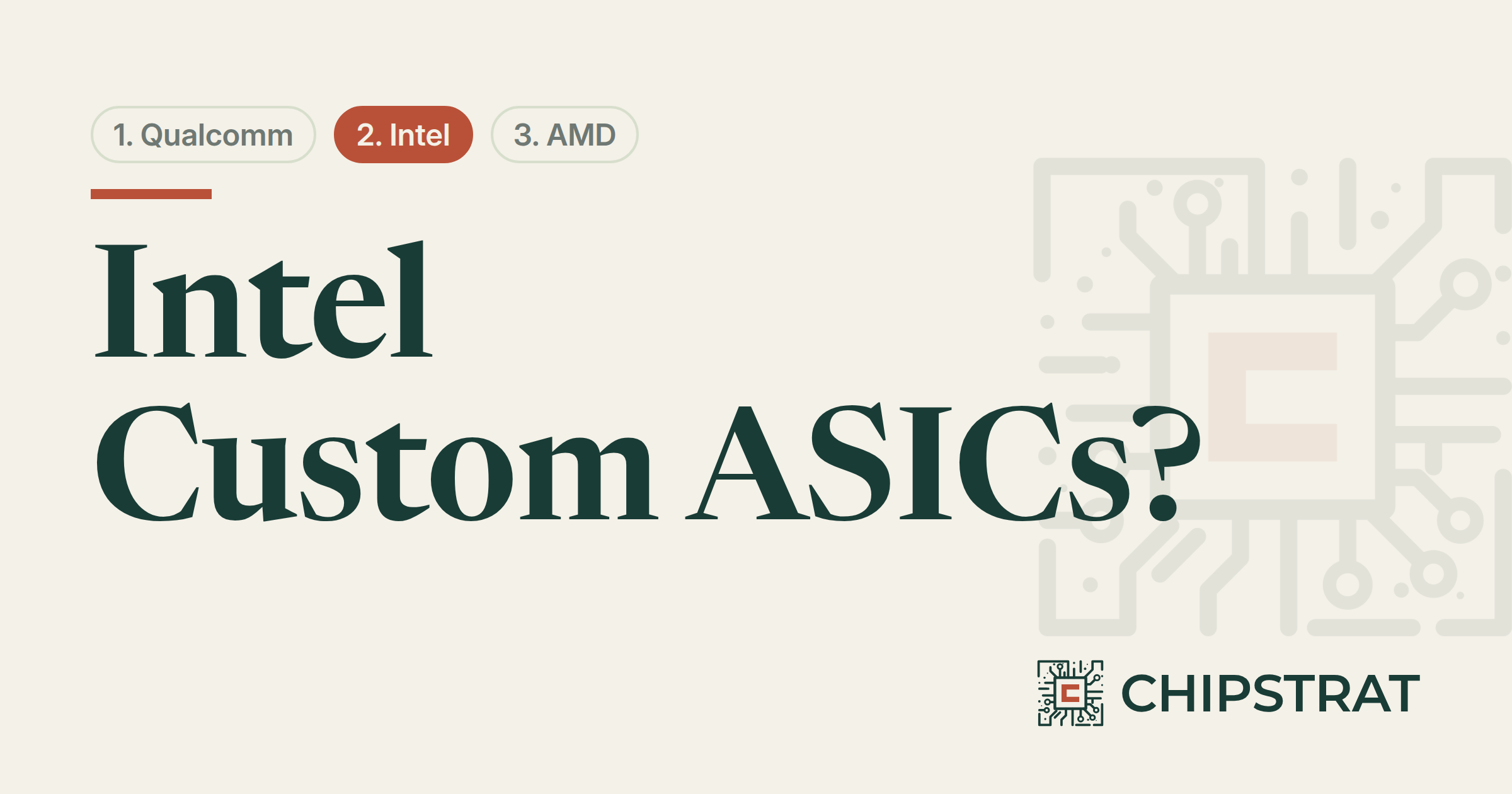
Intel Custom ASICs?

Intel’s custom ASIC business more than doubled last quarter as it pursues hyperscaler demand, AI accelerators and a stronger Intel Foundry.

PayPal tries again (and again)

Stripe’s startup-focused product sprawl contrasts with Adyen’s enterprise restraint; despite 20% more payment volume and faster growth,…

Altria: An Oral History

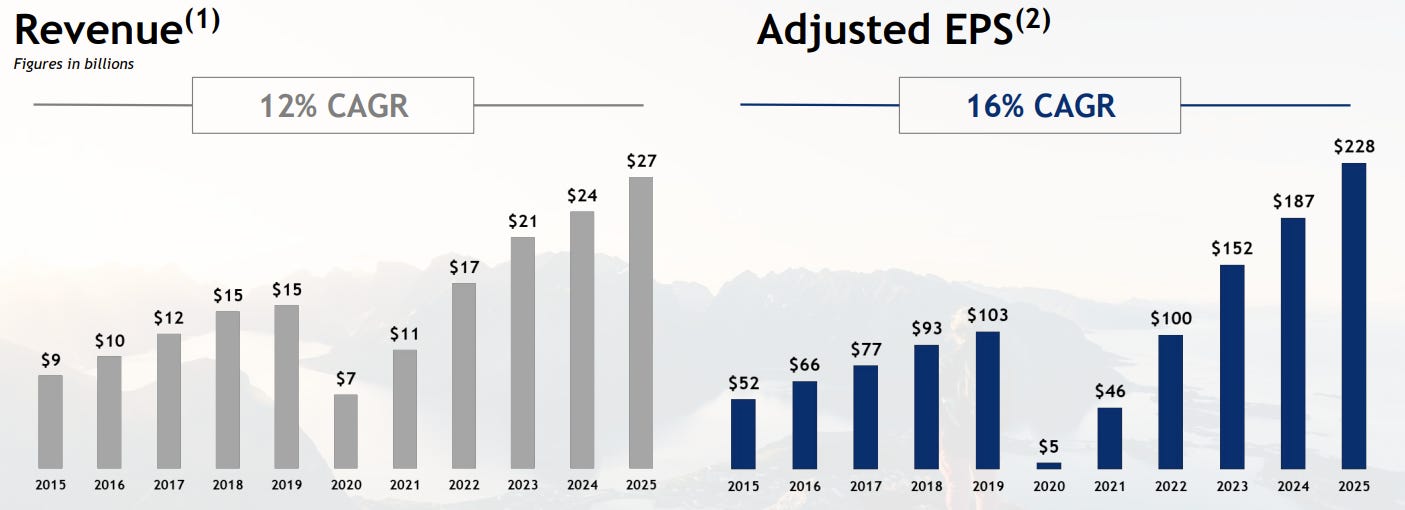
Altria's Q1 2026 revenue rose 3.2% and adjusted EPS 7.3%, while oral tobacco share fell to 29% amid nicotine-pouch competition and a long…

Winning Cultures, Brutal Truths

Norges Bank’s Winning Cultures conference drew lessons from Ken Griffin, Michael O’Leary and Jamie Dimon on rapid decisions, cost…

Publications we follow

Every publication on this site, hand-picked.

130 publications

Newsletters 110

X accounts we follow

Every account on this site, hand-picked.

91 accounts

Investor letters we follow

376 firms

Sectors

Ordered by how often our editor reaches for them.