NASDAQ

Intel CORP

INTC

28 stories

$536B Market cap · 2026-10-13

@aleabitoreddit

Serenity on X

So spent some more time to look at more DBS conference material: - "Two semiconductor giants, $AVGO and $INTC, both stated that breakthroughs in AI will keep demand for chip investment elevated for at least another 2 years. As current supply is insufficient to meet market demand." - "Current chip production capacity is already far from sufficient to meet demand, and $AVGO CEO expects the shortage to become even more severe in the future." (HKEJ) - "Regarding OpenAI, Hock Tan stated that the market had misinterpreted the company because its underlying fundamentals remained strong. He argued that investors who sell based on a single short-term data point [$50B ARR] are "essentially no different from people gambling in a casino." (eg. Hong Kong Economic Journal): - Commenting on investors' disappointment in OpenAI’s latest revenue forecast: "by itself, not that bad" on their $50B ARR. (Business Times) And connected investors' disappointment to a failure to understand the business and excessive expectations like a casino. - Tan rejected the proposition that OpenAI was overvalued. It quotes him saying: "It’s almost like they are in a casino gambling" in regards to investors' unrealistic expectations and lack of understanding on OpenAI. - Hock Tan if OpenAI and Anthropic achieve widespread market adoption: their attractiveness would substantially strengthen their bargaining power when raising capital. But cautioned elevated global interest rates could make capital requirements a constraint for future growth. - The real driver, he said, is whether frontier AI companies can create models that generate enough value and returns to justify the buildout. (which is fair) - Most companies are wasting money on tokens. He also warned that most companies just waste money spending tokens like kids in a video arcade. This part was the most badly worded by Hock Tan given he's running $AVGO. But Western media commentary narrowed this down to: - "Shortage of capital now, AI Investors are gamblers". In the conference, Broadcom's CEO was actually defending frontier lab valuations and giving cautiously bullish statements about AI infrastructure demand. While citing rising interest rates as a potential constraint that larger revenue or adoption could overcome. Cherry picking quotes out of context disorts the actual messaging. TLDR: - Large and elevated AI semi demand, semi supply insufficient to meet market demand. At least another 2 years of elevated spend - OpenAI valuations defensible, people who sell based on extreme expectations for the company are like casino gamblers. - Tan stated markets had misinterpreted OpenAI's ARR because its underlying fundamentals remained strong. - Frontier labs if they achieve widespread adoption / revenue would strengthen capital raising, which overpower headwinds from raising interest rates. Lot of $AVGO CEO remarks looks heavily nuanced, which Western media coverage distored.
@aleabitoreddit

Serenity on X

Sure... Random train of thoughts on markets now, optics like $LITE / memory + $IREN / Anthropic. On Memory: - Demand visibility on $MU / Samsung / SK Hynix extend into 2030-2031. Samsung has LTAs covering 70% of their capacity into 2031 (likely with SK Hynix type price floors)... and their operating profit is already absurd. There's a consensus that shortage in 2027 will be much more severe than 2026... Even $SNDK expends gross margins to exceed 80% entering 2030. You're going to hear Acer and other CEOs that want memory prices to go down cite bear cases like CXMT/YMTC, and Chinese players. But just looking at supply procurement that $NVDA is doing + hyperscalers, demand visibility is absurd for the next 5 years. And by that time, cumulative FCF coming in from these take/pay + pricing floor contracts might exceed some of their entire marketcaps so it feels like there's some baseline. Near-term is always volatile (IV dropped a ton across $EWY to $DRAM to $MU), so people with call options likely got nuked, along with underlying prices. But if Samsung is 3x 2027E, has 5 year LTAs with 70% of capacity committed from hyperscalers, and price floors, it's kinda hard to see these names suffer a sustained crash... For optics: - $LITE is literally sold out into 2029, starting discussions into 2030. With demand visibility lasting into 2031… with hyperscalers largely funding the capacity buildout. Their 2028 Greensboro fab expansion was ~$5B in UHP laser capacity revenue alone, yet it’s basically allocated toward $NVDA (50%+ with options for more) and co from channel checks. Existing supply chain bottlenecks are extremely severe as optical content/XPU skyrockets entering 2027-2028. So everything from DSPs/TIAs, photodiodes, lasers, InP/SOI substrates, wafers (epi, SOI, etc) are expected to go brrr. And what does that imply to anyone else with enormous amounts of capacity coming online like $AAOI + $SIVE + $MTSI capacity expansion in 2027? Or other players like Sumitomo / Furukawa? But again it's not quite the same situation as memory since the BOM % is extremely low in a cluster... If micron/samsung raised another 2000% hyperscalers would go bankrupt. But doing that for InP substrates seems possible. Or a 100% increase on CW laser content. I actually thought $LITE was overvalued at $100B+ MC, relative to capacity expansion on your smaller optical players to their respective MCs. So I chose to position accordingly (But lumentum does deserve premiums for demand visibility). For the companies leading the charge like $NVDA / $AVGO / $MRVL: - Nvidia has 70% forward revenue growth FY2028 which is supply constrained growth. - Broadcom 100% Y/Y for 2027/2028 which is also supply constrained growth. - Marvell FY2031 upgraded guidance to $70B-$90B from $46B analyst projections... They all seem to be very happy.... and read through on demand for next 2-3 years is enormous (also echoing what $INTC CEO said today on the panel with $AVGO CEO). So you have overwhelming growth on memory + photonics + from the leaders... But the nuance is not everything in the AI supply chain get the same economic benefit. HBM/Laser/CPU/MLCC and other players in the bottlenecks look to be printing money. And seem to be the largest beneficiaries of the current bottlenecks. Test players are also getting price hikes + capacity allocated by players like $NVDA, but economic impact seems a tad lower than other players since forward P/E for many I modeled were still in the 45x+ range even if you hiked prices like 10-30%. As for capex intensive players... there's some like $IREN ($25-30B for 2027) that despite a deal with Anthropic ended up dropping. I don't think markets seem to appreciate players spending a lot of money + ongoing financing (think they're like halfway through their $6B ATM). Just some hopium for $IREN investors, $NBIS also signed a deal with $META at the start of the year (but markets didn't care at all, since Nebius dropped to ~$70-80 at the lowest point?). But did 6 months later, as the time to revenue inflection gets closer and you're past the ATM/capex window, markets would likely care more. I don't think it's irrational but at the same time, the fundamentals have improved from Mirantis acquisition to others. I also think it was known for awhile it was either OpenAI/Anthropic from CEO comments earlier too? But either way to be a more risk-off environment where funds seem to be rotating to larger names as a flight to safety. $CRWD / $PLTR as just two example, but my take is that the valuations of these rotations are reaching clown levels. And that certain AI supply chain beneficiaries in comparison are undervalued now. I was thinking markets would just rotate to names that are extremely profitable like Samsung or names that have <2X P/E, so it was surprising to see $KOSPI and some legacy memory players get sold off today. Since all of this is colliding with uncertainty about sht macro environments and renewed sustainability concern of AI capex/commitments from frontier labs like OpenAI/Anthropic from due to that FT piece recently. I've always been sounding the alarm about the contractual backlog OpenAI has with $CBRS, $MSFT, $ORCL and others earlier in the year. But OpenAI did just raise $122B or so , so I don't quite think they're at risk of going down anytime soon. I also don't think overall capex can just exponentially go up, but even if it stalls / hovers around a certain point or even drops... Capex toward certain areas like optics will still explode as hyperscalers fight over allocations when CPO scale up comes about, but might drop in others where more capacity comes online like test or DRAM. So it's a lot more nuanced than capex down = everything down or vice versa. I also slightly agree with community agreements that open weight models wouldn't lessen demand on AI infrastructure (otherwise $NVDA wouldn't be funneling funds into Reflection), but all the contractual obligations that Anthropic has might get messy if their models/company get cannibalized. Either way, I'd expect some of these frontier lab valuations to likely compress but I do think Jensen knows what he's doing though to avoid contagion. But basically: - Extremely difficult market now, can't just throw money at any AI supply chain company like $GLW and expect it to go up. There's cause for concern of rate hikes mixed with financing per $AVGO CEO but not to the point you just blindly sell off everything. Also I think markets are stupid and ties baskets together so that leads to mispricing + individual buying opportunities with certain chokepoints too. If capacity + demand is visible and forward p/e compresses like $AAOI to single digits off hundreds or thousands of percent growth from hyperscalers off $471m transceiver revenues and hundreds of thousands of monthly ELSFP capacity. Or $SIVE coming online with 100M+ laser capacity + multiple foundries with ASP hikes on lasers. I wouldn't lump them into other AI supply chain names in IP like $RMBS or others. My take is that AI supply chain beneficiaries with closer inflection points, demand visibility, and forward P/E compressing due to economic leverage would likely outperform medium term despite current volatility. TLDR: - Memory strongest risk/adjusted return with LTAs + pricing floors extending to 2030's + buybacks. - My opinion is that optical supercycle for 2027-2028 with CPO/NPO is going to look absurd relative to capacity coming online of smaller suppliers. - Overwhelming fundamentals/growth colliding with sht macro + media scares - Markets are stupid and groups things in baskets and sells them all off together or buys overvalued names, creating short/long opportunities I'd give a prayer to people on short term options given underlying drop + IV decline, but there could be a reversal... who knows. Most valuable thing right now is time.
@convequity

Convequity on X

We prefer $UMC to $GFS, and we are increasing our UMC position. Both companies are foundries that make chips on mature processes, well behind the leading edge. We hold GlobalFoundries as a recovery investment. United Microelectronics offers two things on top of a recovery: a manufacturing partnership with production targeted for 2027, and a longer-term way to make its existing processes more competitive. 1. The nearer-term driver is the 12nm process UMC is developing with $INTC. 12nm is a mature process generation, not a leading-edge one. Production is targeted for 2027 at Intel's factories in Arizona. UMC contributes its foundry experience and its experience working with chip designers. Intel contributes the manufacturing capacity. UMC gains a way to offer customers chips made in the United States without building an American factory itself. UMC could also earn income from intellectual property and revenue sharing, but the commercial terms are not yet clear, so we do not yet count on royalty income. The attraction today is the chance to win customers and expand the business through the partnership. 2. The longer-term driver is logic folding. In a conventional chip, the circuits sit on one layer and signals cross it along long horizontal wires. Folding arranges the circuits across two or more layers connected vertically, so many long horizontal wires become short vertical ones. Signals travel a shorter distance, which takes less time and less energy. The chip gets faster and more energy-efficient without smaller transistors. For UMC, folding could make chips built on its established processes more capable and easier to sell, which extends the value of its factories without matching the most advanced processes at $TSM. We described the mechanism in our Huawei series on the Kirin 9050. 3. We think a mature process is the more manageable place to start folding. Whoever folds chips has to solve bonding, heat removal and reliable high-volume production. UMC would solve those on a transistor process it already understands. Applying folding to TSMC's newest processes would combine two difficult manufacturing changes at once: a new generation of smaller, more complex transistors, and active circuits connected across several layers. A problem with either one can reduce the share of usable chips, raise costs or delay customer launches. This is a difference in the risks being combined. TSMC already offers advanced stacking technologies and has the expertise. 4. The commercial incentives differ as well. For UMC, folding extends the useful life of processes it already owns and lets it compete for business that would otherwise need a newer process. For TSMC, folding on older processes competes with the returns it expects from its leading-edge investments and could disrupt customer roadmaps built around those investments. So UMC has the stronger reason to become an advocate for folding on older processes. This is our prospective thesis about where folding is most likely to be adopted. UMC has not announced a logic-folding program. We have two reservations. UMC's shares have already recovered from their low, so the entry point is less attractive than it was. Logic folding could take years to contribute to revenue. The Intel partnership is our reason to add now. The chance to make UMC's existing processes more competitive is why we hold a larger position in UMC than in GlobalFoundries.

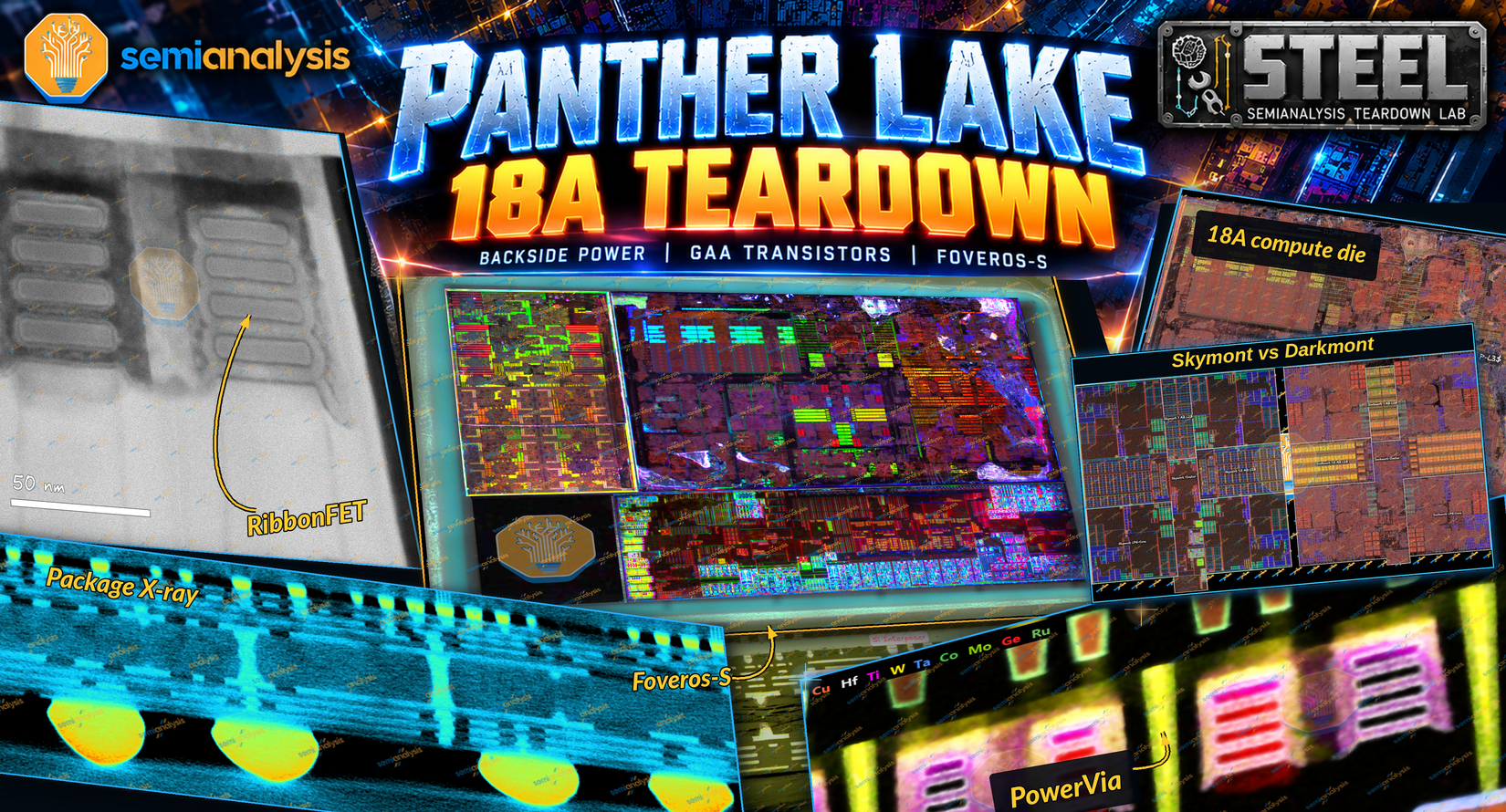
Intel Panther Lake Teardown

Intel’s Panther Lake puts 18A PowerVia backside power and RibbonFET GAA transistors into commercial silicon, with logic density similar to…

@aleabitoreddit

Serenity on X

All right $META Muse is cooking. I can hear all the $AMD, $INTC, and $ARM CPUs vrrrring in the background. Along with the memory + components (NICs, SSDs, DRAM) needed for all the browsers/VMs When I ask it to do a bunch of long form tasks… Intel CEO also said recently that CPU demand is so strong they can only support 50% of what customers need, so there’s some signals there. I’m also curious how much $AMZN or $NBIS is involved with running Muse, or if Meta hosts everything inhouse. Kinda an ADHD post but Meta beat my expectations with this release. Will keep trying it out
@aleabitoreddit

Serenity on X

$SIVE and $AAOI, yes for a 2027 timeframe. That's the nuance. Sivers you're coming on with 100M CW DFB laser capacity + 2 external foundries (maybe 300M in total), and all my supply chains mapping maps to larger hyperscaler suppliers. AAOI you're coming on with $471m transceiver revenue + 400K ELS units for 2028 timeframe. With hyperscalers + demand eating up all their capacity. There's just a $600m ATM which presents overhang near term. $NBIS already got re-rated but it's very positive upcoming for Q4 2026 (esp. with price hikes). Legacy memory like $ESMT + (some I haven't named yet) + regular memory names like Samsung, I do think will strongly outperform near term. And obviously CPUs names like $INTC $AMD $ARM as of recent.
@aleabitoreddit

Serenity on X

I'm not having a fun day since I got sick today. But the bottlenecks are having a good time: $AMD +9.13% | $INTC +14.16% | $ARM +14.33% CPUs go brrr $SIVE +10.32% | $AAOI +3.39% | AMS OSRAM +24.61% Lasers go brrr $EWY +4.08% | $DRAM +2.83% | $MU +2.23% Memory go brrr $NBIS +4.7% | $CRWV +5.03% | $IREN +1.73% Compute go brrr Probably most material developments were CPU:GPU ratio expectations + CPU demand (from new AI releases). As well as optical developments from ECOC 2026 (as seen with $MRVL PR + others) Still a lot to catch up on.
@MultiplesCap

Multiples Capital on X

Not an AI expert by any stretch, but wonder if US labs actually coordinate to "pace the frontier," it could be a stealth negative for Nvidia’s top-line growth rate. Here’s why: Flattening the Frontier Race: If scaling massive base models is intentionally delayed for alignment, the panic to hoard the newest, most expensive contiguous GPU clusters cools down. Shift to Post-Training & RL: Progress shifts to squeezing intelligence out of existing models via synthetic data and self-play. This relies on inference-class rollout fleets rather than cutting-edge pre-training mega-clusters. The Verification Layer: Evaluating, sandboxing, and grading all that synthetic RL data requires massive CPU compute .... benefitting $INTC Less brute-force pre-training = extended hardware refresh cycles and a normalized upgrade curve for $NVDA. Markets much smarter on this than I, will wait into see how the stock prices react to this next week!
@AsifSuria

Asif Suria on X

As I was working through the insider transactions filed last week for our Insider Weekends article that we have published every Sunday for the last 16 years, these four buys from last Friday stood out to me: 💻 1. A rare insider purchase by Intel's CEO Lip Bu Tan, where he bought $10 million worth of stock after the recent pullback at an average price of $95.00. $INTC The last purchase before that was by the CFO David Zinsner who bought shares in January at an attractive price of $42.50 per share. Former CEO @PGelsinger did even better with his purchases in 2023 and 2024, the last of which were at an average price of $22.53. He is up 365% on that purchase. Lip Bu Tan previously purchased $2.5 million worth of Intel stock in November 2023 when he was the CEO of Cadence $CDNS and was an Intel board member. 🚗 2. A purchase by the Chief Accounting Officer of Valvoline $VVV at an average price of $33.20. While the size of the purchase was not large at about $50K, you don't frequently see purchases by Chief Accounting Officers. @ChrisPavese mentioned that Valvoline was a top contributor to the Broyhill Asset Management portfolio in Q1 2026. ☕️ 3. A purchase by a director of the coffee chain Dutch Bros $BROS where he picked up 2,000 shares at an average price of $51.56. He also purchased shares in May of this year at a slightly lower price. 🧑‍🎓 4. A purchase by a director of Universal Technical Institute $UTI at an average price of $25.94 after a massive drop in the stock last week. Competitor Lincoln Education Services $LINC was also down sharply and I remember liking the thesis for the business after attending a presentation at an investor conference a couple of years ago. Unfortunately I didn't act and buy stock right away. Lincoln is up over 50% over the last year and is up 365% over the last five years despite this recent pullback.

Investor Letters

Letters that discuss INTC.

Every letter that discusses INTC

Tickers on this page

Companies the stories above are also about, besides INTC.