New Ask Claude or ChatGPT about any stock, using Bullpen. Bullpen in Claude or ChatGPT. 7 days free

Monday, November 23, 2026

Back to the front page

From X

Convequity on X

Tesla's Powercore takes 34.5 kV grid power to 800V DC in one step at 7.4 MW. This is a huge deal for the 800V HVDC landscape. $TSLA unveiled Powercore on 17 November. One cabinet takes 10 to 34.5 kV AC and puts out 800 to 2,000 V DC, with 98.86% peak efficiency and first units operating in 2027. Tesla is working with $NVDA to certify it for 800V DC data centers. This changes part of what we wrote in June, when we argued 800V DC was not ready for mainstream adoption. Our reason was the conversion path. Solid-state transformers in production worked at low voltage only. A data center had to step the grid's 13 to 20 kV down to about 400V AC, convert that to 800V DC, then step down again to 50V for the servers. We put the direct path from the grid to 800V at two or more years away. Think of voltage as water pressure. The transmission line is the trunk main. The substation transformer drops it to a 34.5 kV district main. The path we described in June uses two sets of valves to get from the district main to the 800V pipe that feeds the server racks. Powercore uses one. Most Powercore users, including SpaceX ($SPCX), will pair it with behind-the-meter natural gas turbines coupled with Megapack. The last drop inside the rack, from 800V to about 50V and then 12V, is not part of what Tesla announced. Powercore stops at 800V, so the 50V step we flagged in June is still there. So Tesla is addressing the main gap we flagged in June, with a product that first operates in 2027 and that Nvidia has not yet certified. How does Tesla do it? No silicon carbide (SiC) transistor in volume production blocks 12 kV or more on its own. $WOLF has shown a 10 kV device, and it is not in volume supply. Converters in this class stack many cells in series, each built on 1.2 to 3.3 kV SiC parts, so the cells share the grid voltage between them. Tesla has not published Powercore's circuit design, switch material or supplier. Our reading is stacked SiC cells, because gallium nitride (GaN) in production is mostly rated 650V and below. Tesla builds its converters in-house, about 3 terawatts so far, and says Powercore uses "U.S. and imported parts". It does not own a SiC fab. Teardowns of Model 3 and Model Y inverters show SiC chips from $STM, and $ON is reportedly a second source for the cars. Tesla is ahead on size, and it has company. Amperesand said it would ship 30 MW of one-step 800V units in 2026, built on Wolfspeed 3.3 kV modules. Delta Electronics has had a unit running at a Chinese data center since February. Heron Power, founded by former Tesla executive Drew Baglino, plans volume production of a 4.2 MW data-center unit in late 2027. $ETN has a 2 MW, 15 kV unit that passed a new UL standard, and Infineon supplies SiC for Eaton's platform. Tesla's edge is 7.4 MW per cabinet, converter manufacturing at scale, and Megapack batteries on the same DC bus. The read-across by layer: 1) Medium-voltage gear. Powercore replaces the conventional transformer, switchgear and rectifier between the substation and the rack. $VRT and Schneider Electric sell that equipment and, per an industry survey, have not announced a commercial solid-state transformer. JPMorgan reportedly says Powercore would compete with traditional data-center electrical suppliers once it ships. 2) SiC chips. Every one-step converter needs a large number of SiC switches, whoever builds the cabinet. Chinese industry estimates put this demand at roughly $500M a year by 2030. If Tesla takes share, more of that volume goes to whichever supplier Tesla picks. 3) Rack power. The 800V to 50V step stays with the chip vendors Nvidia has named for 800V: Infineon, STMicro, ON, $NVTS and InnoScience. Navitas and InnoScience sell GaN for that step, which Powercore does not touch. Wolfspeed is not on Nvidia's list. It would also be worth tracking whether Tesla expands into this layer itself. For Tesla, a 1 GW campus needs about 135 Powercores. Energy revenue fell 15.6% y/y to $2.88B in 3Q26 at a 33.1% gross margin, against 18.0% for the rest of the company. $SPCX will likely be the largest user and the biggest beneficiary of this cutting-edge power supply for AI data centers. It is a big part of the reason SPCX can build 500 MW of data center per month, and 1 GW per month next year, without the typical lead time for energy. It is also the reason SPCX can build 1 GW of data center at roughly $35 billion, about 60% of peer costs. #Tesla #800VDC

Convequity on X

Keysight's orders show customers are still paying for 1.6T optical links Optics shares have fallen this month. Innolight lost 9% in one session on 6 November and Applied Optoelectronics is down 45% in a month. Keysight ($KEYS) took $2.34 billion of orders in fiscal Q4 against $1.99 billion of revenue, 1.17 times. AI bookings for the full year were about 2.5 times the prior year's, and the number of AI customers nearly doubled. Keysight makes the test instruments that prove a high-speed link works, and a transceiver maker buys from it twice. In R&D, engineers use its bit-error-rate testers and lab oscilloscopes to design and qualify each new module speed. On the production line, its digital communication analyzers, sampling oscilloscopes that measure a module's optical signal, test 800G and 1.6T modules before they ship. In August management put its data center link business at about two-thirds R&D and one-third manufacturing, with the mix moving toward production as 1.6T ramps. The other buyers sit on either side of the module: chip designers validating silicon before tape-out, switch and cable makers qualifying 1.6T copper and optical links, and cloud companies emulating AI traffic on a cluster's network before deployment. A separate business sells wafer test systems to foundries and memory makers, where orders grew double digits on advanced nodes, high-bandwidth memory (HBM) and silicon photonics. Foundries are now taking silicon photonics into commercial production, which adds optical test to the electrical wafer test Keysight already sells. Management expects the bigger step-up from co-packaged optics (CPO), which moves the optics into the switch package, in 2028. Customers buy much of this equipment when they develop and qualify the next link speed, before modules ship in volume, so Keysight's orders move ahead of the optics makers' revenue. Management said 1.6T is early in its ramp and 3.2T is already in R&D. Our estimate: the CFO guided Q1 orders down by a mid-single-digit percentage, which puts them near $2.2 billion against a $2.05 billion revenue guide, about 1.08 times. Risk: the CFO said $200–300 million of the backlog built up because Keysight could not ship fast enough, so that part measures its own supply shortage.

Somewhat exciting Income Ideas

AXIS’s AXS-E preferred yields 8.3% at $16.49, while discounted WaFd and Bank OZK preferreds offer 8% to 14% paper yields amid long-rate…

YOU · short

Clear Secure INC

Clear Secure's Clear Plus subscription business is nearing maturity despite recent bookings strength, supporting a short thesis on YOU.

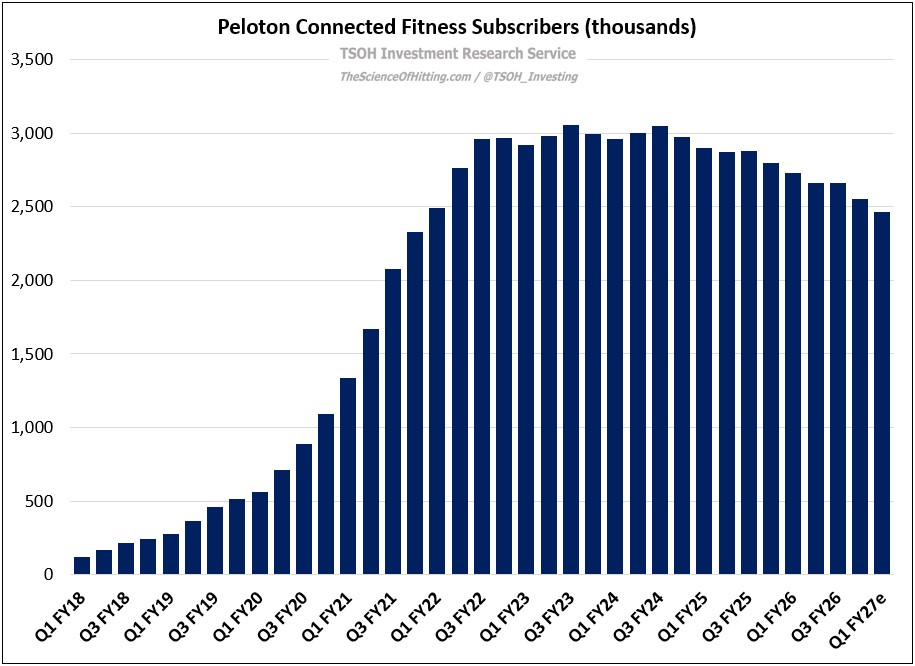
Peloton: Subscriber Squeeze

Peloton’s improved balance sheet has not stopped weak subscription trends or sharp volatility, prompting purchases near $3.70, a later…

The Last Bidder

Aquarian won Brighthouse Financial despite a lower bid after higher offers failed to secure reinsurance for its legacy liabilities and thin…

OXY's Plan for Financial FREEDOM

Occidental Petroleum’s plan targets debt-free operations and roughly double 2025 cash generation under new CEO Richard Jackson, following…
Publications we follow

Every publication on this site, hand-picked.

130 publications

Newsletters 110

Seeking Alpha 102 of 305

X accounts we follow

Every account on this site, hand-picked.

94 accounts

Investor letters we follow

383 firms

Sectors

Ordered by how often our editor reaches for them.