AstraZeneca reported $16.2 billion Q3 revenue, up 7%, as oncology grew 17% and Farxiga fell 25% after US generics.
BL Cestrian Capital Research Oct 30 2 clicks
Sanofi raised FY26 guidance after Q3 sales grew 14.3% at constant currency, led by 34.8% Dupixent growth; vaccines declined 6.6%.
BL Cestrian Capital Research Oct 30 1 click
Bloom may have reopened imports of scandium-containing components from China to the United States, according to new trade data.
BL Hunterbrook Oct 30 4 clicks
Markel spent $315 million repurchasing shares in Q3 as Thrive agreed to buy ADT for $7.6 billion and Hasbro cited rising adult toy demand.
S TSOH Investment Research Oct 30 1 click
Verisk Analytics’ 40 petabytes of proprietary insurance data and regulatory infrastructure shield its underwriting business from generative…
S First Strike Research Oct 30 7 clicks
Applied Materials posted 51% growth while trading near 23 times forward earnings; memory spending and fab construction support orders, but…
SA Capital Minded Oct 30 1 click Marvell’s reported Lumentum bid would combine DSPs, lasers and optical modules, but $4 billion of cash and $5 billion of debt point to a…
S Vik's Newsletter Oct 30 1 click
SoFi’s stock case hinges on interest rates, tangible book value and private-credit loan sales after its $1.5 billion equity offering.
S WHAT ARE WE DOING? “Contrarians At The Gate” Oct 29 3 clicks
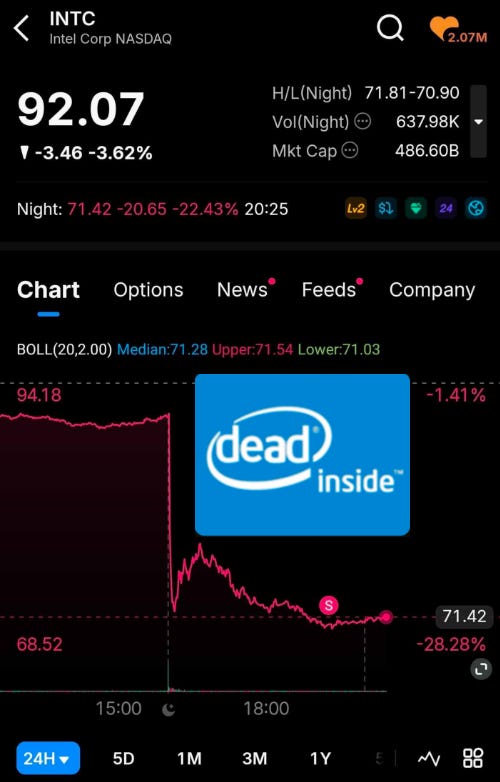
Intel’s Q3 2026 datacenter CPU shortage reflects wafer-start planning failures, not substrate constraints, after demand shifted from client…
S Irrational Analysis Oct 29 2 clicks
Alphabet, Amazon and Intel face market pressure as the big three cloud giants reaffirm AI spending plans.
BL The Technology Letter Oct 29 1 click
Regeneron’s Q3 revenue rose 36% to $5.1 billion, driven by a 68% jump in Sanofi collaboration revenue, while operating income doubled to…
BL Cestrian Capital Research Oct 30 2 clicks
SAP · long SAP shares are down 45% since February 2025 as AI disruption fears create a long thesis on its risk-reward.
BL Value Investors Club Aug 1 2 clicks
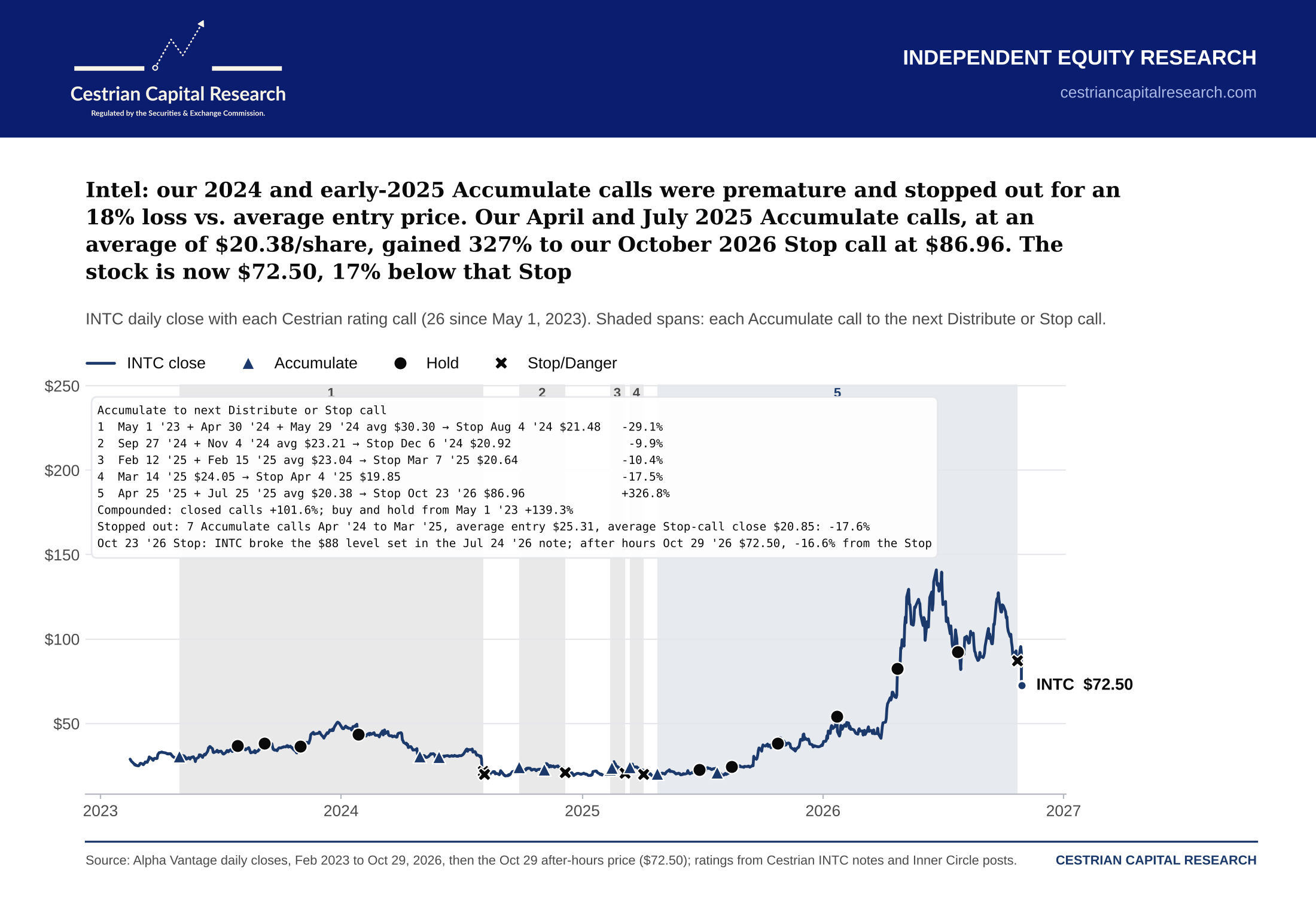
Intel's Q3 revenue rose 21% to $16.5 billion, led by 78% data-center and AI growth, but Q4 guidance of $15.5 billion trailed consensus.
BL Cestrian Capital Research Oct 29 4 clicks
Twilio CEO Khozema Shipchandler urged investors to “buy the dip” after earnings sent the software maker’s shares down 17% after hours.
BL The Technology Letter Oct 29 2 clicks
Incyte reported Q3 FY26 revenue of $1.56 billion, up 14%, while a $1.23 billion Vega acquisition charge drove a $708 million operating loss.
BL Cestrian Capital Research Oct 29 2 clicks
CoStar’s 3Q26 revenue growth slowed to 14% as bookings fell to $37 million, while cost cuts lifted EBIT margin to 8.8%.
S Speedwell Memos Oct 29 3 clicks
Simran Jeet Singh recounts pricing oil through WTI’s -$37.63 collapse, then explains crypto perpetual funding arbitrage, market making and…
YT Odds on Open Oct 29 5 clicks
Carpenter Technology fell 25% after Q1 2027 despite revenue rising 9%, EPS up 34%, and commercial aerospace bookings up 25%.
S Monte Independent Investment Research Oct 29 3 clicks
Google’s AI search could improve ad economics, while Amazon protects its retail ad funnel from shopping agents and specialty insurers face…
S scuttleblurb Oct 29 1 click
Alphabet’s $200B 2026 capex and weaker AI-search monetization contrast with Microsoft’s accelerating Copilot and Azure momentum; the review…
S Rebound Capital Oct 29 1 click