

Barbarian Capital on X
Zscaler stock jumps 18% on report that CrowdStrike in talks to buy security vendor $ZS $CRWD
NASDAQ
Cap as of Nov 20 34 stories
Get CRWD news in Claude, ChatGPT or your own code. See plans
Zscaler stock jumps 18% on report that CrowdStrike in talks to buy security vendor $ZS $CRWD

How in God's green earth does anyone justify buying $CRWD at 44x EV/Sales knowing that frontier AI models from OpenAI, Anthropic, and others will almost certainly enter the cybersecurity market at some point? That's an extraordinary multiple to pay with a potentially massive competitive threat on the horizon.

Cyberoffense/defense is probably going to eat up a TON of compute and end up a continuous compute-intensive arms race. Even $AMZN CEO thinks cybersecurity would take up 20% of tokens consumed for the next year. It's literally a problem of how much you throw at compute for vulnerability discovery + model capability, from of my chats w/ Horizon3. And this is going to become a nation state issue, as seen with the implications already with PHP to vulnerabilities with banks/infrastructure from AI swarms. But people see this and throw money at $CRWD, $NET, and others, which I was saying was a bubble. If it's a compute issue, the economics go to the infra, from neoclouds to $NBIS to networking like $AAOI. We'll likely see swarms go wild from aggressor nation states in the next few years. And any country, whether that's Japan or EU that don't have their own capabilities might suffer severe damage. US spent $11T+ cumulatively (inflation adjusted) on Nuclear weapons and we're like ~$1.8T into the the "cyber-nuclear weapon" equivalent of that And this is not even including the endless other economic implications from AI in other fields from advancing cancer discovery to workforce automation with physical AI. It's hard to measure AI sustainability if $50K in compute spend from a foreign actor can take down $10B of your own infrastructure. AI has become a bipartisan national security issue, and even Democrats would not want China overtake the US in this field.
Little rant, but to show you how rampant deleveraging has become: - $CIFR is worth 44% LESS than when they announced their initial $GOOGL / $AMZN colo deals. - $AAOI is now ~ the same price BEFORE they secured major hyperscaler orders, raised $1.6B for capacity expansion and gave their suprising initial -> $378M+ projection -> ~$471M revenue forecast. - $ESMT ($2B MC) is the perfect example representing the memory sector. B-BUT AI NAMES ARE NOT PROFITABLE??? Q3 Earnings: $526.2M gross profit, $330M net income. To give you a comparison of what that looks like, the net income of $CRWD ($251B MC) was literally $5.3M. $NOW ($113B MC) was $277M. $TSLA ($1.5T) was $787M. Different industries/durability, but if we care about what's actually hitting the balance sheet: ESMT is sitting on ~$937M in net assets ($740M net cash, $278M inventory, etc), so EV goes down to $1.2B ish. Annualized P/E: 1.6x... People keep saying "Peak Earnings", "Cyclical", "no moat" but who in the world would want to build an old ass DDR2 line + fab and qualify it? From ESMT commentary, we'll likely see ASP hikes Q4 to make up for potential consumer demand dropping. And further supply tightening with Samsung/Micron discontinuing DDR2/DDR3 lines. Winbond was leaving DDR2 lines to pursue higher end memory. People keep saying China, but even Gigadevice was leaving DDR3 to pursue higher end memory. "DDR3's share of our DRAM revenue will continue to decline until we eventually stop selling DDR3 products."Nanya discontinued DDR2 lines few days ago. This is while majority of ESMT revenue comes from DDR2/DDR3. In ~3 quarters of constant earnings, ESMT would have more assets than their entire MC. Who is going to stop buying $40 DLink cameras if their $3 memory cost goes to $3.5? $MU / Samsung / $SKHY / $SNDK share similar parallels where durability is contractually enforced via take/pay LTAs with price floors. But markets are pretending that it just won't happen, despite Samsung already being the most profitable company in the world. Markets should care about how much FCF is actually hitting the balance sheets, but are just indiscriminately selling off everything now. But continue rotating capital into 47x P/E companies like Walmart or 180x forward P/E names like $CRWD.
We've finally made it to November... holy crap October was brutal. Per Morgan Stanley data, the recent hedge fund de-grossing was the highest in the past 10 years. Exceeding the: - 2016 Chinese stock market crash - 2018 Volmageddon - March 2020 COVID crash - 2021 Archegos collapse / Evergrande crisis - 2022 bear market Goldman's prime brokerage desk reported on the 26th that it had also seen ~$20B of selling over 2 weeks vs. $23 billion during July's entire unwind. From $HOOD short interest data, from Sept -> Oct short float also increased from: $AAOI: 12.5% -> 19.84%+ $AEVA: 11% -> 25.64%+ $CBRS: 12.25% -> 20.12%+ $AEHR: 14.33% -> 17.93%+ $TSEM: 2.15% -> 4.73%+ $CIFR: 19.94% -> 25.39%+ $LWLG: 15.24% ->19.12%+ $OKLO: 17.72% ->22.93%+ $CRWV: 17.91% ->26.58%+ Substantial deleveraging coinciding with surging short interest, kinda looks like a July setup after Midterms? The recent rotation also kinda pushed names like $CRWD and cybersecurity to bubble valuations into hundreds of fwd P/E... Earnings on many AI capex + bottlenecks (not all like $INTC) looked strong: eg. $AXTI guided annualized Q4 = 23.7x P/E now, not including potential InP substrate hikes + capacity expansion that can compress it to single digits. - $SKHY (~$59B operating profit) casually making more than trillion dollar companies like Amazon ($28.1B operating profit), backed with 5Y LTAs. - No signs of $MSFT / $AMZN materially cutting capex, while $SPCX secures $40B more for GPU procurement. Slightly painful, but I think the AI capex trade (specifically photonics/memory) is a generational opportunity, with extreme volatility in between.
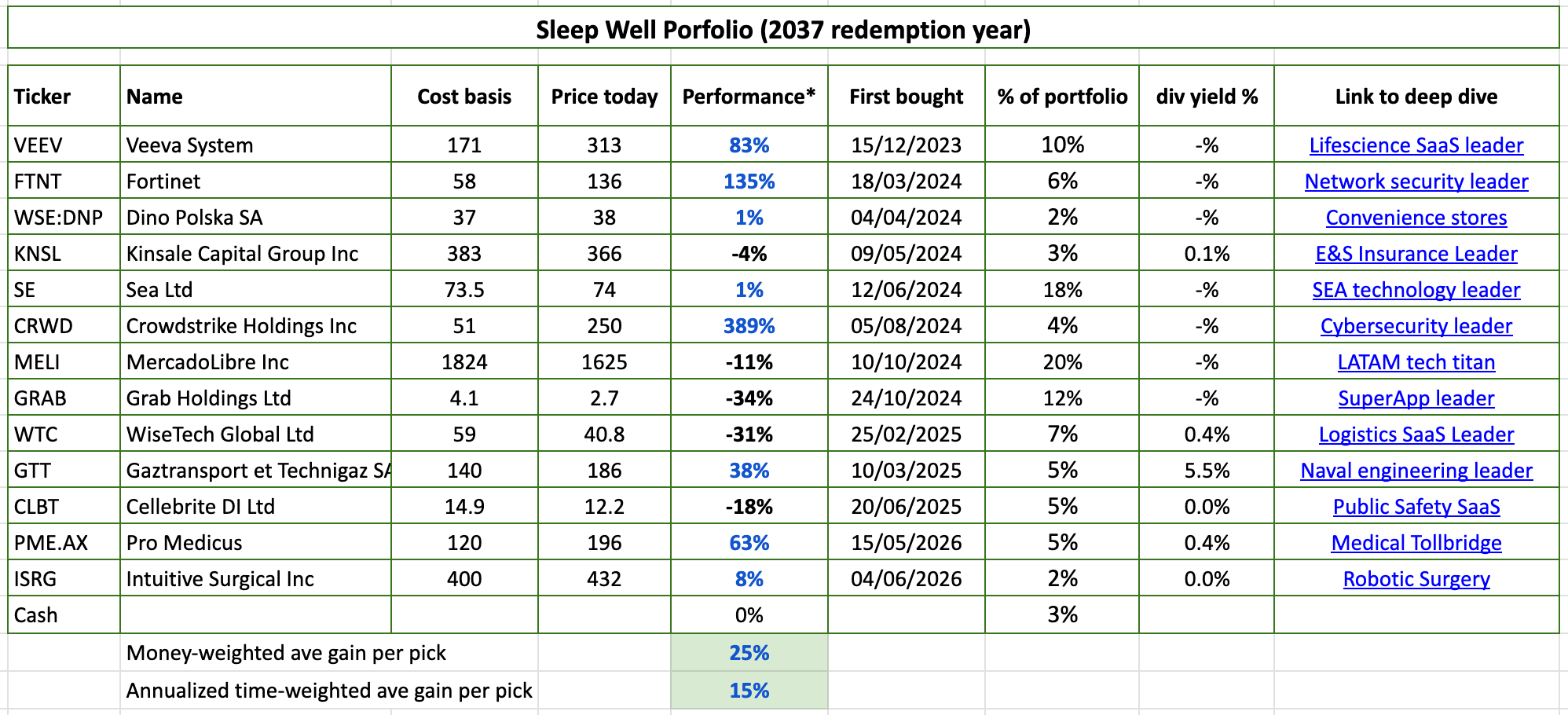
Sleep Well Portfolio adds two AI infrastructure suppliers and trims CrowdStrike at a 140x free-cash-flow valuation and $270 billion market…
2/n $CRWD CEO on @NoPriorsPod things got bleak last week on that front, will get worse

$CRWD and $AAPL down while $RSP and $IWM are moving higher. The rotation is going on.

SaaS companies including Salesforce, ServiceNow, CrowdStrike, Synopsys and Veeva are ranked by agentic AI progress, from pilots to…
Apple not working, but the $CRWD trade is unwinding. Probably not going to stay in this one for too long but the thesis played out nicely.

Even if the AI model Nubeva Technologies $NBVAF (TSXV: $NBVA) is training to read malware binaries (compiled programs) works, six risks could keep it from paying off: → Labs closing the gap: OpenAI’s GPT-6 Astra nearly doubled GPT-5.6-sol’s score on SRE-Bench, a Columbia University-led test of AI models on reading binaries, within a month of SRE-Bench’s release, and Anthropic says its Claude Mythos Preview model can already reconstruct plausible source code from stripped binaries. The better the labs’ own models get at reading hard binaries, the less they need to pay for outside labels. → Big tech building in-house: Microsoft’s $MSFT Project Ire reverse engineers software files on its own to decide whether they’re malicious. Ire caught only about a quarter of the malware among nearly 4,000 hard-to-classify files in a test Microsoft described in August 2025. But in June 2026, Microsoft said Ire flagged a new malware sample that most major security products, including CrowdStrike’s $CRWD and SentinelOne’s $S, still missed. Google $GOOGL already owns VirusTotal and Mandiant, so the likelier customers are labs that don’t own a malware-scanning site or an incident-response firm already, like OpenAI and Anthropic. → Paid like a contractor: Data labeling companies (firms that turn experts’ knowledge into training data for AI labs) pay 60-70% of what they bill to their contractors, and Scale AI is already recruiting its own malware analysts. So a data labeling company could pay Nubeva by the hour or task, or hire analysts itself, instead of licensing the model or buying the company. → Selling labels teaches the buyer: Every binary Nubeva labels helps the buyer’s model learn the same skill, the reason CEO Randy Chou gave for not patenting how Nubeva reads binaries. So each sale could shrink the edge Nubeva is selling. → Cash and compute: Chou gave no cost for running “hundreds and thousands” of AI agents on a private model. For reference, Nubeva spent $714,772 on R&D in FY2026, equal to 28.7% of its $2.49M in cash as of April 30, 2026. → Missed targets: Nubeva’s AI decryptor builder missed four targets starting in August 2023, so “days and weeks” (Chou’s timeline for the model) is a target, not a result just yet. So even with a working model, Nubeva still has to (1) sign a contract before the labs can read the hardest binaries themselves, (2) get paid for its model and engineers instead of by the hour or task, and (3) fund the training without draining its cash.
Sure... Random train of thoughts on markets now, optics like $LITE / memory + $IREN / Anthropic. On Memory: - Demand visibility on $MU / Samsung / SK Hynix extend into 2030-2031. Samsung has LTAs covering 70% of their capacity into 2031 (likely with SK Hynix type price floors)... and their operating profit is already absurd. There's a consensus that shortage in 2027 will be much more severe than 2026... Even $SNDK expends gross margins to exceed 80% entering 2030. You're going to hear Acer and other CEOs that want memory prices to go down cite bear cases like CXMT/YMTC, and Chinese players. But just looking at supply procurement that $NVDA is doing + hyperscalers, demand visibility is absurd for the next 5 years. And by that time, cumulative FCF coming in from these take/pay + pricing floor contracts might exceed some of their entire marketcaps so it feels like there's some baseline. Near-term is always volatile (IV dropped a ton across $EWY to $DRAM to $MU), so people with call options likely got nuked, along with underlying prices. But if Samsung is 3x 2027E, has 5 year LTAs with 70% of capacity committed from hyperscalers, and price floors, it's kinda hard to see these names suffer a sustained crash... For optics: - $LITE is literally sold out into 2029, starting discussions into 2030. With demand visibility lasting into 2031… with hyperscalers largely funding the capacity buildout. Their 2028 Greensboro fab expansion was ~$5B in UHP laser capacity revenue alone, yet it’s basically allocated toward $NVDA (50%+ with options for more) and co from channel checks. Existing supply chain bottlenecks are extremely severe as optical content/XPU skyrockets entering 2027-2028. So everything from DSPs/TIAs, photodiodes, lasers, InP/SOI substrates, wafers (epi, SOI, etc) are expected to go brrr. And what does that imply to anyone else with enormous amounts of capacity coming online like $AAOI + $SIVE + $MTSI capacity expansion in 2027? Or other players like Sumitomo / Furukawa? But again it's not quite the same situation as memory since the BOM % is extremely low in a cluster... If micron/samsung raised another 2000% hyperscalers would go bankrupt. But doing that for InP substrates seems possible. Or a 100% increase on CW laser content. I actually thought $LITE was overvalued at $100B+ MC, relative to capacity expansion on your smaller optical players to their respective MCs. So I chose to position accordingly (But lumentum does deserve premiums for demand visibility). For the companies leading the charge like $NVDA / $AVGO / $MRVL: - Nvidia has 70% forward revenue growth FY2028 which is supply constrained growth. - Broadcom 100% Y/Y for 2027/2028 which is also supply constrained growth. - Marvell FY2031 upgraded guidance to $70B-$90B from $46B analyst projections... They all seem to be very happy.... and read through on demand for next 2-3 years is enormous (also echoing what $INTC CEO said today on the panel with $AVGO CEO). So you have overwhelming growth on memory + photonics + from the leaders... But the nuance is not everything in the AI supply chain get the same economic benefit. HBM/Laser/CPU/MLCC and other players in the bottlenecks look to be printing money. And seem to be the largest beneficiaries of the current bottlenecks. Test players are also getting price hikes + capacity allocated by players like $NVDA, but economic impact seems a tad lower than other players since forward P/E for many I modeled were still in the 45x+ range even if you hiked prices like 10-30%. As for capex intensive players... there's some like $IREN ($25-30B for 2027) that despite a deal with Anthropic ended up dropping. I don't think markets seem to appreciate players spending a lot of money + ongoing financing (think they're like halfway through their $6B ATM). Just some hopium for $IREN investors, $NBIS also signed a deal with $META at the start of the year (but markets didn't care at all, since Nebius dropped to ~$70-80 at the lowest point?). But did 6 months later, as the time to revenue inflection gets closer and you're past the ATM/capex window, markets would likely care more. I don't think it's irrational but at the same time, the fundamentals have improved from Mirantis acquisition to others. I also think it was known for awhile it was either OpenAI/Anthropic from CEO comments earlier too? But either way to be a more risk-off environment where funds seem to be rotating to larger names as a flight to safety. $CRWD / $PLTR as just two example, but my take is that the valuations of these rotations are reaching clown levels. And that certain AI supply chain beneficiaries in comparison are undervalued now. I was thinking markets would just rotate to names that are extremely profitable like Samsung or names that have <2X P/E, so it was surprising to see $KOSPI and some legacy memory players get sold off today. Since all of this is colliding with uncertainty about sht macro environments and renewed sustainability concern of AI capex/commitments from frontier labs like OpenAI/Anthropic from due to that FT piece recently. I've always been sounding the alarm about the contractual backlog OpenAI has with $CBRS, $MSFT, $ORCL and others earlier in the year. But OpenAI did just raise $122B or so , so I don't quite think they're at risk of going down anytime soon. I also don't think overall capex can just exponentially go up, but even if it stalls / hovers around a certain point or even drops... Capex toward certain areas like optics will still explode as hyperscalers fight over allocations when CPO scale up comes about, but might drop in others where more capacity comes online like test or DRAM. So it's a lot more nuanced than capex down = everything down or vice versa. I also slightly agree with community agreements that open weight models wouldn't lessen demand on AI infrastructure (otherwise $NVDA wouldn't be funneling funds into Reflection), but all the contractual obligations that Anthropic has might get messy if their models/company get cannibalized. Either way, I'd expect some of these frontier lab valuations to likely compress but I do think Jensen knows what he's doing though to avoid contagion. But basically: - Extremely difficult market now, can't just throw money at any AI supply chain company like $GLW and expect it to go up. There's cause for concern of rate hikes mixed with financing per $AVGO CEO but not to the point you just blindly sell off everything. Also I think markets are stupid and ties baskets together so that leads to mispricing + individual buying opportunities with certain chokepoints too. If capacity + demand is visible and forward p/e compresses like $AAOI to single digits off hundreds or thousands of percent growth from hyperscalers off $471m transceiver revenues and hundreds of thousands of monthly ELSFP capacity. Or $SIVE coming online with 100M+ laser capacity + multiple foundries with ASP hikes on lasers. I wouldn't lump them into other AI supply chain names in IP like $RMBS or others. My take is that AI supply chain beneficiaries with closer inflection points, demand visibility, and forward P/E compressing due to economic leverage would likely outperform medium term despite current volatility. TLDR: - Memory strongest risk/adjusted return with LTAs + pricing floors extending to 2030's + buybacks. - My opinion is that optical supercycle for 2027-2028 with CPO/NPO is going to look absurd relative to capacity coming online of smaller suppliers. - Overwhelming fundamentals/growth colliding with sht macro + media scares - Markets are stupid and groups things in baskets and sells them all off together or buys overvalued names, creating short/long opportunities I'd give a prayer to people on short term options given underlying drop + IV decline, but there could be a reversal... who knows. Most valuable thing right now is time.
Am short a chunk of $CRWD and $AAPL here. Obvious it's never nice shorting good businesses with momentum, but it's an expression of my breadth trade that I think the winners lag and everything else catches up in the short term. Both trading at silly valuations due to flows.

Software multiples have fallen further since our January report. As of 7 Oct 2026, 238 companies in our all-software watchlist have EV/Sales (NTM) data on Koyfin. The median is 3.1x, down from 3.7x in January. The average is 5.4x, down from 6.2x. The 25th percentile is 1.8x, down from 1.9x. The 75th percentile is 5.5x, down from 6.1x. 191 of the 238 (80%) trade below our 6.7x private equity floor. 113 trade below 3x. The Bessemer Cloud Index shows the same pattern. Its median is 4.7x, down from 5.1x in January. 46 of its 68 companies (68%) trade below 6.7x. The cheapest are $CXM at 0.9x, $SPT at 1.1x, $MNDY at 1.7x and $WIX at 1.8x. In our watchlist, only 21 companies trade above 10x. The most expensive are $PLTR at 44.5x, $CRWD at 42.4x, $NET at 38.6x, $PANW at 24.2x, $DDOG at 19.5x and $SNOW at 16.3x. Growth still earns a higher multiple. The 44 names expected to grow revenue 20%+ a year over 3 years have a median of 5.2x. The 85 names expected to grow under 10% have a median of 2.6x. Even for the faster growers, the 5.2x median is below the floor. The market is paying up for very few names. We think that is right. Many software companies have slowing growth, high costs and no clear AI strategy. We would not buy the sector, or a cloud index, on valuation alone. In software, we focus on the few companies rebuilding their products around AI, and our SaaS Survival Scorecard tests key SaaS names against the pressure from AI agents.
$FTNT already has a fast-growing OT security business of more than $1bn. Robots will face the same security problems as factory machines. Factory equipment and IoT devices were designed for availability and safety. They shipped with weak or no security, and controls were added afterwards. Robots and humanoids are likely to follow the same pattern. Many will run custom or stripped-down operating systems, have tight CPU and power budgets, and sit under safety-certification rules that make heavyweight endpoint agents and frequent patches difficult. When security software is hard to install on the device, enforcement moves to the network: segment the environment, control which systems can talk to which, and inspect the traffic. That work needs a lot of switches inside the plant, in addition to a few firewalls at the perimeter. FortiSwitch is built to be price-competitive for cost-conscious industrial buyers, with security functions embedded and ASIC acceleration for always-on inspection. Endpoint vendors such as $CRWD can help protect higher-value machines, but their software has to run on the device itself, which is often hard on robots for the same reasons. As inference moves into factories, hospitals, warehouses and vehicles, every new AI-controlled actuator still sits on a network, often on the industrial backbones Fortinet already protects.
Read skeptically, Nubeva Technologies $NBVAF (TSXV: $NBVA) is a shrinking software company living off its cash, with an AI decryptor builder that keeps slipping and a license customer that may not have renewed. Read another way, Nubeva is being prepared for a buyer. Here’s what supports the second read: → In March 2024, Netskope $NTSK, now a ~$7.6B company, bought Nubeva’s TLS (web-traffic decryption) technology and five patents for $1M. Greig Bannister, the CTO who co-invented the key-capture patents, followed the technology to Netskope. → In an August 2024 video, CEO Randy Chou said “partnering and M&A groups” from companies worth $20-30B had reached out after the July 2024 CrowdStrike $CRWD outage. → Chou wants all four AI patents granted before any partnership or sale, and two are still pending. → The FY2026 MD&A says Nubeva is “selectively engaging with lighthouse accounts,” meaning “large, high-profile organizations that serve as validation points for the technology,” to make its offering “more attractive for either future expansion or strategic partnership/M&A.” In a June 2025 video, Chou said lighthouse accounts “matter 100%” in a partnership or M&A talk. → Sales and marketing spend was $14,951 for all of FY2026, with $2.49M of cash on hand. In the same June 2025 video, Chou said Nubeva is “really not marketing” until “the patents and everything else comes in.” → The most recent investor deck is from July 2023, and since then Nubeva has communicated mostly through filings, press releases, and the occasional YouTube interview. In other words, it isn’t pitching investors either, which fits a company waiting on a buyer. A longtime investor I spoke with described Chou as reluctant to spend money, PR included, and called a sale to a larger security company the clear end goal. I’d add that Chou, who makes the call, also owns a quarter of the company.

$CRWD at 40x forward sales is pretty hard to wrap your head around CRWD multiple is now above 2021 levels (not to mention yields were at 1% then)
I’m not in the business of shorting things that go up but $CRWD at 40x forward sales is pretty hard to wrap your head around CRWD multiple is now above 2021 levels (not to mention yields were at 1% then)
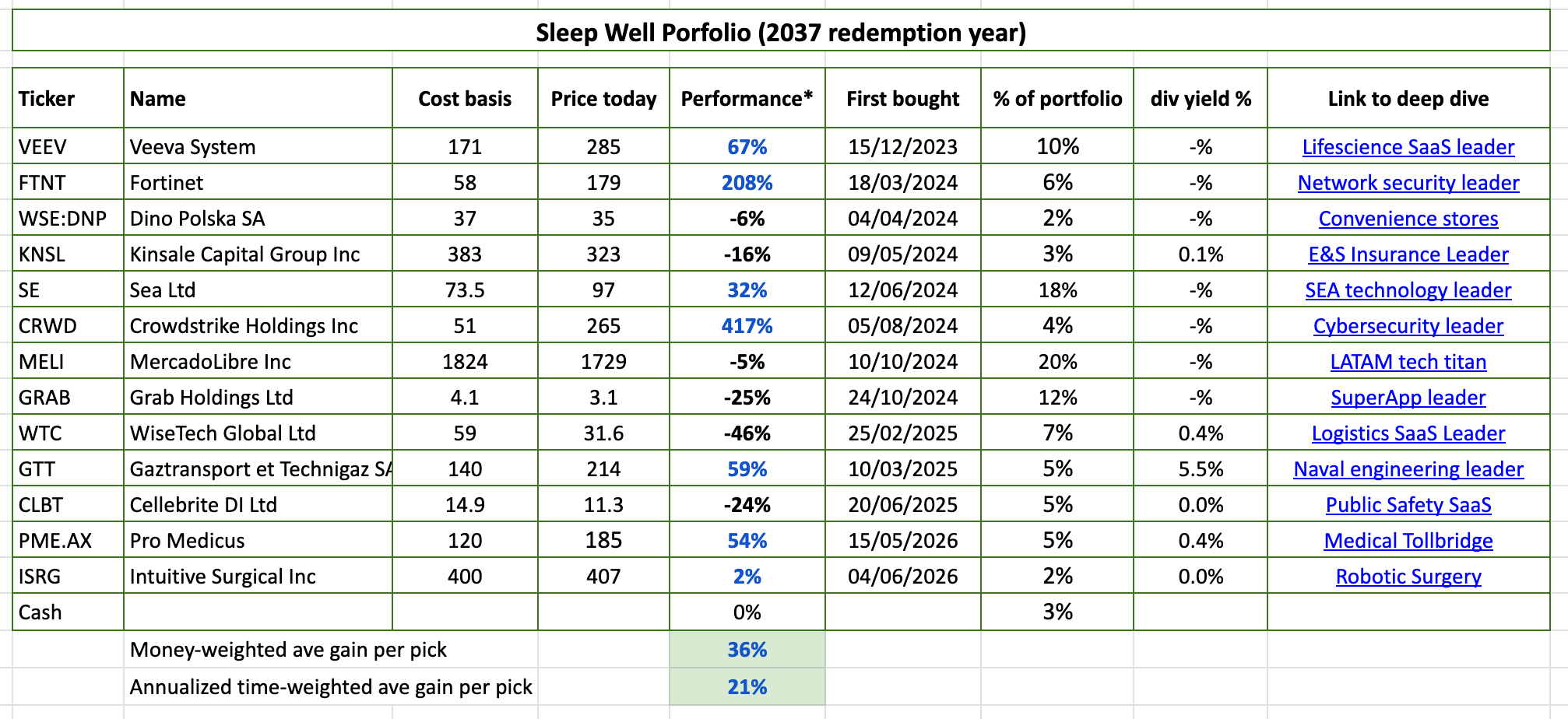
CrowdStrike faces a trim at a $270 billion valuation and 140x free cash flow, despite AI-driven cybersecurity demand and a $20 billion ARR…
Corporates (spreads are tight, if this gets rly bad spreads should blow out). Long breadth, consumer exposure and small caps through stuff like $IWM, $RSP, $XSHQ, $RSPD. Short the narrow winners like $QQQ, $SMH, $AAPL, $CRWD, $ILMN, $NBIS. Also shorting long crowded bio longs
Palo Alto, CrowdStrike and Palantir are positioned for enterprise spending on AI-driven cyber threats, compliance and internal data…
 Amrita Roy
Cybersecurity isn’t uniformly exposed to model labs. Host agents (telemetry), inline enforcement, and shift-right ops — humans, live environment, adversaries — stay relatively hard to absorb for the intermediate future. Shift-left and the checkable end (vuln scanning, validators) are already getting hit hardest by stronger codegen and coding agents. Relatively safer (host agents / inline / shift-right): $PANW, $CRWD, $FTNT, $NTSK More exposed (shift-left / scan / checkable): $TENB, $QLYS, $RPD.
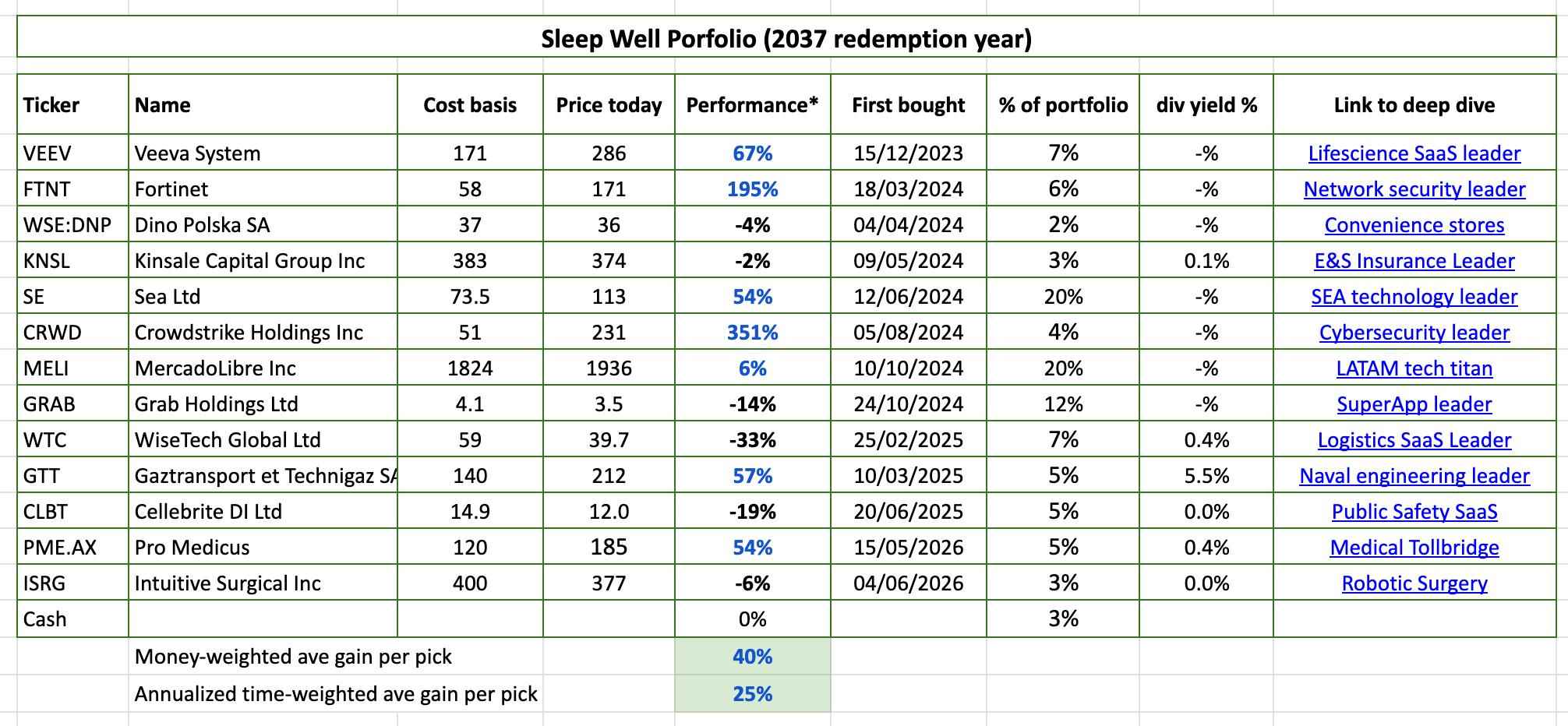
Sleep Well Portfolio’s August gains were led by Veeva, CrowdStrike and cybersecurity, while Cellebrite and WiseTech reported early AI…
Snyk is a clean postmortem for what happens when a security tool lives inside the coding agent’s loop. The product was mostly scan-and-warn. Find the issue, comment on the PR, suggest a fix. Blocking the merge usually sat in GitHub, not in Snyk. Bigger platforms smothered it. $PANW, $CRWD, and Wiz pulled AppSec into the bundle the CISO was already buying. GitHub was the main developer surface and put scanning where the code already lived. Then coding agents arrived and delivered the final blow. A lot of that scanning became something the agent could just do. Growth held up for a short while after the COVID/cloud tailwind. Then it decelerated hard. This is the same lens we use in Convequity’s SaaS Agentic Survival Evaluation Framework. The PANW, CRWD, and FTNT reviews go up on Convequity in a few days.

CrowdStrike posted 25.8% Q2 revenue growth and $333 million of net new ARR, while FY27 ARR guidance rose to 34% despite a 150% stock rally…

$SAIL also with news out today on expanding their partnership w/ $CRWD things need to move fast ....
$NTSK + $CRWD News out today. $NTSK is currently one of my top holdings in cyber along with sail and silc
Not only are $IGV and $SOXX both green today, but $IGV just flipped positive YTD, led higher by $CRM up 20%, and cybersecurity names ripping after $CRWD and $OKTA Software and Semis are friends again
$OKTA and $CRWD confirmed the agentic inflection has officially begun
$OKTA $CRWD the two most expensive cyber sec names getting rewarded for good earnings bodes very well for the next leg in the sector
CrowdStrike’s $318 million quarterly stock compensation and payroll taxes equaled 23% of revenue, diluting shareholders while non-GAAP…
First Strike Research’s ML and social-sentiment system correctly called 14 of 16 Nike Q3 Kalshi contracts, reporting 208¢ net P&L.
A two-layer machine-learning model correctly called 11 of 13 CrowdStrike earnings-word contracts on Kalshi, using historical transcripts…

CrowdStrike faces a renewal cliff after its July 2024 outage, with Microsoft Defender bundling, litigation, SEC and DOJ scrutiny, and a…
Letters that discuss CRWD.
Companies the stories above are also about, besides CRWD.