Tuesday, October 13, 2026

Back to today

From X

@calvinblissett 3 clicks

Calvin Blissett on X

$CHRD: 6.5x FCF, Good CEO, buying back lots of stock, low-cost pure play EP. 8% FCF yield at $60 WTI. No meaningful leverage CHRD trades at ~$142, market cap ~$7.74B, enterprise value ~$8.63B. Dividend yield ~3.7% ($5.20 annual base). Buyback/total shareholder yield is higher: policy returns ≥75% of adjusted free cash flow (mostly buybacks after the base dividend) at current low leverage (<0.5x). On 2026 guidance of ~$1.3B Adj. FCF, this implies a potential total cash return yield in the low-to-mid teens. Valuation is low: ~9.5x TTM P/E, ~7.6x forward P/E, EV/EBITDA ~3.2-3.6x, P/FCF ~6.5x. Analyst consensus PT ~$166-174 (~20%+ upside); highs to $193. Marcellus non-op sale (to POSCO, expected Q4 2026 close) provides ~$550M gross proceeds, sharpening pure-play Williston focus, boosting cash/flexibility for returns or balance-sheet strength, and removing a non-core asset. Reasons for future growth: Flat-to-low absolute oil volumes (maintenance program ~161 MBopd oil) but rising per-share metrics via efficiency and buybacks. Longer laterals (majority of program, including 4-mile) cut costs/breakevens and improve recovery; base production enhancements and lower declines support volumes with less capital. Pure-play focus post-sale plus disciplined consolidator role in the Bakken. Efficiency gains already drove material FCF improvements. LTM Owner’s Earnings (Buffett-style): Roughly Net Income + DD&A + other non-cash charges − maintenance CapEx (and normalized for WC/one-time items). For this E&P, nearly all CapEx is maintenance to offset natural declines, so Owner’s Earnings approximates free cash flow. TTM (to ~Jun 30, 2026): Operating cash flow ~$2.59B, CapEx ~$1.40B → FCF ~$1.19B. DD&A ~$1.54B; Net Income ~$841M. Company-reported adjusted FCF (preferred operational proxy) was strong in 1H26 (~$738M combined Q1+Q2) and has been running at an elevated rate. This is a rigorous, cash-based measure after the capital required to sustain the business. Expected next-12-months Owner’s Earnings: ~$1.3B adjusted free cash flow (company 2026 guidance, including derivatives, at $75 WTI / $3 HH for 2H). Why higher than LTM: stronger realized oil prices vs. prior periods, operational efficiencies (longer laterals, cost controls, base enhancements), volumes at/above high-end of prior guidance, and capital discipline (CapEx held ~$1.4B midpoint). The $550M Marcellus proceeds is one-time cash (not recurring earnings) that further supports returns and balance-sheet optionality. At ≥75% payout, this supports substantial shareholder distributions while maintaining a strong BS. Business simply: Pure-play Williston Basin (Bakken) E&P—largest operator there. Drills oil-focused horizontal wells, produces/sells crude, NGLs, and gas. High-quality inventory; shift to longer laterals improves economics. Management: Danny Brown (CEO; prior Oasis/Anadarko). Track record of efficiency, synergies, disciplined capital allocation, and per-share value creation. Capital allocation: Base dividend + aggressive buybacks under the 75%+ Adj. FCF framework (leverage-dependent). Share count reduced meaningfully; cumulative returns large relative to market cap. Maintenance production focus. Risks: Oil price sensitivity/volatility (primary driver), basin decline/inventory longevity, execution on laterals or M&A, regulatory factors in ND/MT, energy transition headwinds. Margin of safety & upside: Low leverage, high cash generation even at moderate oil prices ($60-70 WTI still supports solid FCF/returns), conservative CapEx, and efficiency gains provide protection. Upside from multiple expansion toward peers/history, continued buyback accretion to per-share metrics, operational outperformance, oil strength, and pure-play clarity. Consensus implies ~20%+ near-term upside; higher in stronger commodity scenarios. Attractive FCF yield + value profile in E&P. Figures based on company results/guidance, market data, and analyst notes as of early October 2026. Oil prices and execution remain key variables.
@aleabitoreddit

Serenity on X

I think almost everything about my $AXTI thesis from 2025 was validated? From AXT's position in the InP substrate bottleneck... Being able to threaten the hyperscaler buildout (per Reuters)... $IQE has been flagging this as a major risk, VPEC and Taiwan epiwafer foundries have been crying over InP substrate bottlenecks. And there's even AXT direct confirmation of partnerships with $LITE and $COHR as the InP substrate supplier. AXT also stated $130m/quarter InP revenue capacity exiting 2027 (~$520m annualized) so that's a massive revenue inflection compared to previously. Now... the biggest question is: How much can AXT price hike? The substrates they make are just such a tiny part of the BOM... but can threaten hyperscaler buildouts with optics. So if they manage to price hike to $SNDK NAND degrees (which they can), then I think AXT could get re-rated a ton from here. But if they end up like Japanese ABF suppliers that are less willing to abuse their position, that's a different story. Will need to do more channel checks to see how that's coming along. But at the very least, I would argue there should be some valuation baseline just due to their critical importance (eg. upstream refinery ownerships, crucible processing, etc) + existing capacity revenue without hikes. TLDR: - Bottleneck thesis was at like ~$500m MC - Upside now comes from price hikes due to duopoly position + ownership of upstream bottlenecks in the InP substrate manufacturing process. (which they can due to low cost of InP substrates in overall costs) - Uncharted territory, we'll see (also a central part of geopolitical tensions so there's always risk there).
@aleabitoreddit

Serenity on X

Good question! Just some informal thoughts... there's three "moats" to look at for $SIVE: - Capacity - Qualifications (especially for custom DFB lasers) - Technological 1. For capacity, they're coming online with 100M+ CW DFB lasers Q4 2027 (global supply is roughly ~608M EML/CW lasers currently per Trendforce). Obviously by 2027 global capacity is going to grow a lot, with $AAOI, $AVGO (3x expansion), and others coming online. But if you extrapolate their 2:1 statement, that implies 300m lasers/year long term coming from their own supply + external foundries. This is incredibly valuable during a shortage that was quoted to be 3-5 years, and $LITE stating they already have demand visibility into 2031... And when suppliers have started to qualify many more (eg. 5-7 vendors vs. 2-3 earlier) due to bottlenecks. I'm sure a lot of how they achieve that staggering amount is due to their manufacturing process/yields (which is a moat). 2. For qualifications, if you look at 70mW/100mW pluggable lines with Chinese players, I'd argue this is more generic and moreso reverting back to a capacity argument and manufacturing process to achieve those numbers. Custom DFB arrays that they've been working on with Ayar (they hinted at 2-3 others back in 2023 like Celestial) take years for optical i/o related things and would be a moat if they finish quals. So it's not quite something you can hot swap or design out really easily for $MTSI or another company. But of course cpo scale up and such is mass volume in 2028, and we're still H2 2026. 3. People can always compare raw specs like power output, but it's probably way way more nuanced so easier to just point toward customer statements. With $JBL 1.6T LRO: "I think that there's the potential for a relatively dramatic moat with our LRO part…" from Jabil's EVP, especially related to power consumption. And $SIVE is my guess sole source in this line. Jabil is probably the most important testament to how their lasers perform in mass production scenarios maybe around Q2 next year. Ayar said something similar along the lines of "we couldn't do it without Sivers" for custom implementations.
@StableBread

Fajasy on X

BWX Technologies $BWXT is in military base power three ways, through (1) Project Pele, a prototype reactor it’s building for the Pentagon, (2) the TRISO fuel its microreactors run on, and (3) Janus, the Army program that chose $BWXT’s commercial reactor for Fort Campbell, Kentucky. Pele is a 1.5-megawatt (MW) transportable, gas-cooled microreactor built for the Pentagon’s Strategic Capabilities Office under a 2022 award. $BWXT delivered its full TRISO fuel core to Idaho National Laboratory (INL) in December 2025, received the Department of Energy’s (DOE) preliminary safety approval in September 2026, and targets delivering the reactor to INL in 2027. TRISO (tri-structural isotropic) fuel, which the Department of Energy calls “the most robust nuclear fuel on earth,” packs uranium into particles coated in carbon and ceramic layers. $BWXT produces TRISO at Lynchburg “in the hundreds of kilograms quantities,” Joe Miller, president of Government Operations, said at its Investor Day on September 29, 2026. It also supplied the fuel for Antares, a microreactor startup whose reactor was the first new reactor to reach criticality (a self-sustaining chain reaction) under DOE’s reactor pilot program in June 2026. POWER magazine, a power-industry trade publication, reports $BWXT is “the only Janus vendor that self-supplies its TRISO fuel.” $BWXT is also negotiating a commercial TRISO plant in Wyoming with Kairos Power, an advanced reactor developer, at up to $500M of capex. CFO Mike Fitzgerald said at Investor Day that $BWXT needs to see high-assay low-enriched uranium (HALEU, the 5-20% enriched uranium most advanced reactors need) become available before committing to the plant, and “probably will not make a decision on that for a little while.” The Army chose BANR (the BWXT Advanced Nuclear Reactor), a 20 MWe (megawatts of electricity) gas-cooled design scaled up from Pele, for Fort Campbell. $BWXT plans to start construction at the site in late 2028 and have the reactor running in the early 2030s. Three details matter here: 1) No contract value: $BWXT’s release describes “a phased contracting approach.” For comparison, the Janus agreement for Radiant, a microreactor startup, is worth up to $750M. 2) $BWXT will own the reactor: The Army chose vendors “to own, construct and operate nuclear microreactors” ($BWXT’s release), under fixed-price, milestone-based agreements in which the Army pays at milestones rather than buying power. 3) Not first in line: With operation in the early 2030s, $BWXT’s reactor won’t meet the September 30, 2028 deadline a May 2025 executive order set for an Army-regulated reactor running on a U.S. military base. Radiant and Antares, two of the other Janus vendors, both target 2028 for their first reactors. After Radiant’s agreement, $1.45B of the program’s $2.2B is left, and an even split among the other four vendors would give $BWXT ~$360M over fiscal 2027-2031, or $72M/year, under 2% of 2026 revenue guidance.

Vicor Update, Part Two

Vicor uses ITC exclusion-order cases to license power-module patents, with published royalty multipliers rising from 1.0x before filing to…

Expert Call | Nebius

Nebius’s 1 GW annual active-capacity target from 2027 is realistic, according to a former product manager, with greenfield data centers…

PTRN · short

Pattern Group INC

Pattern Group is a fragile consumer business targeted on the short side.

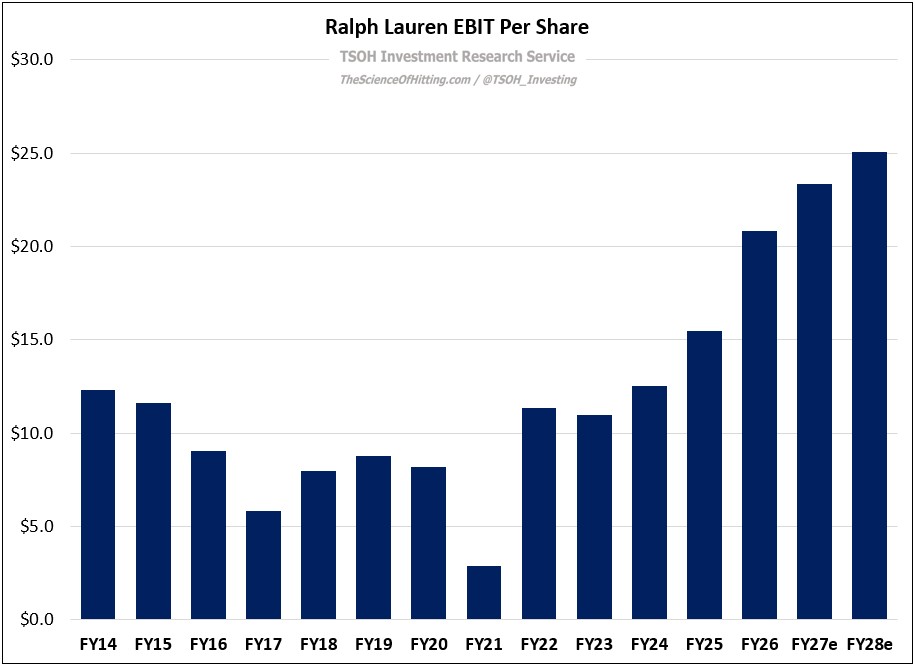
“Is Ralph Lauren Still Relevant?”

Ralph Lauren’s 2017 CEO change put Patrice Louvet in charge of reversing nine quarters of same-store sales declines and restoring the…

Publications we follow

Every publication on this site, hand-picked.

129 publications

Newsletters 107

X accounts we follow

Every account on this site, hand-picked.

88 accounts

Investor letters we follow

189 firms

Sectors

Ordered by how often our editor reaches for them.