TSOH Weekly Roundup (10/16/2026)
Bumble agreed to a $1.3 billion take-private deal, while Netflix cut about 1,000 jobs and Meta discussed its Muse superintelligence models.
Bumble agreed to a $1.3 billion take-private deal, while Netflix cut about 1,000 jobs and Meta discussed its Muse superintelligence models.
Anyone have access to BofA downgrade on $DCH? I'm long and this is a pretty steep cut lol https://t.co/6mhk6JRqA8
Shorting a tiny bit of $RGR here on a post tender slide.
I kind of love this, sets up the capital slosh effect that happened in 2000s with the great rotation from tech to value. I think something similar happens here eventually and offers uncorrelated returns which will be more valuable. I will be eating dirt on value until then, clipping my coupons and buybacks. $KSPI $BOC $SLM $HHS $ZIM $CCLD $WU $HY $AMR $CNR $METC $HCC $FISV $YB $BTU $CNRD
$HTZ Squeeze just doesn't want to give up. Now IBKR is completely out of borrow and borrow rate has ticked up to 24.8% https://t.co/GjLOXFCwA3
To the surprise of absolutely no one, the Copart-ACV deal is closed. $CPRT $ACVA Get ready to hear the word “synergies” everywhere. Now it’s up to Copart to show they’ll be good ones. https://t.co/sGgwasBBT1 https://t.co/DYsYj79dcA
Free Recaps of the best new stock ideas, delivered every morning.

Modine, soon Modexus Solutions, has a $4 billion hyperscaler cooling contract but must ramp factory output and restore margins as data…

Dream Finders Homes’ controlling owner borrowed against DFH stock before the homebuilder agreed to finance an acquisition with costly…

Park Aerospace’s 11% Q2’27 sell-off overlooks sole-source PAC-3 rocket-motor materials and A320neo engine composites, with missile capacity…
UniQure's Huntington's gene therapy faces an FDA accelerated-approval decision around November 1 after three-year data met both agency…
 Bhavneesh Sharma 10 clicks
Transocean’s Valaris merger clears regulators, creating a 68-rig offshore driller controlling four in 10 global drillships.
October 2026 market commentary covers SOLS’s cancelled merger, a hypothetical Starbucks-Chipotle deal, Russell 2000 weakness and AI…

Shenandoah Telecommunications’ Glo Fiber buildout ends this year, and private infrastructure investors’ repeated fiber deals frame a…

El Pollo Loco plans 18 to 20 FY26 openings, including 15 franchised New York stores over five years, as asset-light expansion and…
 Pedro Goulart
SED Energy's proposed Ventura merger projects a 22% to 40% dividend yield, but idle tender barges, debt and repayments materially reduce…

 Ignacio Planas Gonzalez
  SLVM · long
 Sylvamo, a $1.6 billion uncoated freesheet paper producer, has fallen about 60% from its November 2024 high above $95 to roughly $40.

TIC targets $3 billion of 2029 revenue, 18% adjusted EBITDA margin and 85% free cash flow conversion, requiring roughly $400 million of…

Vidrala has grown from a Spanish glass-container maker into a multi-country packaging platform with expanding Latin American exposure.

Everspin Technologies, a $900 million MRAM maker, has surged 300% in weeks as AI speculation blurs distinctions among memory chips.

Colombian election risks for Grupo Aval, CAAP's near-doubled Q1 EPS and new dividend, and May buy-and-hold purchases.

Inter, Nu and MercadoLibre reported 38%, 53% and 51% revenue growth, respectively, as Latin American political and macro risks drove a…
Entravision’s Smadex AdTech segment grew Q1 2026 revenue 204% and generated over $34 million of EBIT, becoming 78% of sales and the core…

Installed Building Products and Mettler-Toledo, down 38% and 32%, test whether lower valuations reflect deteriorating moats or cyclical…
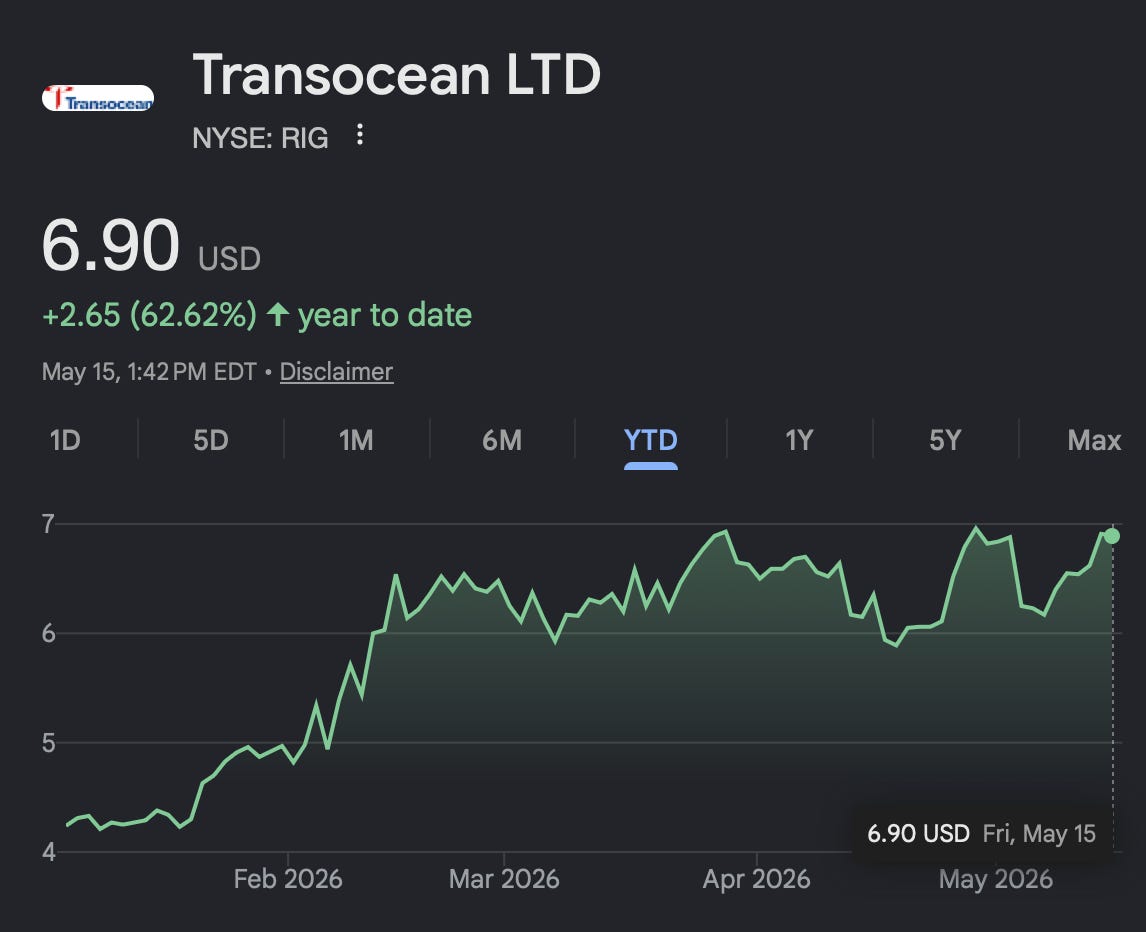
Transocean's acquisition of Valaris faces a DOJ second request, putting the offshore-drilling merger's antitrust approval and closing…
Compass Pathways plans a Q4 2026 NDA submission for COMP360, a synthetic psilocybin treatment for resistant depression, backed by $466…
Have a source we’re missing? Send your pick
Every publication on this site, hand-picked.
 Albert Anthony
 Andres Veurink
 Bay Area Ideas
 Blake Winiecki
 Capital Connoisseur
 David Zanoni
 Deep Value Investing
 Dhierin Bechai
 Dilantha De Silva
 Equity Eagle
 Eudaemon Research
 Fernanda Galvez Jalil
 Henrik Alex
 High Alpha Professor
 Investor Overview
 IWA Research
 Jaden Mealy
 Julia Ostian
 Khaveen Investments
 LL Insights
 Long Player
 Marc Gerstein
 Melissa Tucker
 Mike Zaccardi, CFA, CMT
 Miletus Research
 Myriam Alvarez
 Petri Dish Reports
 Philip Wang
 Prakhar Agarwal, CFA
 PV Research
 Quantryon Capital
 Robert J. Lake
 Ron Ferrie
 Sam Mancini
 Sharon McArd
 SiliconBytes Insights
 Simple Investment Ideas
 Sorrento Research
 Stephen Ayers
 Steven Fiorillo
 The Alpha Analyst
 The Asian Investor
 The Bullionaire
 The Curious Analyst
 The J Thesis
 The Supercycle Investor
 The Undercovered Dozen
 Value Capital Research
 Vishal Jadaun
Every account on this site, hand-picked.
 ⚽️📡
⚽️📡 💥PETITION💥
 A Capital
 absreturnchaser
 Adam D. Wyden
 Alpha Vulture
 AltayCap
 Asif Suria
 Bank Reg Blog
 Barbarian Capital
 BDC
BDC Bill Ackman
 Brian McGough
 Broken Moats
 BuccoCapital Bloke
 Calvin Blissett
 catechwilliams
 Charles Frischer
 Chris Camillo
 Clark Square Capital
 Cluseau Investments
 Colin King
 Connor Haley
 Conor Maguire | Value Situations
 Convequity
 Dalius - Special Sits
 David Orr
 Deep Sail Capital
 Derek Pilecki
 Devin LaSarre
 DOMO Capital Management, LLC
 Edwin Dorsey
 Evan Tindell
 Fajasy
 Farmer
 Fierce_beast
 Fred Liu
 Gavin Baker
 George Noble
 Hunterbrook
 Ian Bezek
 Idea Brunch
 JabroniCoin.USD
 John_Hempton
 junkbondinvestor
 kab60
kab60 KEDM.com
 Kevin Mak
 Kuppy
Kuppy Laughing Water Capital
 Lee Roach
 Little Owl Research
 Maius
Maius Maj Soueidan
 marginofdanger
 mavix
mavix Mike
Mike Mikro Kap David
 Multiples Capital
 Myles
Myles Nat Stewart
 Negligible Capital
 Odd Diligence
 Odd Lot Arbitrageur
 PAA Research
 Paradis
 Pernas Research
 Porter Collins
 Prepared Remarks
 Psyop Capital
 Raging Capital Ventures
 Red Dog Capital RiverRoadPartners
 Rusholme Capital
 Sahil Khetpal
 Serenity
 SG
SG Sheel Mohnot
 Steve Eisman
 The Friendly Bear
 Tim Eriksen
 Timyan Bank Alert
 Todd Wenning
 ToffCap
 Trevor Scott
 Undiscovered Compounders
 Voss Capital
 Yaron Naymark
Ordered by how often our editor reaches for them.
Anything we’re missing?
Send us a pick