
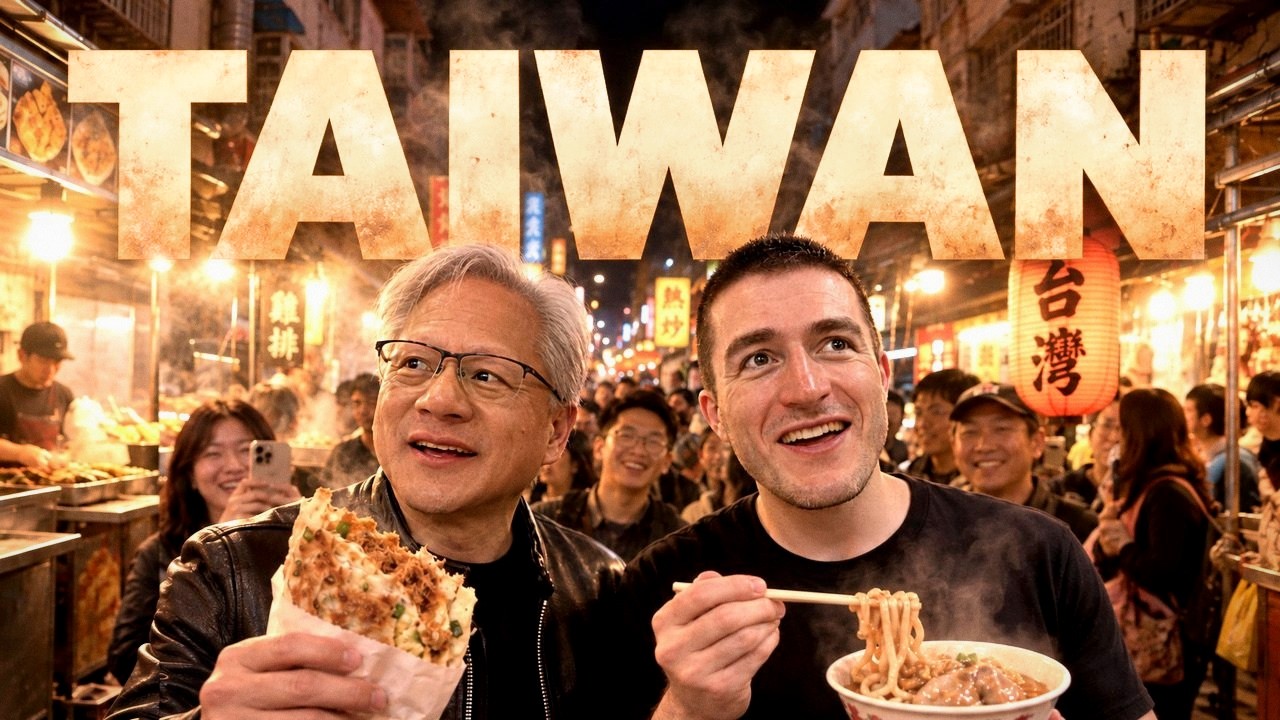
Taiwan: The Most Epic Night Market Experience w/ Jensen Huang | Lex Fridman
Jensen Huang hosts Lex Fridman in Taiwan during Computex, taking him through Nvidia’s exhibition, employee events and several night…
Tuesday, October 13
Everything we published on this day.
105 stories — the front page that day →
Jensen Huang hosts Lex Fridman in Taiwan during Computex, taking him through Nvidia’s exhibition, employee events and several night…

@tuviagroup The $CPT disposition of their $1.625 bn portfolio in LA/SD was done at a 5.2% cap rate as is and around 4.9% on a tax adjusted basis for a 19 year old portfolio Granted interest rate has moved a lot, but a meaningful data point
Hey @grok what was the latest rent collection rate for $CPT $MAA $CUBE $REXR Any rent collection issues that amounts to 5%?
@sean91237 Speaking of homes $INVH is selling at $275-280k/home and they sold hundreds of homes at over $400k/home in Q2. Mix of Cali is high, but even taking out Cali, avg home sold was about $375-$380k Huge gap between what's in private market and public REITs
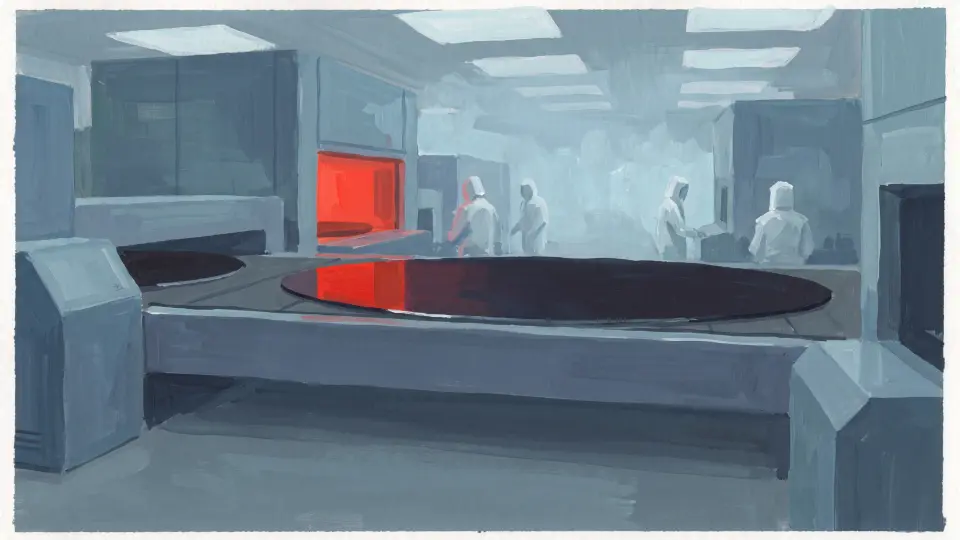
ASML’s strong quarterly results failed to prevent a selloff, as AI investors focused on scarcity fears facing chip-equipment makers…

@MMTLP4ME88 @ericjackson @rabois @mikealfred @APompliano @philrosenn @dayetweets @nejatian Am still short as $OPEN is valued at over 2x book.
The $open army has been obliterated. @ericjackson @rabois @mikealfred @APompliano all belong in jail. And to all the financially illiterate haters who gave me crap for being short $OPEN from $8, have a nice day. @philrosenn @dayetweets
Apple HomeView raises questions about demand for expensive Apple devices built around subpar AI.

Trump’s new Press Secretary is married to a producer who has handled many films for $ANGX, probably not a coincidence.

Wait, so everyone suddenly realized $CRWV has a shitty business model because their bond yields went up? Same business six months ago. Where were all these forensic accountants then? Apparently the due diligence starts when the chart stops going up.

@POVMexico Tulum Airport was only built in 2024 as an AMLO pet project, minimal market demand. The hippies can go back to flying through Cancun Airport as they should. $asr
$QBTS is still worth $5.2B or 325x revenues. They have $1.5/share of cash. 80% downside still.
@jeffborack If I'm wrong, my $U stock will go to zero so I'll suffer that way.

$PSIX recent price action is behaving very differently to the entire global AIDC power peer set, which begs the question, what has $PSIX told its bankers and how much of that is beginning to leak into the public markets?🧐

United Airlines is making it harder to reach its top frequent flyer status in 2027 $UAL
BP to set out new strategy after windfall year $BP

It's on my list of things to do. I would like to know how much of that $2.3M Solano is requesting is cash/base vs bonus. Was it disclosed somewhere? Need to see the entire terms. His base is currently $370K and $500 in bonuses, split evenly between cash and stock. My feeling is that Solano made his request since he believes $RAVE "Pizza Inn is aiming for more significant growth this fiscal year." "Mr. Schwarz initiated a phone conversation with Mr. Solano the next day, August 27, 2026 where Mr. Schwarz indicated to Solano that his Requested Compensation Increase beginning Fiscal Year 2027 and increasing 2.5 times to $2.3 million annually for Fiscal Year 2029 could be discussed at the Board’s upcoming meeting, but that for Mr. Schwarz such a request was a “non-starter”. Four days later, the Solano Correspondence was delivered to the Company."
Sweetgreen’s Plan to Shed Its Expensive Salad Image $SG
J&J Is Leaning Toward Spinning Out Its Hips-And-Knees Business $JNJ
Albertsons Pulls Full-Year Guidance, Plans Business Review $ACI
Kimberly-Clark, Kenvue Win Conditional EU Approval for $40 Billion Tie-Up $KMB $KVUE
Six Flags Closes Several Rides After Georgia Roller-Coaster Death $FUN stock did not like this

Looks like Nike $NKE isn't able to just do it anymore. It will need a significant amount of energy and work to regain its place in stores. I remember reading in Phil Knight's Shoe Dog book that his coach Bill Bowerman felt that runners only had a limited number of all-out races in their legs. I think they were referring to the legendary runner Prefontaine who unfortunately died in a car crash late one night in Eugene, Oregon. Incidentally I was in Eugene last year with some friends for a Ducks game and we crossed Pre's rock a few times as we drove up to our Airbnb in the hills above the University of Oregon. I hope Nike has a few more all-out races left in it. Overall I don't feel like the brand is impaired in the eyes of consumers despite their recent preference for On $ONON and Hoka $DECK. Disclosure: I am long $ONON but have been watching $NKE closely.

@jeremie0117 $DKNG and $SERV are my two favorite ideas!
@majgeoinvesting Any opinion on the situation at $RAVE? It seems crazy they aren’t keeping Solano happy

One AI data labeling contract could be worth multiples of the $500,586 of revenue Nubeva Technologies $NBVAF (TSXV: $NBVA) booked in FY2026. Its CEO said in a new interview that data labeling companies (firms that turn experts’ knowledge into training data for AI labs) have asked the company to help label malware, and that most of its engineering focus is now on training its own AI model to read malware binaries. Nubeva now has three ways to pay off, up from two: → Having AI write the decryptors for its key-capture software, Ransomware Reversal (NuRR), so Nubeva can grow again or attract a partner/buyer. → A partnership or sale following the approval of all four AI patents. → Selling binary analysis (labeling what malware programs do) to data labeling companies, which could also attract a partner/buyer. Moreover, a data labeling contract wouldn’t depend on NuRR’s sales or on AI writing its decryptors, so it could come before either of the other two routes. CEO Randy Chou gave no price, volume, or timeline for a contract. But if you were to extrapolate the $200-250/hour that Mercor, one of the largest data labeling companies, pays its security experts, one full-time contractor (~2,000 hours/year) would earn $400-500K/year, just about Nubeva’s FY2026 revenue of $500,586. That implies Nubeva could earn multiples of its revenue from a single data labeling contract if its engineers and model can do the work of several contractors. A contract worth three of Mercor’s full-time experts ($1.2-1.5M/year) would be 2.4-3.0x its FY2026 revenue.

Corning’s NVIDIA-backed 10x fiber expansion, enterprise connector demand and carrier capacity plans frame its optical communications…

Guess like we found out why Elon has been going on a crusade against memory in his recent posts. $SKHY and Samsung have been price hiking memory too much?
@AllTheWayRay8 I have positions in Agility! I do want to see US humanoid programs succeed, even if they’re behind Unitree and others now. So I have a personal preference in funding US players over foreign programs. But $NVDA and $AMZN are heavily backing Agility so that’s always positive
Nvidia’s investor meeting features CFO Colette Kress and IR and Strategic Finance VP Toshiya Hari.

$META bulls say its ad cash flow lets it undercut the AI labs on price. The Muse Wonder launch shows Meta matching their prices instead. Meta released Muse Wonder and Muse Wonder Full on Monday and says they score level with Claude Fable 5.1 and GPT-6 Astra on its own tests. Three details from the launch. 1. Wonder costs $4 per million input tokens and $20 per million output tokens on Meta's API. TechCrunch puts that in the same price band as GPT-6 Sol and Opus 5.5. Meta is pricing with the labs, not under them. 2. The stronger model, Wonder Full, is not on the API at all. It is only available to Muse Code subscribers. A developer comparing API models is not buying the model Meta uses to claim the frontier. 3. Both models are distributed only through Meta's own API and Muse Code subscriptions, and the launch says nothing about releasing the weights. I read this as Meta adopting the labs' business model rather than attacking it. The frontier model is a subscription product, and the API is priced at the labs' level rather than below it. That weakens one part of the bull case. If Meta is not undercutting, the price pressure on the labs that bulls expected has not arrived with this launch. The question for the results on 21 October is what Muse subscriptions, Muse Code and the API are earning against the spend on the Prometheus data centre that trained these models, not whether Meta can take the labs' customers on price.
I'm just tracking technological inflection points, not making an argument for stock prices right now like $CCXI (Agility). But if people are long term investors in humanoids + their supply chains like actuators, feels more like a matter of when. Since mass commercialization seems inevitable if humanoids are able to do 80%+ of tasks in unfamiliar environments... for such a cheap cost
Physical AI + Humanoids are the next progression of AI. $NVDA CES 2025 projections and Elon's prediction on $TSLA + 1 Billion humanoids in the next decade, seems to be speeding up. New statement from Unitree CEO after testing GPT-6 on their humanoid program was that: - In August, before GPT-6's release, Wang said the industry could take two to three years at its fastest pace, or as long as a decade, to reach its "ChatGPT moment" - Now, OpenAI's GPT-6 model prompted expectations that a breakthrough could happen "within 1 or 2 years" - He defined that moment as robots being able to complete around 80 per cent of tasks in 80 per cent of unfamiliar environments using voice or text commands. - "It's possible that, say, a GPT-7 model released next year could directly crack the problems of embodied intelligence" - "The whole embodied intelligence industry has been shaken up after the release of GPT-6" Just looking at some benchmarks on robotic hand manipulation, "On the bowl task Astra placed the block in 19 of 20 trials, against Fable 5.1's 8 of 20". But for the puzzle task "Astra completed the insertion 2 times in 20 against Fable 5.1's 2 in 20"".. so we're getting there. But going from 2-3 years (potentially to a decade), and compressing that down to 1 or 2 years (to achieve 80%+ of tasks in unfamiliar environemnts) is a significant change in outlook.
Samsung has LTAs covering 70% of memory capacity spanning until 2031. $LITE is completely sold out into 2029 and with customers starting to lock in orders for 2030. There's the actual demand. Then there's short term media narratives that cause people to sell. There's been many scares over the past few years over $NVDA GPUs from Deepseek to macro but in the end fundamentals matter more.
So spent some more time to look at more DBS conference material: - "Two semiconductor giants, $AVGO and $INTC, both stated that breakthroughs in AI will keep demand for chip investment elevated for at least another 2 years. As current supply is insufficient to meet market demand." - "Current chip production capacity is already far from sufficient to meet demand, and $AVGO CEO expects the shortage to become even more severe in the future." (HKEJ) - "Regarding OpenAI, Hock Tan stated that the market had misinterpreted the company because its underlying fundamentals remained strong. He argued that investors who sell based on a single short-term data point [$50B ARR] are "essentially no different from people gambling in a casino." (eg. Hong Kong Economic Journal): - Commenting on investors' disappointment in OpenAI’s latest revenue forecast: "by itself, not that bad" on their $50B ARR. (Business Times) And connected investors' disappointment to a failure to understand the business and excessive expectations like a casino. - Tan rejected the proposition that OpenAI was overvalued. It quotes him saying: "It’s almost like they are in a casino gambling" in regards to investors' unrealistic expectations and lack of understanding on OpenAI. - Hock Tan if OpenAI and Anthropic achieve widespread market adoption: their attractiveness would substantially strengthen their bargaining power when raising capital. But cautioned elevated global interest rates could make capital requirements a constraint for future growth. - The real driver, he said, is whether frontier AI companies can create models that generate enough value and returns to justify the buildout. (which is fair) - Most companies are wasting money on tokens. He also warned that most companies just waste money spending tokens like kids in a video arcade. This part was the most badly worded by Hock Tan given he's running $AVGO. But Western media commentary narrowed this down to: - "Shortage of capital now, AI Investors are gamblers". In the conference, Broadcom's CEO was actually defending frontier lab valuations and giving cautiously bullish statements about AI infrastructure demand. While citing rising interest rates as a potential constraint that larger revenue or adoption could overcome. Cherry picking quotes out of context disorts the actual messaging. TLDR: - Large and elevated AI semi demand, semi supply insufficient to meet market demand. At least another 2 years of elevated spend - OpenAI valuations defensible, people who sell based on extreme expectations for the company are like casino gamblers. - Tan stated markets had misinterpreted OpenAI's ARR because its underlying fundamentals remained strong. - Frontier labs if they achieve widespread adoption / revenue would strengthen capital raising, which overpower headwinds from raising interest rates. Lot of $AVGO CEO remarks looks heavily nuanced, which Western media coverage distored.
$AGLT (Agility Robotics) has cleared SEC review for public listing through $CCXI If you want an estimate timeline: ~Oct 13 (today): SEC S-4 declared effective ~Nov 2nd (shareholder vote): for merger approval ~November: Merger closing and ticker goes live for trading. Company’s official statement was: “The business combination remains subject to approval by Churchill XI shareholders and other customary closing conditions, and is expected to close in November 2026.” So likely less than a month away for the first pure play US humanoid company to go live!
51% jump after hours in Liquidia $LQDA on this news.

Memory fundamentals are still very strong (stronger than Q1). $MU CEO: - "We expect memory and storage supply demand conditions to be much tighter in fiscal 2027 and 2028 than they were in 2026." - "We do not have line of sight to when supply and demand will return to balance." Back in July, $NVDA supply commitments rocketed from $119B -> $279B which was "primarily related to the procurement of memory", with ~$175B of commitments for 2028-29... $MU also said that >75% of FY27 output is already committed + "a majority of discussions with our customers today are already around 2028." So as a reminder....ultra long-term demand visibility in the context of the memory market. Samsung’s Q3 prelim last week was 107.4T Won O.P. on 195T Won revenue: - So that's ~55% margins company-wide. - Micron did 87% GM in their most recent quarter - $SNDK 84.6% GM. All accelerating/stabilizing margins as of their most recent fiscal Q's. Mass production from new capacity (from Micron, Samsung and SKHY) is also not expected to come online for quite some time. In other words, the shortage will intensify next year at least. Then long-term contracts solidify long-term earnings further via price floors + committed volumes: - $MU with 26 SCAs worth >35% of revenue through to 2030 with some now running into 2031. - $MU CFO: "even at floor prices, we expect margins meaningfully above any prior cycle peak margins." - $SKHY has ~10 LTAs of ~5 yrs w/ pricing structures "designed to respond to price fluctuations." - Sammy (as of recent reporting) holds ~70% of memory capacity under LTAs until 2031 with $MSFT, $NVDA and $GOOGL, with ~25% of contract value prepaid. - $SNDK also has their "New Business Model" agreements with 8 customers that lock in ~66% of fy28. Then on buybacks, $MU will step up returns from December - "over time, we expect to return 100% of our excess cash." Just crazy how much cash these companies are bathing in rn. Obviously there are risks, mainly with positioning and sentiment towards the AI trade currently - thanks to macro/ARR fears/pacing talks/other stuff I'm probably forgetting rn. China is ofc another risk with CXMT but I don't see how they'll be a massive problem for HBM / US hyperscaler RDIMM where they'll continue to face US restrictions + massive qualification walls imo. But ultimately, memory fundamentals are in-tact and very strong. Stronger than Q1.
@GuptaRK22 Congratulations Ravi! There is so much potential you can unlock at Bumble $BMBL
@RelativalueMike @compound248 For a situation where the fundamentals line up along with a potential deal situation, I like Waystar $WAY. We wrote about it in the October newsletter and covered it briefly in episode 71 of the podcast:
The situation reminds me of Tidewater $TDW (without the flip-flopper angle). I recently exited Tidewater from the model portfolio and my personal portfolio:
The CEO was also buying shares last month but we prefer buying by directors and that is why Tor Olav Troim's purchases were more interesting. From our Insider Weekends article about $BORR:
Another large insider purchase by a director of Borr Drilling $BORR filed today (yesterday was a holiday for the SEC and so no Form 4 filings). This is his largest single day insider purchase coming in at $11.84 million. We had been watching him buy consistently for several weeks and decided to dive into the company in an Insider Weekends article last Sunday. As we did our research, we realized that he was the founder of the company. A couple of screenshots from that article in the next tweet.
@TSOH_Investing Part of that was providing exit liquidity to Blackstone $BX But yes, as is often the case, the buybacks were ill-timed and a use of precious capital.
Congratulations to the Bumble $BMBL shareholders! I am glad the $1 billion number we heard yesterday was the equity value and not the enterprise value like so many of us who follow M&A closely had assumed. We added the deal to our Merger Arbitrage Tool this morning and as I had expected, the spread on the deal is about 2%.
@RecoveryTrade @compound248 Even with the current lax antitrust environment, I think it would be difficult to get a $MTCH and $BMBL deal past the FTC or DOJ.
Katie Harbath discusses Facebook’s role in elections and political disruption during the 2010s, drawing on her book Disrupting Politics.

Apple is leaning on partner integration for the smart home, while Amazon faces strategic choices around AI agents.

$BAFN shareholders did not exercise their free rights to buy more shares at $3.50 when it was trading at $7. 749,535 shares worth. It never ceases to amaze me when this free money is passed up but it happens every time.

Solitron Devices $SODI fiscal Q2 results filed today. Sales up 42%. Bookings 48%. Backlog 29%. Net income up!

GameStop $GME hits year to date highs as Wall Street hedge funds are left in the dust as they refuse to even look at the company given prior meme stock scarlet letter, despite the CEO buying $118 million worth over the past year. Every purchase a higher price than the one before it too. All indications that Pokemon market not slowing down and GameStop is sandbagging the back half of the year hard. I wrote up a thesis on the company a month or so ago back. It is about to hit my price target if this keeps up.

If anyone has the capital this is free money $CCLD
Ryan Cohen just bought another $23 million dollars of $GME. Incredible. You just need to follow the insider buys and you can make money in this market. Maybe my quickest returning idea this year. See my full thesis here:

$OGI has pulled back most of this move. I had been out since May but started to buy again today just above $.90.

#Valueinvestor @ryancohen $GME

@TedWilliams1930 I like $SIF, Maj has done really good work on it. Big drop off of essentially inventory timing but recovering now.

Monster run past few days in retail -- $SHOP, $URBN, $EBAY, $ETSY $SHAK etc. especially considering where oil and diesel have traded and the results from $DPZ today..... seems selective still many laggards in each of those verticals - someone making a rates/inflation play or pure rotation slop as they sell chips? Weird(er) is the strength in rate sensitive plays like $w and even $trex relative t the rest of housing like $QXO, $BLDR, $low Opportunities in-between sectors to make our own call based on where you view the data

Agree here. The specialty pharma side of the biz will keep growing fast. Hugh margin revenue. $stln team continues to execute and take share.
I'm not publicly telling people that $FNMA and $FMCC are safe investments and then telling them I sold after the fact. I'm not charging people for ideas like the above. Any prospective client can request my audited performance and it'll be provided with the interaction memorialized for request and review by auditors.

Six Flags / $FUN's bonds getting absolutely rocked following the recent accident Long end unsecureds now yielding 12%+
Wow - @ryancohen was right. These are not the actions of a value investor. This is hardcore trading. Is there any recommendation @michaeljburry has actually held for longer than a month (or that has actually increased in value) since this newsletter has started??? $GME would have counted in both categories if he had actually held.... Just brutal performance since inception. Maybe this is why he has refused to publicly release his funds performance? I think Burry is the only "big name" investor where the public has no clue what the actual performance of the fund was since inception. Crazy lack of transparency.

On Shopee VIP. Once customers sign up, they stop comparison shopping + avg spend increases 5x (granted, there's bias, as power users sign up first). VIP members already make up >25% of GMV - think it's a good ROI on capital, by locking up their customer base / reducing churn, and in turn increasing customer LTV. h/t @farrer36am. $SE
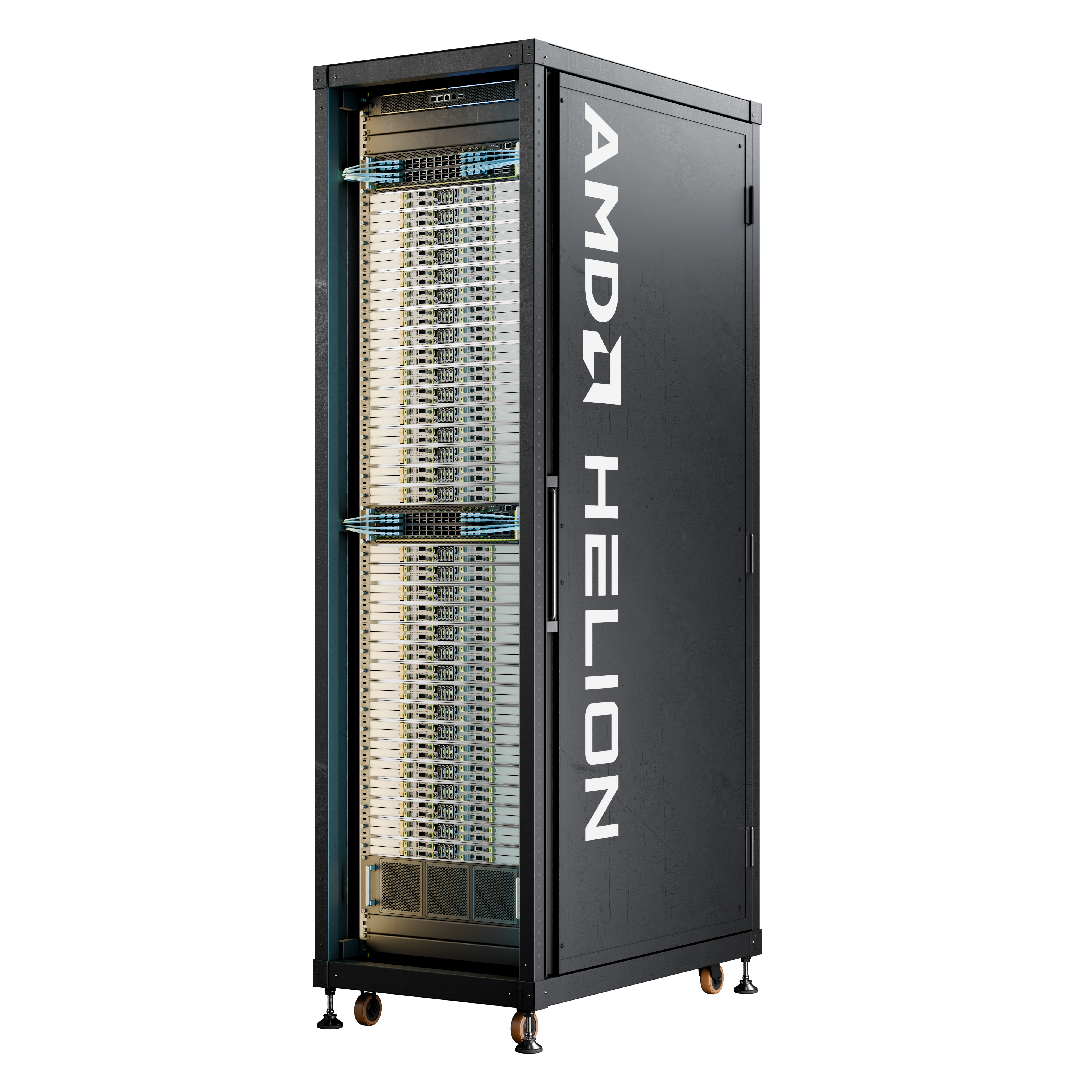
AMD CEO Lisa Su says demand for AI inference and CPUs continues to rise as computing capacity becomes more valuable.

Verisure’s 6.38 million monitored-alarm subscribers generate 90% recurring revenue, while its disclosed acquisition costs and 6%-8% churn…
$AVGO's Hock Tan is right that capital is now the constraint on AI, and that is healthy. The $60bn banks are placing for Anthropic's lease of $GOOGL's TPUs shows how it gets eased: by moving risk, not reducing it. We read his two remarks as cause and effect: tokens are not yet earning a return, so capital is expensive. That brake stops a buildout outrunning its returns. The $42bn senior slice leans on Broadcom's A-minus credit through a partial guarantee of the chips' residual value. The rest is expected to wait for Anthropic's IPO. The brake works where Broadcom's credit stops. On the guaranteed slice the risk has moved, not shrunk: out of a loan spread lenders would price, into a chip deal the seller priced, onto a balance sheet already long the same cycle, where it is too small to move the shares. Google sits on the same outcome three times: Anthropic shareholder, TPU lessor, Broadcom's customer for those chips. The IPO junior lenders are waiting for also puts a public price on Google's stake, and Broadcom's guarantee is safest if it goes well. Spreading risk only reduces it when the holders are diversified against it. None here are. Each piece is ordinary. The total is capital arriving ahead of proven returns, and two of the market's largest companies carrying more of one lab's downside than their labels suggest.

Bernstein today on accelerating localization at all levels in China including SCM, driving total localization and growth for WFE $ACMR
On Shopee VIP. Once customers sign up, they stop comparison shopping + spend increases 5x. VIP members already make up >25% of GMV - think it's a good ROI on capital, by locking up their customer base / reducing churn, and in turn increasing customer LTV. h/t @farrer36am. $SE
$AXTQ I'm a seller of the Mar27 85C. Pairs well imo with the calls I sold in the spring on $AXTI itself.

$orcl
And we do it up again. $CRDO.
Interesting to see $V up 9 days in a row (nearly funtrun the Chinese announcement). While a positive, it will be years before it plays out (if China follows through down the line, and gets them in the same place AXP and MA already were + the domestic competition). But thats incremental and down the road at best the focus though should be the support the administration (trump recently, and JD wrote the bill when in congress) has thrown behind the CCCA as well as additional bipartisan sponsors that signed on in the past few weeks....that bill will open the rails to an additional network. Which would be a very big additional push towards stable coin based transactions (even greater push from agents commerce). Ultimately the power is shifting towards merchants that no longer want to be subjected to 3%+ interchange fees. If $V losses the CCCA and pandoras box on competition is opened their entire moat is at stake, similar to what is going on with $FICO and Vantage. A once unassailable business model could very quickly come under pressure. Australia lowered interchange fees, went in to effect Oct. 1.....the pressure is building worldwide. But it's the cracking the door open in addition to a new way of shopping that could really leave $V disrupted. Not a mistake the first move earlier this year was lower on the back of AI fears, it has bounced with software now where somehow Phone systems from $RNG and website domains from $GDDY are somehow the new "hot trade", but secular trends seem obvious regardless of pacing that Visa and its pricing power and duopoly are in trouble and FICO to me is a similar case study.
Earlier this year, $CBIZ reported they were being purchased on the day of their earnings report. Will be interesting to see if $MNRO follows suit...
Definitely some insider trading yesterday prior to the news today as ethanol prices rocketed higher (Nov jumped nearly 6 cents). October crush margin for the 2nd half jumped to $0.42 yesterday... we'll see if ethanol rallies again now that the news is actually public. $ALTO $GPRE
Huge news for $ALTO and $GPRE

@IHaveNoCapital @CliffordAsness Even $BTAL hasn't performed that poorly unless you only look back a few years.
Insiders have sold $META 150 times with zero purchases over the last six months. They are dumping in size as the AI bubble continues to expand.
My message to someone Saturday September 26th. AI is powerful and this wasn’t my whole thesis but this is a bit of alpha I got from listening to all the Whitney Wolfe Herd Interviews and hearing someone usually so polished unusually stutter and fumble around, could also be a coincidence. $BMBL. AI can’t do it all

$MU and $NVDA are expected to contribute 36% of total Q3 EPS growth for the S&P500 per CitSec
I think $HHS drifting because S4 taking a while and no news, I am going to buy some more, I think even if STARR doesn’t acquire someone else will. Could be delayed due to the other proposals from the go shop. Or just not able to obtain financing, or administrative burden. $4.35 ish price

SED Energy's proposed Ventura merger projects a 22% to 40% dividend yield, but idle tender barges, debt and repayments materially reduce…
We own both $ONTO and $CAMT because they sell overlapping tools to different HBM makers, and we raised Onto while holding Camtek. In our 4Q26 portfolio rebalance we increased Onto in our portfolio and held Camtek unchanged. Inspection identifies defects. Metrology measures dimensions and material properties to check that manufacturing meets specifications. Both companies sell inspection and metrology tools for HBM and advanced packaging, but their customer exposure differs. Onto is more closely tied to SK hynix's capital-spending plans. Our industry information identifies Camtek as a preferred supplier for Samsung's HBM production lines, and Samsung is investing aggressively to catch up with SK hynix in HBM. Camtek is smaller and more specialized, and we see a technical edge in selected HBM applications. Onto also sells chip-fabrication metrology and packaging lithography, which Camtek does not offer. We raised Onto because increasingly complex chip designs give customers reasons to keep investing beyond the current packaging recovery. We hold Camtek as the more focused advanced-packaging investment.

Micron's AI-driven memory demand, customer agreements and cost controls support a $1,500.36 DCF fair value estimate, 52.5% above the…
 Adam Schadt 4 clicks

Every new day brings a new round of downgrades to my levered shitcos with top tier negative momentum - but they hardly seen to go down anymore (end is near?); $FOUR $FIS $GPI $ABG
BridgeBio Pharma reported Q2 revenue of $243.7 million and has three Priority Review NDAs, while $1 billion in convertible preferred…
 Terry Chrisomalis 2 clicks

$NOMD held their first investor day in ~6 years... dedicated an entire slide to the insane amount of recent insider buying + incentive comp upside
CXMT’s capex is $ACMR’s revenue
See the 10-Q’s explanation of the cash flow increase here: Continue reading here for how $BWXT’s $1.25B convertible note affects dilution:
How much of the $8.4B backlog at BWX Technologies $BWXT turns into revenue by the end of 2027? $BWXT expects to recognize 55% of the $8.4B backlog, or ~$4.6B, by the end of 2027. Another $1.4B of unexercised contract options sit outside the backlog, with $900M expected to be awarded in 2030 and $500M in 2035. Three items drive $BWXT’s quarterly FCF swings: 1) Payables: Higher accounts payable added $71.4M to H1 2026’s $249.0M of operating cash flow, vs. $6.9M a year earlier. The 10-Q credits the cash flow increase mainly to the timing of vendor payments, customer billings, and project cash flows, which can reverse in later quarters. 2) Seasonality: Retainages (payments withheld on the government segment’s fixed-price incentive contracts until set conditions are met) build in Q1 and Q3, with larger payments in Q2 and Q4. 3) Equity income: $BWXT’s share of the profit from the joint ventures that manage 14 government nuclear sites, including Savannah River and Pantex, comes in as equity income, now $80M/year. It counts toward adjusted EBITDA (15.7% of Q2’s $155.5M), but $BWXT only gets the cash when the joint ventures pay dividends. That’s why I’d judge $BWXT’s FCF on the full year, not the quarter.
GitLab targets a 2027 inflection as agentic AI, software sovereignty demand and GitHub reliability issues lift win rates, first orders and…
 Ignacio Planas Gonzalez 1 click
$CCLD. Image 1 shows a 2.82x MOIC in 5 years with the same multiple 8x and paltry EBITDA growth, basically without acquisition. One of those two variables would have to give. EBITDA growth of 16% over 5 years is highly conservative especially if they gain momentum as a AI beneficiary or just continue acquiring. 8x EBITDA is conservative as well, this is versus peer sets transacting at a median of 13.6x (Image 2) and 18.6x (Image 3). @R1RCM @Waystar @trubridge @CorroHealth @IKSHealth
Virtu Financial’s resilient trading income, double-digit EPS growth forecasts and forward-earnings valuation support an upgrade despite…
 Albert Anthony 2 clicks

Cabaletta Bio's 40% sell-off leaves CABA below its $2.41 pipeline value ahead of pivotal rese-cel autoimmune data in 2027, despite dilution…
 Cypriot Invests 2 clicks
Tempted to buy some $CMCSA Jan 2029 calls... Spin coming mid-2027 so these would expire ~18 months later... plenty of time for spinco/remainco to play out a bit
We think Amazon ($AMZN) blocks Meta's ($META) Muse shopping agent partly to protect its advertising business, while Shopify ($SHOP) welcomes it to earn payment fees. Amazon cites authorization and security concerns. We also see an advertising business to protect. Amazon earned $68.6 billion in advertising revenue in 2025, including payments from sellers to place their products prominently in front of shoppers. An agent that selects products without taking customers through those sponsored listings could reduce sellers' willingness to pay for them. Amazon still handles payment and delivery, which gives it bargaining power even when an agent chooses the product and places the order. Shopify welcomes Muse through Shop Pay. It can keep earning payment-processing fees when agents complete purchases through its systems, and it has no comparable advertising business to defend. We think shopping agents could favor merchants whose products stand out for quality or features over merchants whose sales depend heavily on paid placement. That could give independent brands another way to reach customers, which would benefit Shopify as more purchases pass through its merchants' stores. Agents and established platforms could still agree to share advertising revenue. We are watching whether agents improve product discovery or simply become another place where sellers pay to be recommended.
Almost every software company ships AI features. Very few do real work on the models behind them. We compared $PLTR, $PANW, $DDOG, $NET and $MNDY on what each one trains itself and what it rents from the labs. From our SaaS Survival Scorecard.

Park Aerospace reported 27% revenue growth and 72% EPS growth, supported by composite materials for Airbus engines and PAC-3 rocket motors.
let's see how much this reads through to $MRNA. Unfortunately, its yet another confirmation that while mRNA cancer vax is promising the path will be choppy and we have many years if not decades to go.

$META $GOOGL pretty funny to see $2T company talk trash and then delete their post after proven wrong - very bubbly behavior Imagine Lisa Su talking shit on X to Jensen about GPUs And @alexandr_wang account is 100% run by Meta's marketing team
Apparel manufacturing is having a great month $VFC $JRSH $PVH (I own all three)
The AI memory squeeze is hitting Android chip suppliers harder than the phone market. Counterpoint says global smartphone shipments fell 20% in the third quarter from a year earlier, the lowest third quarter since 2012. AI data centres are taking more of the memory supply, and higher DRAM and NAND prices left most phone makers short. 1. The fall is in cheaper phones. Xiaomi's shipments fell more than 30%, and OPPO's and vivo's more than 20%, as they cut low-priced models and raised prices. Samsung's fell 3%, and Apple ($AAPL) reached a 22% share, its first third quarter above 20%. 2. Chip suppliers fell further than phone makers. In the second quarter, phone shipments fell 21%, while MediaTek's and Qualcomm's ($QCOM) phone chip shipments each fell more than 30%, per Counterpoint. 3. Qualcomm is exposed too. Counterpoint ties MediaTek's decline to its entry-level and mainstream chips, and Qualcomm's to its Snapdragon 600 and 400 lines. Qualcomm also lost some premium volume as Samsung used its own Exynos 2600 chip in base Galaxy S26 models in some regions. Samsung's Exynos shipments rose in the second quarter. The phone maker that held up best is making more of its own chips. The third-quarter phone data shows the same pattern, so I expect MediaTek's and Qualcomm's phone chip volumes to fall faster than phone shipments again when they report the quarter.
Broadcom's AI semiconductor growth rests on custom-chip partnerships and advanced packaging as Google, OpenAI and Meta demand larger…
 Eudaemon Research 9 clicks
CarGurus, the largest U.S. auto-shopping marketplace, trades near $29 despite roughly $1 billion in expected revenue, $300 million in free…

Altria’s EPS gains rely on tax refunds and discount brands while Marlboro growth lags.
 Vishal Jadaun 2 clicks

$FIZZ seems like an attractive short. Classic staple juicing price into slowing volumes, meanwhile they're getting attacked by competition. They trade at around 17x earnings for some reason when a lot of better looking staples trade at low teens.

Lam Research posted record Q4 FY26 revenue of $6.72 billion, up nearly 30%, as AI chip investment and process complexity lift demand for…
 Research Wise
