
Negligible Capital on X
$NVDA’s $150B buyback authorization is bigger than the market cap of around 84% of all S&P500 companies
NASDAQ
NVDA
251 stories
$4.6T Market cap · 2026-11-06
Get NVDA news in Claude, ChatGPT or your own code. See plans
$NVDA’s $150B buyback authorization is bigger than the market cap of around 84% of all S&P500 companies

Micron’s November revenue guide will test whether an 86% gross margin reflects a structural memory shortage or a cyclical peak, while…
I mean $LITE / $COHR did have $NVDA funding $2B for their buildout. But Lumentum seems primarily self-funded from operating cash flow. So I'd expect $AAOI to follow suit once they start ramp up around H1 2027. 2026 is just that high capex buildout period. My criticism was over visibility and financing methods during this timeframe.
$AAOI has finished a $500m ATM In April.. $600m ATM in June. Then filed another $600m in August. It's out of my control if management wants to abuse this trash repeated ATM structure. Instead following $AXTI like LTA prepayments and using that to fund buildout. Or taking private placements like $NVDA + Nebius for $2B and using that to fund buildout. Or convertible notes at 40% premiums. It's really hard for the stock to break out of $100 or $150 or $200 if there's $600M of selling pressure at those levels (and maybe expectations of future ATMs). I had the same criticism with $IREN with their $6B ATM, which is why it's been rangebound for half a year. And I'll say the same thing with my own thesis names too. I see $AAOI operationally very bullish for 2027, with $471m/month transceiver revenue. 400k ELSFP units/month entering 2028. The revenue ramp is absurd and can compress to single digit forward P/E. But I find it hard to get excited over funding infinite ATMs during the buildout, when you're sacrificing opportunity cost with names currently profitable like $SNDK or Samsung. I think a lot of retail investors conflate stock performance with how a company is doing operationally. $AAOI is capitalizing on a bottleneck with high demand visibility, but stock has been going nowhere near-term with repeated ATMs. I do expect AOI to strongly outperform (especially in 2027) if they stop issuing these stupid ATMs.
So update from $LITE + Win Semi ( $SIVE ) foundry: Lumentum in a meeting with Stifel at ECOC 2026 stated: - $NVDA Spectrum-6 CPO UHP demands increased materially. - NPO as larger than CPO, with multi-wavelength external lasers lifting ASPs (Sivers offers multi wave length DFB arrays, read through on higher valued products) - Demand for UHP lasers continues to exceed supply Just a status update in terms of how the optical bottleneck is going (laser prices going up, demand exceeds supply). Digitimes also reported today Win Semi ( $SIVE foundry ) was expanding capacity for CW lasers. - "CW products... are expected to gradually emerge in the second half of 2026", with meaningful revenue contribution likely coming in 2027 and 2028. - Win has strengthened inventory management for InP substrates while moving toward 6-in InP wafers for ongoing process testing. Currently relies on Tier-1 International suppliers. - Many of this was spent on DUV tools from $ASML but (Win Semi's orders spanned machinery, equipment, and fab engineering work) So that answers a lot of questions about Sivers' partner "how is this company securing InP substrates", "4in vs 6in", "production timing" TLDR: - NPO > CPO (per Lite), multi-wavelength lasers going brrr for prices - demand > supply (continuation) - Not sure why people have been bear posting Win Semi when turns out they have everything needed to mass produce CW lasers.
Memory LTAs span until 2031. $AVGO expects 100% supply constrained growth Y/Y for next 2 years. $NVDA expects 70% supply constrained growth next year (implying year after that demand keeps up). $SIVE CEO said there's a massive demand supply imbalance for lasers for at least the next 3-5 years. I think semi supply chain growth needs to be re-accessed year by year, but at least for the next year and half I see unprecedented growth.
Three planar generations of Kirin added 150 MHz in total. The first folded one added 350 MHz in a single step, on the same non-EUV process. How Huawei did it, and why it matters for $NVDA, $AVGO and the Western toolmakers.
Here's the J-curve stock shape -- many examples of software stocks and high growth stocks, sometimes even large mature companies that release a new product. $MPWR was shaping up for this in November 2024 (I wrote about this and went long) when it dropped a lot after they "lost $NVDA" marketshare, but of course their custom AI accelerator business was growing something like 100% a year, and it was only a matter of time before it showed up in the earnings. It subsequently re-rated after troughing at 35x and had significant earnings growth. Today it goes for 35x again. Will there be another big bump in a few years, maybe robotics?
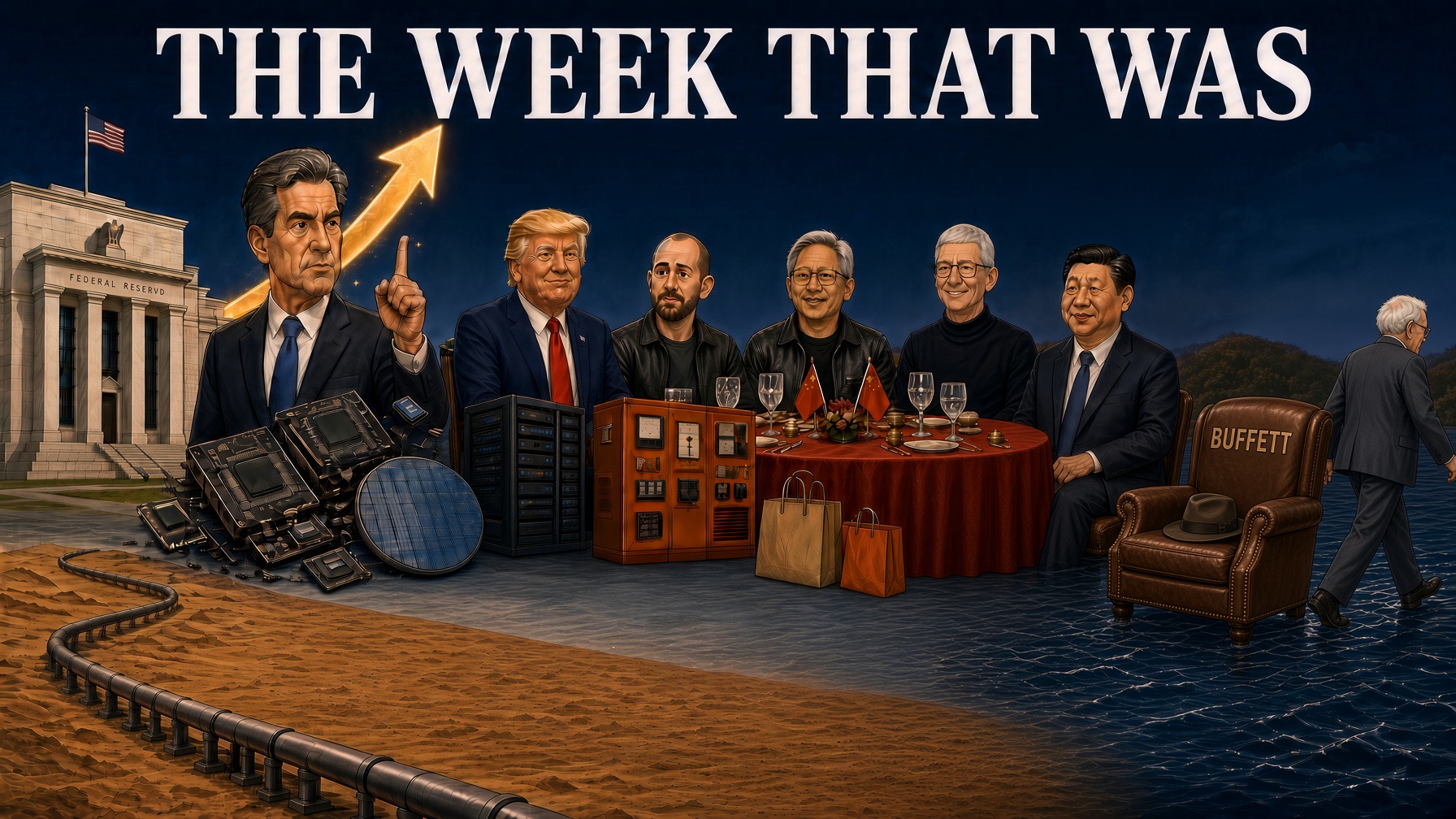
Federal Reserve’s quarter-point hike failed to contain 10-year yields above 5%, while rising legacy-chip rentals and AI safety compute…
Nvidia’s rack-scale AI systems lock GPUs, networking, power and software together as trillion-parameter models push inference spending…
Huawei just updated the Ascend 960 & 970 roadmap. $NVDA's competition pressure is increasing from both $AVGO and Huawei continuously as we've anticipated. → 960DT rollout pulled forward from 4Q27 to 1Q27. (Seems like they are finally getting the HBC-like, tailored-memory approach closer to high-volume production.) → 960PR by 3Q27 with 8 PFLOPS FP4—double the 960DT’s FP4 compute. (Closing in on NVDA’s Blackwell Ultra, which tops out at 15 PFLOPS dense FP4. Rubin moves that target to 35 PFLOPS dense FP4.) → 970 by 2028 with 14 PFLOPS FP4, up from the previous 8 PFLOPS target. Overall, this looks consistent with our Tau Scaling thesis: a higher compute ceiling, more tailored chip designs, and a faster path to production. Not every specification has doubled, but a near-doubling of the 970’s planned FP4 compute alongside an accelerated 960 rollout is a meaningful change. The bigger story, in our view, is Huawei’s CIDM model. Optimizing the entire vertical—not just the logic die—creates more room to change the compute design and shorten the development cycle. Huawei’s disclosed co-optimization already spans devices, circuits, chips and systems. This is the kind of vertical integration Elon Musk is targeting with Tesla and SpaceX’s Terafab. But Huawei is already putting its ecosystem version to work. (Would be quite funny if the Chinese ecosystem gets accelerator-based EUV into production lithography first, too.) Against NVDA, our thesis is that the single-chip gap narrows from roughly three years toward two—and potentially less as the roadmap accelerates. From a PPAC perspective, Tau Scaling could bring the logic die within a year—or less—while memory remains further behind. Bandwidth, not simply capacity, looks like the harder bottleneck. But Huawei may be able to lean into memory capacity and co-design the LLM and serving strategy around that constraint, rather than simply copy something optimized for NVDA’s hardware balance. System-level performance still needs to be proven at the cluster sizes Huawei is targeting. But we would not be surprised if it works better than expected. Even before the full UnifiedBus vision is realized, we think Huawei could gain system-level performance leadership on some large-model workloads sooner than many expect.
*META TO ROLL OUT NEXT-GENERATION ASTRID CHIPS AT END OF 2027 $META says the Astrid chips will save money and energy compared to $NVDA chips But okay NVDA's gross margins will stay at 80% forever
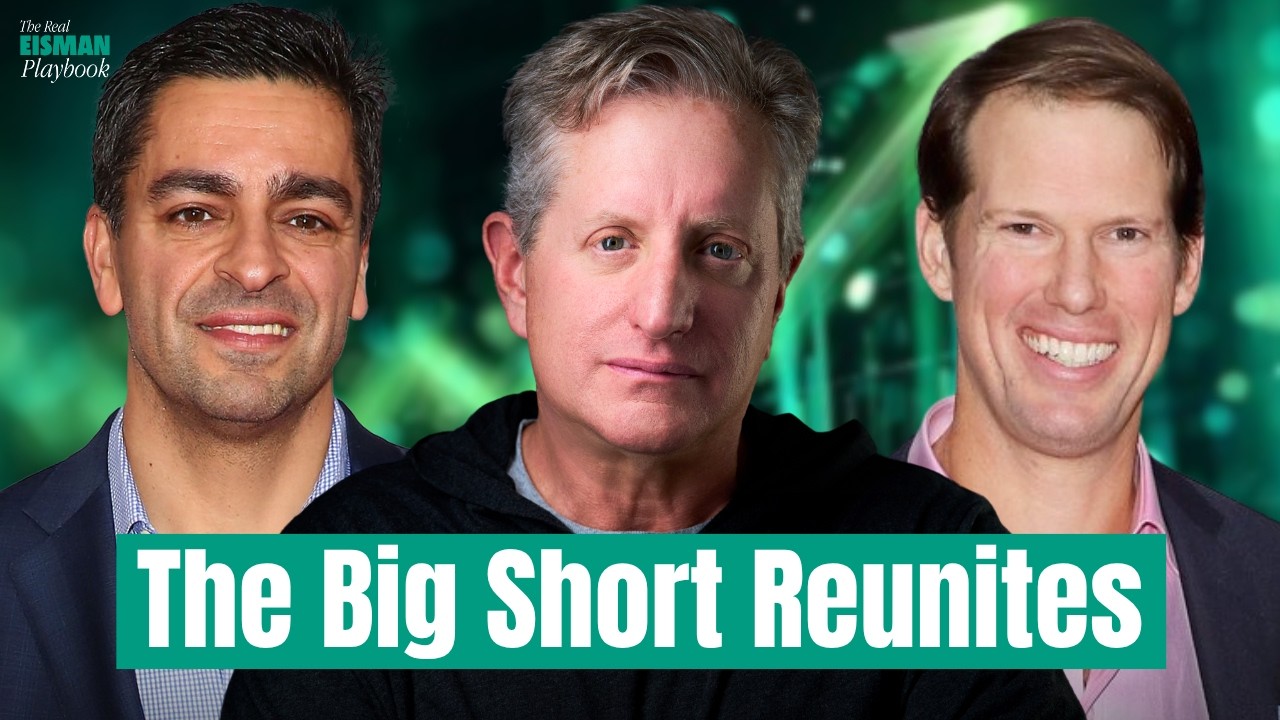
Steve Eisman, Vincent Daniel and Porter Collins discuss Treasury buybacks, OpenAI risk, gold, hedge fund shorting, and live short ideas…
Nvidia CEO Jensen Huang calls AI extinction forecasts irresponsible and says frontier labs should fix safety failures through engineering,…
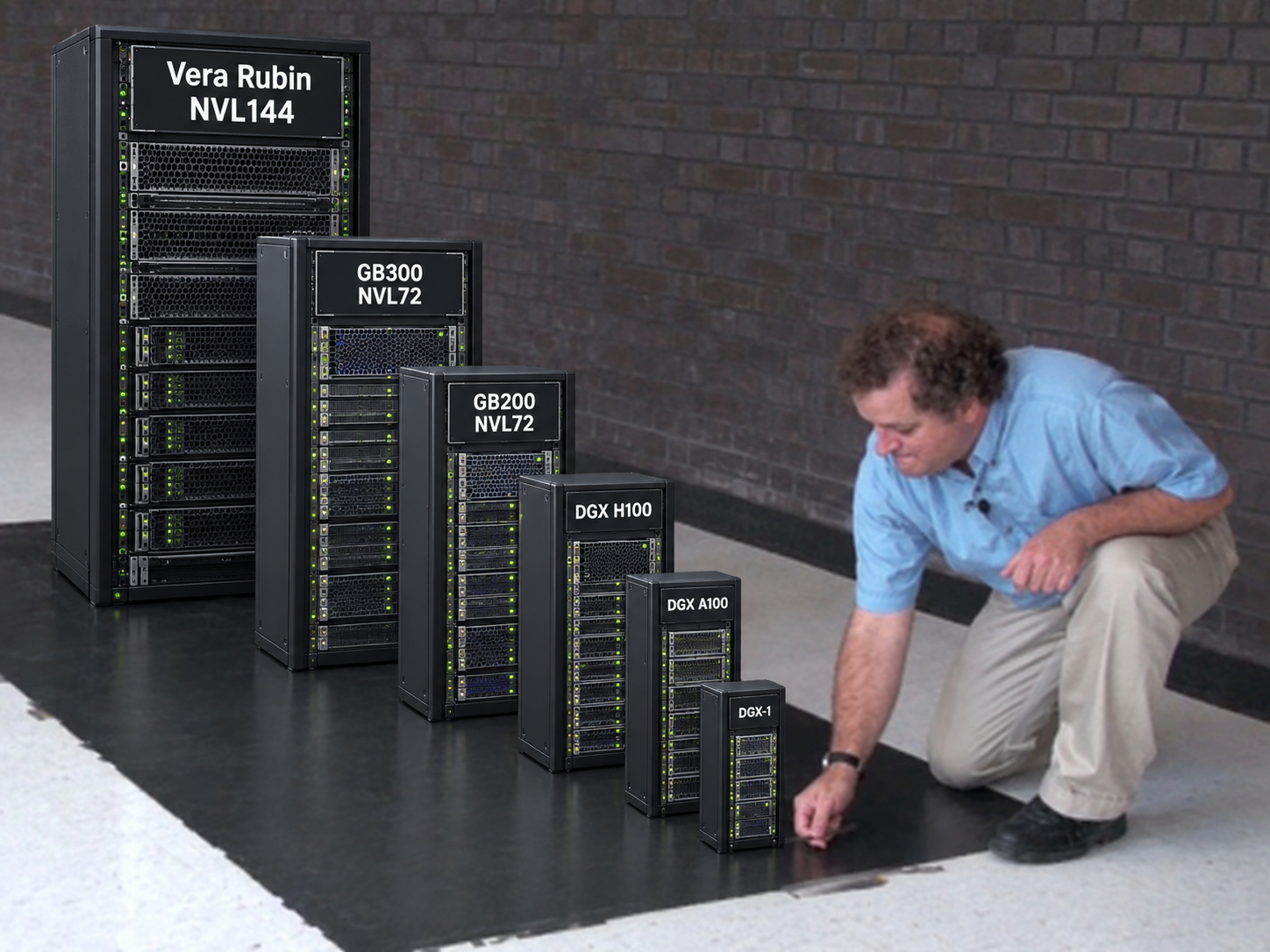
Nvidia’s Vera Rubin NVL72 delivers up to 67x better agentic inference performance per dollar than Blackwell, according to SemiAnalysis…

Latticework’s weekly briefing covers NVIDIA’s AI demand, Deckers’ de-rating, Shurgard’s asset discount, Flitto’s translation-data backlog…

Nvidia’s Rubin Ultra cuts HBM capacity to 192GB per GPU as 8-hi and future 4-hi stacks improve bandwidth economics and ease wafer…
Not an AI expert by any stretch, but wonder if US labs actually coordinate to "pace the frontier," it could be a stealth negative for Nvidia’s top-line growth rate. Here’s why: Flattening the Frontier Race: If scaling massive base models is intentionally delayed for alignment, the panic to hoard the newest, most expensive contiguous GPU clusters cools down. Shift to Post-Training & RL: Progress shifts to squeezing intelligence out of existing models via synthetic data and self-play. This relies on inference-class rollout fleets rather than cutting-edge pre-training mega-clusters. The Verification Layer: Evaluating, sandboxing, and grading all that synthetic RL data requires massive CPU compute .... benefitting $INTC Less brute-force pre-training = extended hardware refresh cycles and a normalized upgrade curve for $NVDA. Markets much smarter on this than I, will wait into see how the stock prices react to this next week!

Ten-year Treasury yields breach 4.9% as Steve Eisman discusses AI fears, OpenAI's price cut, Oracle's 30% revenue growth and Tesla's…
*NVIDIA IN TALKS TO INVEST UP TO $10B IN ANTHROPIC IPO: REUTERS Anthropic is in talks with $NVDA to bring them on as an anchor investor in the IPO. Probably the least surprising news ever Anthropic is in talks to raise as much as $100B, which would beat out SpaceX Safety or not here they come

Nvidia disclosed $530 billion of off-balance-sheet commitments, including AI cloud floors and data-center guarantees, to finance AI…
NVIDIA sees inference, agentic workloads and robotics broadening AI compute demand beyond hyperscalers, while high-speed memory shortages…
Palantir's NVIDIA supply-chain deployment supports its enterprise AI moat, but PLTR's 48x current-year sales valuation remains demanding.
 High Alpha Professor
Nvidia’s valuation now hinges on gross-margin recovery and earnings quality as customer financing and demand underwriting raise FY2029…
 The Alpha Analyst
Letters that discuss NVDA.
Companies the stories above are also about, besides NVDA.


