NASDAQ

Microsoft CORP

MSFT

106 stories

$4T Market cap · 2026-11-05

Get MSFT news in Claude, ChatGPT or your own code. See plans

@aleabitoreddit

Serenity on X

I'm going to give a contrarian take on Neoclouds like $NBIS and say the theme looks compelling after the valuation crash. Since there's a reason why Elon's $SPCX is heavily focused on this market full of "guppies" that would die: He sees how attractive the economics are after selling compute to $GOOGL and Anthropic. And this is reflected by his actions not words, from SpaceX's recent $40B financing for GPUs procurement. $AMZN, $MSFT, and even $META also see how profitable the economics are and are accelerating their AI DC buildouts. I'd argue if a Neocloud has: - Close relationships with $NVDA + others for allocations - Existing contracted capacity + permitting - Well funded counterparties, such as Hyperscalers. - Attractive economics, such as financing their procurement correctly (not the way $CRWV has with high debt interest unless they refinance). Then I think they'll do just fine... However, the bigger worry is more toward newer players starting financing or the permitting process, since barrier to entry has now become extremely high. For financing, read through on $IREN earnings has shown public Neoclouds can adapt extremely well to tight markets: As seen with their 90% prepayments for GPU capex on a 5Y deal. Their older H100 GPUs recontracted at double their previous pricing and 12% higher contracted pricing also point against depreciation fears. And in the case DC buildouts slow from permitting delays... it heavily favors some over others. Rosenblatt's recent note for example stated they see little risk with $NBIS primary buildout that was in Missouri, Pennsylvania, and South Carolina. And there's probably less risk with developers in places like Australia. Markets have also show this infinite compute arbitrage can't go on forever, hence the reluctance to further finance capex, via things like ATMs. But ironically, tighter financing and hypothetical restrictive permitting would increase the competitive advantage of established neoclouds. And create a larger moat against newer DC developers.
@StableBread

Fajasy on X

The companies spending the most on AI are paying for more of it with debt. To understand whether debt-funded spending like this is indicative of a bubble, we can look at William Quinn and John Turner’s bubble triangle, which says a bubble needs three sides: marketability (how easily an asset trades), money and credit, and speculation. The AI boom arguably has all three sides: → Marketability: Index funds held 52% of U.S. long-term fund assets at the end of 2025, up from 19% in 2010, and they buy each stock in proportion to its size, so the biggest AI stocks get the most of every new dollar. → Money and credit: $MSFT, $GOOGL, $AMZN and $META are on track to spend more than $730B on capex in 2026, up from $410B in 2025, and their Q3 reports didn’t change that. $AMZN still expects ~$220B, and $META narrowed its range to $135-145B. Investors are borrowing more too, with margin debt at $1.48T in September, just below June’s record $1.50T. → Speculation: AI startups raised 82.7% of the money U.S. venture capital firms invested in 2026 through September, a record share, up from 65.4% in 2025. So more of the private money is betting on a single theme. $META’s also raising money by selling stock. Its October 27 pricing term sheet shows it sold 40M shares at $625 through forward sale agreements, plus $12.5B of mandatory convertible preferred stock, which together bring in $37.4B of net proceeds once the forward sales settle by November 2027.
@SouthernValue95

SouthernValue on X

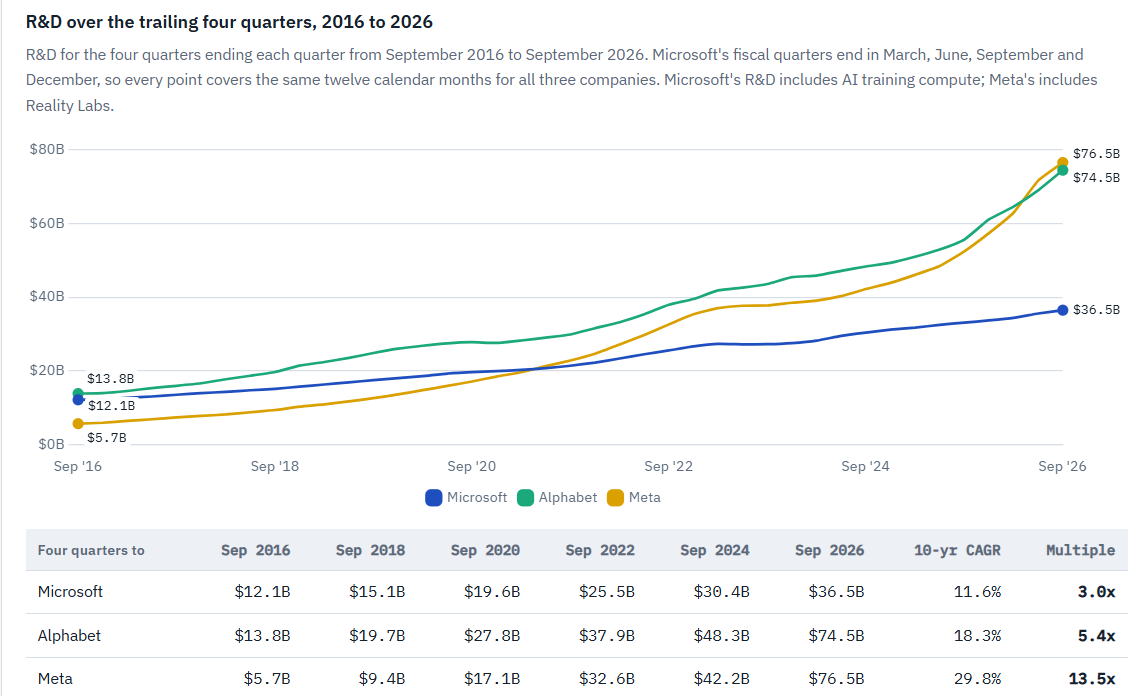
$Msft can leverage OAIs IP through 2032, >6yrs, so what would be the point of duplicating all of that R&D along the way, probably not as well? This is a structural efficiency advantage to $MSFT that is unique among leading AI companies. They can sell premium tokens with owner economics without the elevated training cost. That is worthy of a premium multiple. And why they are growing EBIT >20% with positive FCF and no dilution while META is growing EBIT single digits with negative FCF and significant dilution. I like $META and think it can produce a better IRR than $MSFT from here. But the risk premium is logically higher bc of a messier financial profile and the unproven size and business case for consumer AI vs MSFT in the enterprise where unit economics and demand are clearly compelling today. Research intensity will be higher for MSFT far in the future, but by then the rate of model change may decline, and it will have a larger AI business to absorb the cost.
@aleabitoreddit

Serenity on X

We've finally made it to November... holy crap October was brutal. Per Morgan Stanley data, the recent hedge fund de-grossing was the highest in the past 10 years. Exceeding the: - 2016 Chinese stock market crash - 2018 Volmageddon - March 2020 COVID crash - 2021 Archegos collapse / Evergrande crisis - 2022 bear market Goldman's prime brokerage desk reported on the 26th that it had also seen ~$20B of selling over 2 weeks vs. $23 billion during July's entire unwind. From $HOOD short interest data, from Sept -> Oct short float also increased from: $AAOI: 12.5% -> 19.84%+ $AEVA: 11% -> 25.64%+ $CBRS: 12.25% -> 20.12%+ $AEHR: 14.33% -> 17.93%+ $TSEM: 2.15% -> 4.73%+ $CIFR: 19.94% -> 25.39%+ $LWLG: 15.24% ->19.12%+ $OKLO: 17.72% ->22.93%+ $CRWV: 17.91% ->26.58%+ Substantial deleveraging coinciding with surging short interest, kinda looks like a July setup after Midterms? The recent rotation also kinda pushed names like $CRWD and cybersecurity to bubble valuations into hundreds of fwd P/E... Earnings on many AI capex + bottlenecks (not all like $INTC) looked strong: eg. $AXTI guided annualized Q4 = 23.7x P/E now, not including potential InP substrate hikes + capacity expansion that can compress it to single digits. - $SKHY (~$59B operating profit) casually making more than trillion dollar companies like Amazon ($28.1B operating profit), backed with 5Y LTAs. - No signs of $MSFT / $AMZN materially cutting capex, while $SPCX secures $40B more for GPU procurement. Slightly painful, but I think the AI capex trade (specifically photonics/memory) is a generational opportunity, with extreme volatility in between.

Microsoft: The $250 Billion Club

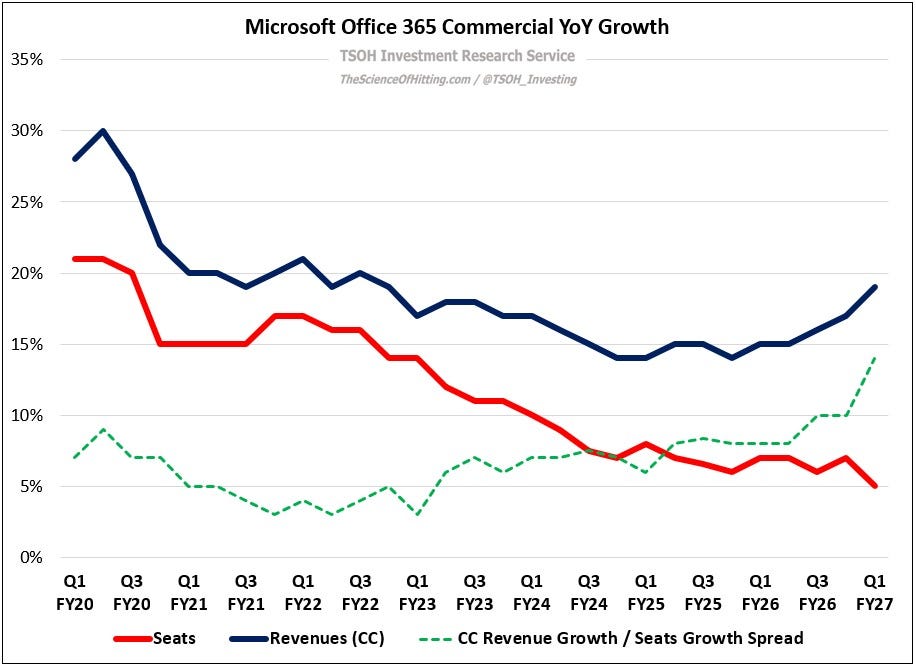
Microsoft’s widening gap between M365 Commercial revenue growth and seat growth eases concerns over Copilot monetization across its 400…

Microsoft's AI Boom Has A Cost

Microsoft’s Azure grew 48% as AI monetization accelerated, but doubled CapEx, largely for CPUs and GPUs, reduced quarterly free cash flow…

@convequity

Convequity on X

Thoughts on Elon's recent neocloud comments "Neocloud" has always been a weak label. These businesses aren't really clouds, and they aren't particularly new. The more accurate term is GPU VPS. Most of them rent bare-metal GPUs. They generally don't offer redundancy across three availability zones, and they don't sell hundreds of platform services on top of the hardware the way a true cloud does. That puts them closer to VPS providers than to cloud platforms. CPU history shows the difference. CPU cloud concentrated among three to five players because platform services lock customers in and drive a demand flywheel. Customers use more of the stack over time, rather than only renting the hardware. That is how AWS-style clouds kept high margins and strong moats. CPU VPS went the other way: many providers selling essentially the same product, in a brutally competitive, commoditized market. If GPU supply stops being constrained by chips or energy, GPU VPS starts to look like CPU VPS, with gross margins of something like 50%. Better marketing and operations can lift margins and grow revenue, but they won't push gross margins to 75-80%. That is the long-term risk Musk pointed to when he predicted most neoclouds would go out of business. Most of these names are VPS businesses earning cloud-like profits and valuations from a temporary imbalance between supply and demand. $CRWV is part of that group. CoreWeave and $NBIS are also the two furthest from a pure GPU VPS, because both already sell platform services on top of the GPUs. CoreWeave is still the most exposed on financing. It pushed hard to maximize margins on each contract and took on interest-rate risk against fixed contracted revenue. Its counterparties, OpenAI, $MSFT and $META, may have played those deals more intelligently. So CRWV is the most vulnerable name on its balance sheet, yet one of the least commodity-like on product. That gap is where the return potential sits for investors willing to stick with CRWV.
@BlueDuckCap

BDC on X

Factor and sector rotations off of day to day and often conflicting data points have been a hallmark of the 2026 market. Not sure if its algos or just heavy retail participation or both. But I would say this: stop reacting to the daily data points - especially during earnings. It's stupid and a recipe for getting chopped into oblivion. While earnings reports are useful for directional trends on sectors, every company is different. Obviously. And different things impact quarters. To wit - its Thursday. Sunday night: AI trade over. Monday after Anthropic S1 out: Oh there's a healthcare TAM here and inherent operating leverage on compute, buy AI! Tuesday: AI stable, sell $SPOT! Weds: Send AI Weds PM: $GOOGL sucks, puke it, its over. Buy $META (why? idk). $NOW sucks puke it. Capex peak in sight (in line with consensus) puke AI. $MSFT good, buy it. Thurs: AI over, software over buy $SPOT. $MSFT good but its AI and software, sell it. Try and have an investment view anchored in what you believe to be confirming data points you expect to see in coming weeks, months, years. Hedge tactically as the data points inevitably aren't linear. Barbell core investments with tactical trades to hedge and take advantage of the rotational chop. Such trades are best in highly liquid securities. But if you trade like a bipolar lunatic - much like the market has traded - you will not do well.

MSFT Q1 FY6/27 Earnings Review

Microsoft Q1 FY27 revenue rose 19% to $92.3 billion as Azure grew 48%; $39.4 billion of capex funded AI and cloud infrastructure.

@SouthernValue95

SouthernValue on X

Right now AI diffusion is happening faster in enterprise than in consumer. $MSFT is effectively the only pure play on enterprise AI diffusion. It’s salesforce, FDE and partner ecosystem, and the security, orchestration and governance capabilities of its platform uniquely unlock new AI TAM in traditional conservative enterprises. My prediction that M365 commercial would accelerate to >20% growth may come true next quarter, based on tonight’s guide. Sooner than I expected*. $MSFT will now have Azure and M365, which are 2/3 of revenue, growing >50% and >20%. And both stand a good chance of accelerating through the year: more copilot rollout, consumption pricing, and Autopilot for M365, and more capacity coming online and price increases for Azure. I still think $24-25 EPS is achievable in CY27 which would make $MSFT <22x fwd PE, even after a nice run. *helped by re-segmenting which added GitHub! But I think will be true this year regardless.
@SouthernValue95

SouthernValue on X

My prediction that M365 commercial would accelerate to >20% growth may come true next quarter, based on tonight’s guide. Sooner than I expected*. Right now AI diffusion is happening faster in enterprise than in consumer. $MSFT is effectively the only pure play on enterprise AI diffusion. It’s salesforce, FDE and partner ecosystem, and the security, orchestration and governance capabilities of its platform uniquely unlock new AI TAM in traditional conservative enterprises. $MSFT will now have Azure and M365, which are 2/3 of revenue, growing >50% and >20%. And both stand a good chance of accelerating through the year: more copilot rollout, consumption pricing, and Autopilot for M365, and more capacity coming online and price increases for Azure. I still think $24-25 EPS is achievable in CY27 which would make $MSFT <22x fwd PE, even after a nice run. *helped by re-segmenting which added GitHub! But I think will be true this year regardless.

Investor Letters

Letters that discuss MSFT.

Every letter that discusses MSFT

Tickers on this page

Companies the stories above are also about, besides MSFT.