New Ask Claude or ChatGPT about any stock, using Bullpen. Bullpen in Claude or ChatGPT. 7 days free

NASDAQ

Microsoft CORP

MSFT

106 stories

$4T Market cap · 2026-11-05

Get MSFT news in Claude, ChatGPT or your own code. See plans

@SouthernValue95 9 clicks

SouthernValue on X

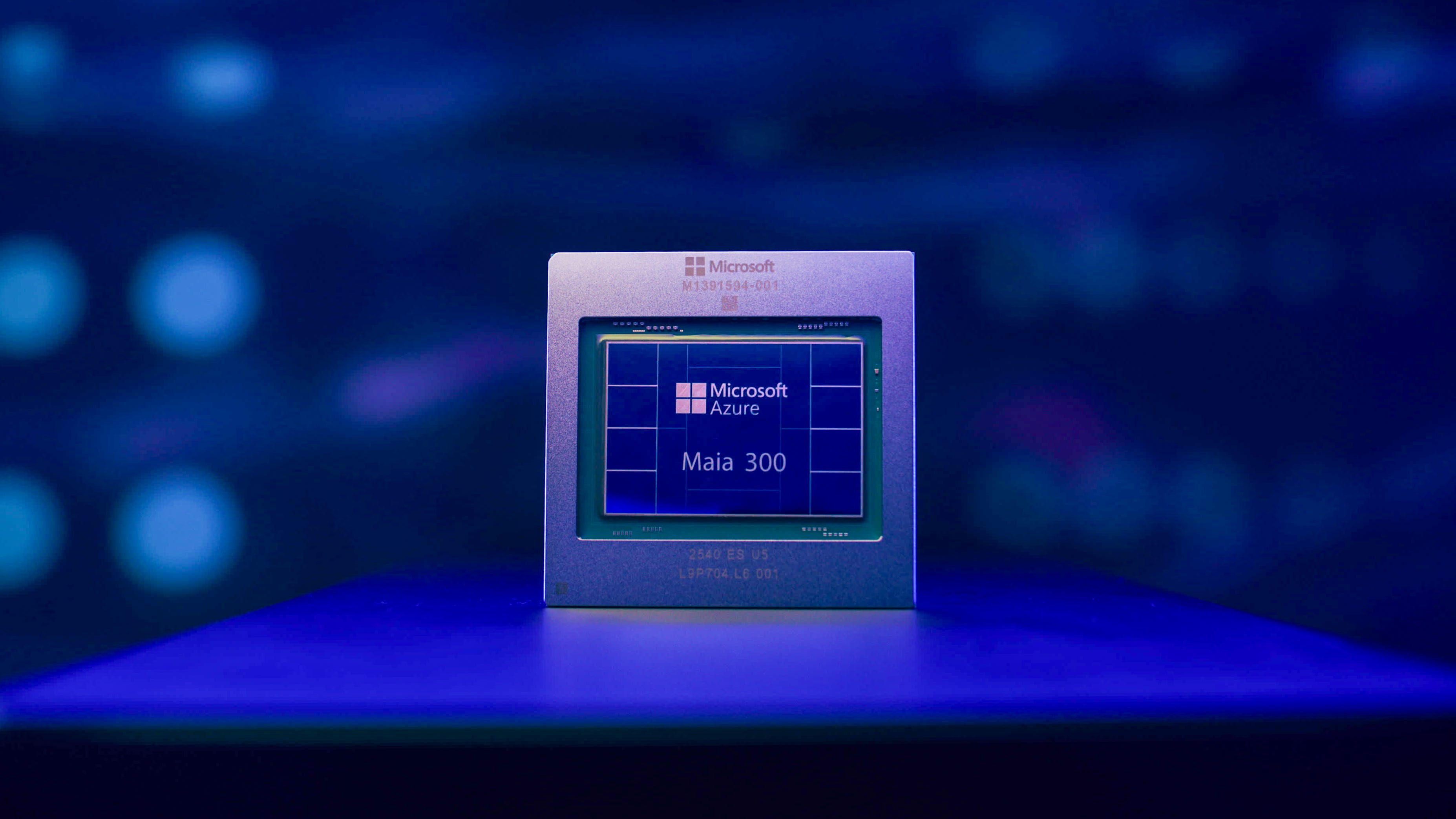
$MSFT Cloud Chief Scott Guthrie: “Over time we expect Maia to be the dominant compute for our inference fleet,” “Multi-GW deployments begin in CY27,” “The future of AI won’t be defined by a single model, or a single chip, we will continue to apply the right model and technology to the right problem to bend down the cost curve,” “We won’t ever get custom silicon to 100%, but do expect it to get to the majority of our internal consumption,”
@convequity 6 clicks

Convequity on X

OpenAI and Anthropic will rent most of the AI capacity they plan, but mainly from the big clouds rather than the listed neoclouds Convequity's AI Bubble Barometer (ABBX) tracks the data-centre capacity each company plans and how much of it it expects to rent from partners rather than own. 1. OpenAI plans 21.2 GW, of which 18.0 GW is to be supplied by partners. Anthropic plans 13.8 GW, all of it from partners. Together the two labs plan to rent 31.8 GW. 2. That is 2.8 times the 11.2 GW that the five hyperscalers, $MSFT, $AMZN, $GOOGL, $META and $ORCL, plan to rent from others. 3. The labs' named suppliers are mostly AWS, Oracle, Google, Azure and SB Energy. CoreWeave, a listed neocloud, and Nscale, a private one, appear on the lists, but the bulk of the 31.8 GW is not with listed neoclouds. 4. The seven listed neoclouds, $CRWV, $NBIS, $IREN, $APLD, $CORZ, $CIFR and $BTDR, plan to build 33.62 GW of their own. Much of that is gross site power rather than contracted IT capacity. 5. The labs are also behind most of the recent growth in AI capacity plans. Since 14 Jul, the total capacity that the 15 ABBX companies say they plan to have has risen by 22.19 GW, from 131.23 GW to 153.42 GW on 7 Oct. OpenAI and Anthropic raising their own plans accounts for 13.7 GW of that rise (62%). We think the labs' rental demand mainly supports $AMZN, $ORCL, $GOOGL and $MSFT. The neoclouds will need to fill their pipelines largely with other customers, including the hyperscalers' own 11.2 GW of planned rentals, so we would not read the labs' plans as demand for the neoclouds.
@convequity 4 clicks

Convequity on X

Neoclouds trade at 2.6x invested capital, less than half the hyperscalers' 6.1x The seven neoclouds in Convequity's AI Bubble Barometer (ABBX), $CRWV, $NBIS, $IREN, $APLD, $CORZ, $CIFR and $BTDR, lost 7.2% of their combined enterprise value this week, from $190.2B at the 2 Oct close to $176.5B at the 9 Oct close. Over the same week the five hyperscalers, $MSFT, $AMZN, $GOOGL, $META and $ORCL, gained 2.4%, from $13,316B to $13,637B. 1. Enterprise value divided by invested capital (EV/IC) at the 9 Oct close was 2.6x for the neoclouds and 6.1x for the hyperscalers. At the 2 Oct close it was 2.8x and 6.0x. 2. ABBX estimates the weighted average cost of capital (WACC) at 14.6% for the neoclouds and 9.7% for the hyperscalers. 3. At the 9 Oct close, neocloud share prices were 20% to 45% below each stock's best Friday close since 17 Jul: CIFR −44.5%, CORZ −33.3%, BTDR −25.8%, IREN −24.6%, APLD −24.1%, CRWV −22.0% and NBIS −20.4%. Among the hyperscalers, ORCL was 10.9% below its best, AMZN and META 4.4% and GOOGL 1.3%, while MSFT closed above its best. We think most of the discount reflects the neoclouds' higher cost of capital rather than a mispricing. We would not call 2.6x cheap until they report their July to September backlog and customer prepayment figures.
@SouthernValue95

SouthernValue on X

$MSFT outlining their view of digital work and application stack of the future: - Copilot as the UI/OS for getting work done - Supported by the context layer of Microsoft IQ, bringing in data from all of your other tools - Connected to an “infinite software factory” to build personalized apps that help you get work done more efficiently, running on a managed infra layer that keeps data within the rails and avoiding app sprawl - and he is clear that existing Systems of Record need to evolve to support this structure or be replaced.
@SouthernValue95

SouthernValue on X

This is frontier lab only, $AMZN $MSFT would be the opposite and inference dominated. Possible that Anthropic is essentially going to be a nonprofit that will always be running at ~breakeven where training R&D = inference gross profit. In periods when they are accidentally profitable (now) that means they are behind on spend. And then partners like the clouds and inference marketplaces dedicate more compute to serve inference, which becomes capital light revenue to labs.
@convequity 1 click

Convequity on X

Despite investor doubts, $IREN is worth a small position. The shares have fallen about 17% from their 22 Sep close. The equipment IREN had ordered at 30 June is covered by the cash, committed GPU financing and prepayments it reported on 27 Aug. In the June 2026 quarter customers funded most of its capex. On signed contracts the shares are priced about where $CRWV is. The main risk is that IREN runs GPU clouds worse than its peers. 1. IREN guided FY27 capex (Jul 2026–Jun 2027) at $25–30B on its 27 Aug results call. Its enterprise value is $14.6B at the 5 Oct close. IREN's FY26 results show revenue of $0.7B, of which $0.58B was bitcoin mining. IREN expects to have shut mining down by the end of December 2026. 2. At 30 Jun 2026 IREN had $13.8B of commitments for GPUs and site work, almost all payable by 30 Jun 2027, per its annual report. Orders placed after 30 June are not in that figure. On 27 Aug IREN put its existing cash, committed GPU financing and customer prepayments at about $14B. That covers the 30 June commitments. 3. The other $11–16B of the capex guide is not yet funded. Management targets about $8B more in GPU financing and prepayments for new GPU capacity, and that funding comes with new customer contracts. IREN says it is in late-stage talks for a large share of 2027 capacity. It has not announced any signed contract for that new 2027 capacity. The rest would come from data-center debt, operating cash flow and corporate funding, which includes selling shares. By 14 Aug 2026 IREN had sold about $2.5B of shares under its $6B ATM programme, leaving about $3.5B at that date, per its annual report. It has not reported any sale since. 4. On signed contracts, IREN is priced close to CRWV. On our ABBX dashboard, enterprise value is 0.88x contract value for IREN, 0.74x for CRWV and 1.60x for $NBIS. The contract values are company-reported, and each company measures them differently. IREN reports about $16.6B, of which about $5.1B is cloud service contracts and about $11.4B is GPU lease contracts. CRWV reports a $104.2B revenue backlog. NBIS reports $37.5B of remaining performance obligations. On 27 Aug IREN said its 2026 capacity was largely sold out. It had $4B of contracted annualised revenue run-rate (ARR) for 2026 capacity, which it earns once that capacity is delivered and accepted. $1B of ARR was already operating. EV is about 3.7x the contracted $4B. 5. In the June 2026 quarter, IREN's customers funded most of its capex. On our ABBX dashboard, customer prepayments and deferred revenue covered 87% of IREN's cash capex in that quarter ($1.72B of $1.98B). The same measure was 21% at NBIS and 12% at CRWV. Working-capital inflows covered 90% of IREN's capex and 36% of NBIS's. CRWV's working capital was an outflow equal to 8% of its capex. More than half of IREN's customer prepayments came under the $MSFT contract. At 30 Jun 2026, $1.01B of IREN's $1.84B of deferred revenue sat in the subsidiary that holds the GPUs for the MSFT contract, per its annual report. IREN said on 27 Aug that $3.6B of GPU financing plus customer prepayments fund about 96% of the GPU capex for the MSFT contract. IREN also said its recent contracts carry prepayments of 45–55% of GPU capex. So in that quarter customer cash, not new debt or shares, paid for most of IREN's capex. At NBIS and CRWV it paid for a small share. 6. Operations are the weak point. Some people are questioning the quality of the GPU cloud service IREN delivers to end customers. We share the concern, and it is not new to us. We recorded it in our 1Q26 rebalancing meeting and again in 2Q26 and 3Q26. One of our biggest concerns on IREN is that the CEO treats software as easy, low-value work next to power, land and data centres. That includes the orchestration software that schedules customers' jobs and manages the GPUs. We expected this to slow IREN's growth, not to threaten the business, for three reasons. (A) In our view the bottleneck in AI infrastructure today is powered capacity, not the know-how to run GPU fleets. IREN said on 27 Aug that its recent 3-year contracts price above $20M of revenue per MW of computing capacity. It estimates about a 2-year payback on the GPUs and related equipment. It also said its 2026 capacity is largely sold out. (B) Hyperscalers and other bulk buyers of IREN's capacity can manage and optimise GPUs better than IREN can. What they need from IREN is powered GPU data centres delivered on time. MSFT's $9.7B contract is for GB300 GPUs in four 50MW buildings. MSFT accepted the first, Horizon 1, in August 2026. IREN targets Horizons 2–4 in the December quarter. (C) $NVDA is partnering with IREN and is trying to make running large GPU fleets more standard and simpler. In our view NVDA wants standard fleet-management software so that more companies can run its GPUs well, which makes its chips easier to buy and use. On 7 May 2026 NVDA signed a five-year, $3.4B managed GPU cloud contract with IREN that uses Mirantis orchestration software. The same day it announced a partnership to deploy up to 5GW on NVDA's DSX reference designs. DSX is NVDA's standard set of designs and software for building and running AI data centres. In its 31 May 2026 DSX release, NVDA says the DSX OS software handles tasks such as keeping GPUs healthy, scheduling jobs and running several customers on one cluster. The same release names IREN, CRWV and NBIS among the cloud partners deploying core parts of DSX. The risk in (C) is that IREN's CEO may be too optimistic about how capable NVDA will be at this and how soon. 7. IREN is buying software and hiring managers to run its cloud better. It bought Mirantis, a cloud software company with more than 1,500 enterprise customers, on 4 Aug 2026. IREN said at completion that it paid about 12.6M shares plus about $40M. In July 2026 it hired a product chief from $ORCL (its cloud unit), a data-center development chief from $GOOGL and CyrusOne, and a security chief from $NTNX. We found no hire of a head of cloud operations. We would change our view in three cases. First, if a Horizon delivery for MSFT is missed or rejected. Second, if the Q1 FY27 report arrives with no new contract for 2027 capacity announced. Third, if IREN's weak end-user experience turns out to come from its infrastructure, meaning power, cooling, networking, storage or the GPU hardware itself, and not just from its orchestration software. The third matters because bulk buyers can replace IREN's software with their own, but they depend on IREN for the site and the hardware.
@convequity 1 click

Convequity on X

Convequity’s AI Bubble Barometer (ABBX) — Week of 2 October 2026 Our weekly framework tracks valuations, returns, capex, financing risk and infrastructure capacity across hyperscalers, neoclouds and model labs. Friday 2 Oct 2026 close (US ET): - Price drove the move: EV rose about $44B to about $14,114B. Invested capital (IC) was unchanged at $2,338B. - EV/IC: 6.04x, up 0.02x from 6.02x on 25 Sep. - All-in EV/IC: 6.76x. 1. Returns. Our paired, annualized forward ROIC (which is not trailing accounting ROIC) for Q2 2026 is 30.0%, against an AI WACC of 9.8%: 3.07x ROIC/WACC and a spread of +20.3 percentage points. 2. Capex. Latest-quarter cash capex is $228.7B. 3. Debt. Borrowings are $595B. All-in exposure is $3,624B, or 6.10x borrowings, adding purchase obligations, construction commitments and uncommenced leases on top of borrowings and leases. 4. Gigawatts. Current capacity is 45.7 GW, with 153.4 GW planned. $MSFT versus $GOOGL: MSFT’s all-in exposure is about 17x borrowings, and it is renting more: external capacity is about 12% now and 21% of planned capacity. GOOGL’s all-in exposure is 10.2x borrowings, while its external capacity share remains small at about 4% now. We see a price-led rise in valuation, with modeled forward returns still well above the cost of capital. Future spending commitments are much larger than borrowings alone suggest, and the reliance on rented capacity differs across companies.
@convequity 3 clicks

Convequity on X

Renting AI capacity protects Microsoft ($MSFT) if the AI buildout busts. It leaves Microsoft exposed if compute gets scarce. On Q2 2026 data, Microsoft's implicit and off-balance-sheet infrastructure commitments were 17 times its headline borrowings according to our AI Bubble Barometer. 1. Microsoft signs a multi-year deal to rent capacity. The partner, a specialist AI cloud such as $IREN or Nebius ($NBIS), typically raises the capital, builds the site, buys the chips and owns the assets. 2. Construction risk, the risk that the GPUs lose value, and most of the financing sit with that partner and its lenders. 3. Microsoft swaps capital spending today for rental payments later. Compare Alphabet ($GOOGL) at 10.2 times. Almost all of its off-book commitments are purchase orders, $811bn of them, for chips and equipment Google will own. We read Microsoft's choice as less than full confidence in the buildout, and Google's as the opposite. In our view the market underweights the risk that compute gets scarce. The partners own any capacity beyond their Microsoft contracts and can sell it to whoever pays more. Microsoft would then have to wait or pay up, as it owns fewer of the data centres and chips it uses. That means higher compute costs and tighter margins. On our reading, Microsoft wins if AI demand falls short, because its partners carry most of the asset risk. If compute gets scarce, Microsoft loses, because renting gives it less control of supply, and Google wins because it will own the chips it ordered.

Microsoft: The Xbox Segment Revamp

Microsoft plans to rebuild Xbox after FY2026 through studio cuts, higher hardware prices, Game Pass growth, exclusive releases and the 2028…

@BlueDuckCap

BDC on X

Just surfacing this one to demonstrate we are not and never were $snap absolutists. We will go long and short and when facts and circumstances change our opinion changes too. And NO - Specs will not be a mass market hit this holiday season. Too expensive and awk form. But here's the bull case from here: 1. FCF/Share is the metric mgmt now focused on. By definition that requires fresh cost and SBC discipline. 16% hc reduction and flat share count already in place. $500mn in opex savings about to flow through. 2. Ads biz stable enough. 9% growth in Q2. Guide implies so decel. But ad checks stable vs Q2. Decent enough. Some progress on ad tech. Only needs 5% growth next year to hit our numbs. 3. Sub biz $1.2B rr, growing 85%. Needs 50% growth next year to hit numbs. 25mn paid subs, still well below penetration threshold of 7-12%. 4. Specs tech is real. 7k+ patents. Real use cases. What's that worth? $META or $MSFT or $AMZN could buy Specs for the patents alone and pay $2B and it would be nothing to them but all the call optionality which could incubate until form factor is mass market. 5. Lets just say Specs is worth $2B to a strategic buyer or partner. That implies $snap 7.5B or $4.5/ share. In this scenario then FCF/share at SNAP goes to over $1/share, easily. So 4.5x FCF on a business still growing revenue mid teens. @evanspiegel Specs are cool. But can't keep spending $500mn a year on them. Bring in a minority investor please and lets make SNAP stock great again. @IrenicCap

Investor Letters

Letters that discuss MSFT.

Every letter that discusses MSFT

Tickers on this page

Companies the stories above are also about, besides MSFT.