
Microsoft Corp Earnings Update: Fiscal Q1 2027
Microsoft’s fiscal Q1 revenue rose 19% as Azure grew 48%, while $45.2 billion of capex including finance leases cut free cash flow 27%;…
NASDAQ
MSFT
106 stories
$4T Market cap · 2026-11-05
Get MSFT news in Claude, ChatGPT or your own code. See plans
Microsoft’s fiscal Q1 revenue rose 19% as Azure grew 48%, while $45.2 billion of capex including finance leases cut free cash flow 27%;…
One year later, and it’s become apparent that the whole fucking market is basically a binary bet on AI capex. $GOOG capex is now at ~40% of sales in Q3, $MSFT at over 42%, and $META at over 52%😵💫 And we’re talking about quarterly capex bills in the $30–50B range for each co.
$MSFT Q1 Earnings: *MICROSOFT 1Q REV. $92.28B (EST. $90.63B) *MICROSOFT 1Q ADJ EPS $4.89 (EST. $4.73) *MICROSOFT 1Q CLOUD REV. $63.9B (EST. $61.62B) *MICROSOFT 1Q CAPEX $39.37B (EST. $45.93B) *MICROSOFT 1Q OPER INCOME $45.92B (EST. $43.92B)
$AMZN, $GOOGL, and $MSFT play five roles for Anthropic at once: 1) Suppliers Anthropic has committed at least $269.4B to "regardless of actual usage." 2) Cloud marketplaces that sold ~48% of Anthropic's H1 2026 revenue. 3) Shareholders. 4) Customers. 5) Competitors. Some of Anthropic's suppliers also help fund its compute: → Anthropic can sell up to $20.0B and $15.0B more of notes or non-voting stock to $GOOGL and $AMZN, subject to certain conditions. → Anthropic can sell up to $42.0B of notes to $AVGO or a financial partner $AVGO designates, solely to pay the rent on its five-year chip lease. → $AMD agreed to buy up to $5.0B of Anthropic's non-voting stock in a July 2026 GPU supply deal, if certain conditions are met. So up to $82.0B of Anthropic's future funding can come from the same companies selling it compute.
Meanwhile, here's what Anthropic has signed up to spend on compute: → $GOOGL: $114.5B from April 2026 to July 2033. → $AMZN: $110.0B from May 2026 to April 2036. → $MSFT: $44.9B from November 2026 to May 2033. → Five-year AI chip lease: $125.2B of rent, up to $42B of which Anthropic can fund by selling convertible notes to $AVGO or a financial partner $AVGO designates. → $SPCX's xAI: Up to $120.5B into 2029 for $NVDA GPU compute, cancellable on 90 days' notice after early 2027. As of June 30, 2026, Anthropic had $265.6B of non-cancelable compute purchase commitments and $321.4B of signed leases that hadn't started yet, up from $54.6B and $50.2B six months earlier. Anthropic has signed ~$266B more since June 30, which by my rough math brings the total to ~$850B (the S-1's own total is still blank). Add an estimated $125-150B for TPU (Google's AI chip) compute in 2028-2031 that isn't in those figures.
~Half of Anthropic revenue is generated through CSP marketplaces like $AMZN bedrock, $GOOG Vertex, $MSFT Foundry. That is even more than I'd have thought.
Revenue per Employee at $MSFT $META $GOOG over time
The way we were... I've been wondering why there was such a rush to get the $ANT S-1 filed amidst a brutal sell-off in AI related names. Then I read the filing and it's painfully clear. $ANT has scaled at a mind-boggling clip up until this point. Yes the company did generate operating cash flow and profits in 2Q26, but that no longer is representative of the business model going forward. With $500B+ of compute cost commitments with $MSFT $GOOG $AMZN and $SPCX and a $161B equipment lease with $AMD, the entire cost structure of this business is now changing under the "Anthropic Direct" initiative. They're showing you that delivering inference was a structurally high margin business in 2Q26 (50%+ margin). Will it be going forward? Well they're sitting on something that looks like $85-100B in compute commitments ANNUALLY. As a point of reference they spent $5.5B in 2Q26 on compute. Even if they get towards $80B of ARR by year end (which could be optimistic), it's a big hurdle to get to profitability in 2027 unless ARR doubles (or more). There is a placeholder for October 2026 ARR in the S-1. I cannot think of another single sentence in a SEC filing that will have more of an impact on the fate of capital markets than that one. My guess is everyone in the VC and tech community will up their Claude spend this month for that very reason.
*MICROSOFT TO OFFER BUYOUTS TO 60,000 WORKERS IN LATEST COST CUT This is 27% of $MSFT's entire workforce
The way we were... I've been wondering why there was such a rush to get the $ANT S-1 filed amidst a brutal sell-off in AI related names. Then I read the filing and it's painfully clear. $ANT has scaled at a mind-boggling clip up until this point. Yes the company did generate operating cash flow and profits in 2Q26, but that not longer is representative of the business model going forward. With $500B+ of compute cost commitments with $MSFT $GOOG $AMZN and $SPCX and a $161B equipment lease with $AMD, the entire cost structure of this business is now changing under the "Anthropic Direct" initiative. They're showing you that delivering inference was a structurally high margin business in 2Q26 (50%+ margin). Will it be going forward? Well they're sitting on something that looks like $85-100B in compute commitments ANNUALLY. As a point of reference they spent $5.5B in 2Q26 on compute. Even if they get towards $80B of ARR by year end (which could be optimistic), it's a big hurdle to get to profitability in 2027 unless ARR doubles (or more). There is a placeholder for October 2026 ARR in the S-1. I cannot think of another single sentence in a SEC filing that will have more of an impact on the fate of capital markets than that one. My guess is everyone in the VC and tech community will up their Claude spend this month for that very reason.
CEWE sold its low-margin printing unit and agreed to buy Kodak Moments for €88M, expanding into North America.
Few things: - $SIVE is targeting T1 hyperscaler deployments for pluggables, CPO, NPO. Not quite sure what you mean by Tier 2. They have direct engagements with hyperscalers but currently are more upstream by qualifying with companies like Ayar, $JBL, $GFS, O-Net that eventually likely ends up -> $AMZN / $MSFT for example. On financing: - Colo players like $CIFR still need $1B+ of financing for their sites. - Neoclouds like $CRWV need billions of financing to buy GPUs. Higher rates + less support for financing makes it more challenging for these players. $SIVE already raised 700M SEK for their buildout and largely rely on external foundries, so they don't have financing constraints. There's pressure on players that need currently need financing for capex, but markets group up everyone in AI sector indiscriminately. The second nuance is whether or not this effects the end customers in terms of demand. I'd argue optical sector is insulated, even if overall AI capex from hyperscalers decreases, I see optical content still rising and aggregate demand rising. And this is especially the case with new incoming players going through their first qual cycles.
$ORCL Spends More of Its Cash Flow on Capex Than $AMZN or $MSFT — Does the Backlog Justify the Stretch? We hold Oracle, so we pulled the numbers from our ABBX dashboard to check whether the contracted backlog supports the heavier spending. Capex intensity (last four quarters) Oracle spent about 161% of operating cash flow on capex (to 31 Aug 2026). Amazon was about 107% and Microsoft about 63% (both to 30 Jun 2026). Oracle put USD 75.7B into capex against USD 46.9B of operating cash flow. Debt and lease load Add borrowings, lease liabilities, and the undiscounted value of leases signed but not yet started. Purchase obligations are excluded for all three. - Oracle: about USD 457B, or 3.6x its USD 125B of borrowings. - Amazon: about 2.9x. - Microsoft: about 11x (its borrowings are small relative to lease commitments). Oracle stands out on size versus cash flow: roughly 9.7x trailing operating cash flow, versus 2.5x at Microsoft and 2.3x at Amazon. The backlog counterweight Oracle’s RPO (remaining performance obligations) is USD 664B — close to Microsoft’s USD 678B commercial RPO, while generating only about a quarter of Microsoft’s operating cash flow. RPO covers about 1.45x Oracle’s debt-plus-leases figure, versus 1.48x at Microsoft. Those contracts provide revenue visibility, though delivery still depends on margins and timing. Amazon’s USD 496B backlog is AWS-only, so it is not a clean comparison. ABBX capacity estimates show Oracle rising from about 4 GW to about 12.8 GW by 2029, Microsoft from 8.5 to 17 GW by 2030, and Amazon from 10.6 to 16 GW by 2028. That implies roughly USD 52B of RPO per planned GW for Oracle versus about USD 40B for Microsoft (rough scale comparison given different RPO scopes and time horizons). Our take The bigger risks at Oracle are timing, execution, and funding rather than a lack of demand. Oracle expects about 13% of its RPO to convert to revenue in the next 12 months while capex is being spent now. Its 12.8 GW figure is an ABBX estimate, not company guidance; it carries ABBX’s lowest confidence of the three, and grid approval is still pending at one or more sites. Oracle also sold USD 20B of stock in FQ1 FY27. We think the backlog justifies holding the position, but sized for funding risk. What we watch: RPO converting to revenue on schedule, new capacity coming online, and whether more equity is needed.
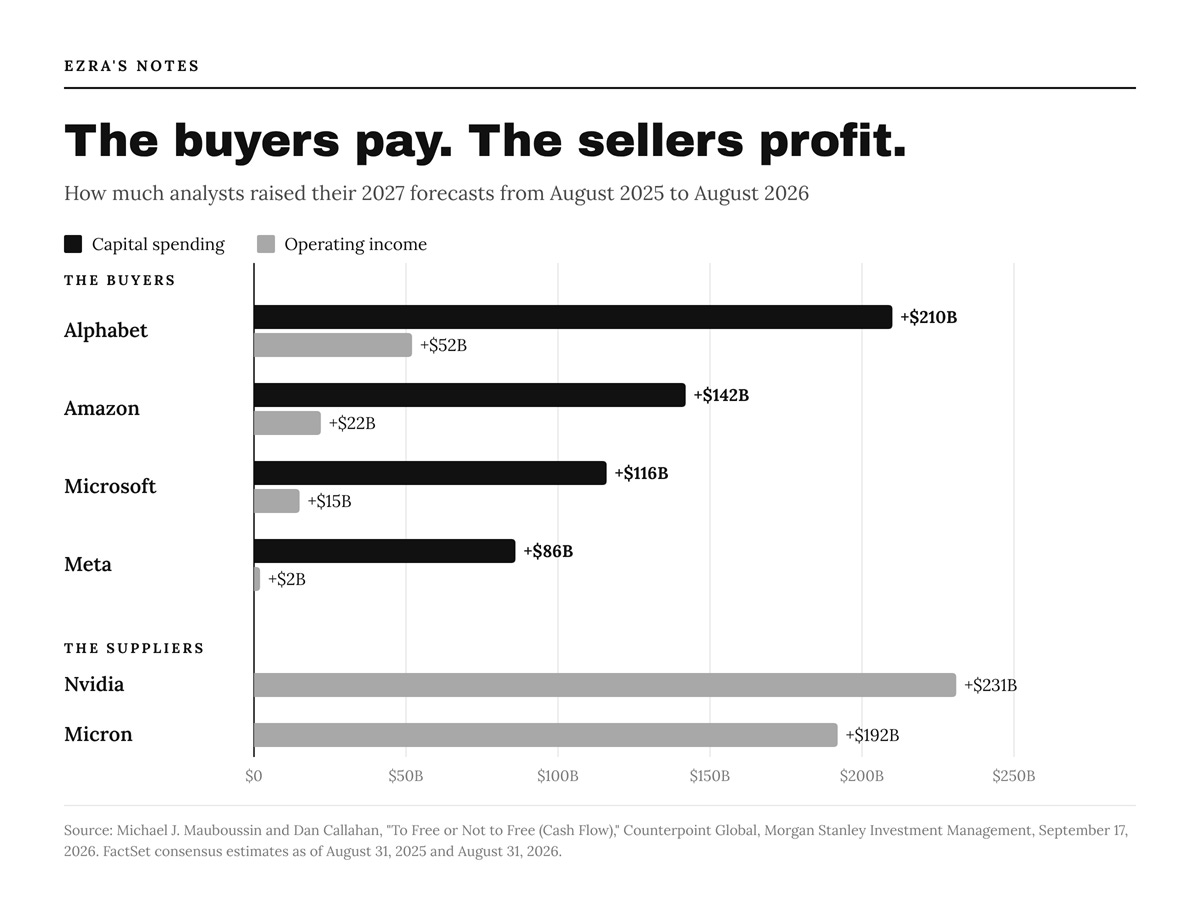
Alphabet, Amazon, Meta and Microsoft plan nearly $800 billion of AI infrastructure spending, testing whether incremental returns can stay…
It's fascinating to me that the best capital allocators in the world ( $AMZN, $GOOGL, $TCEHY, $MSFT) with clear views of returns and use cases across many industries are saying that AI Capex is their best use of capital, yet everyone is still skeptical.
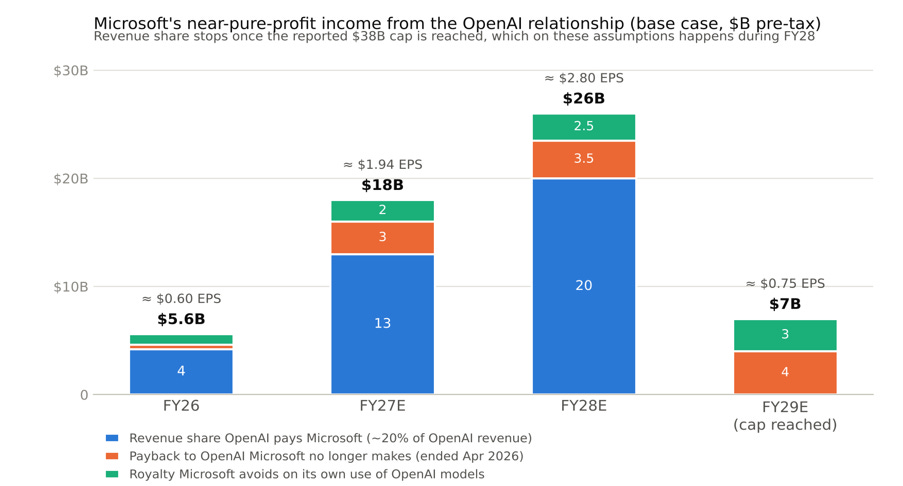
Microsoft booked $24.1 billion from OpenAI in FY2026, nearly a quarter of Azure revenue, raising questions over finite, high-margin…
Also, $MSFT is up 16x since he stepped down as CEO -- hard to argue the business would have done better with him still as CEO. The only benefit he would've gotten from staying is recognition from @chamath and co who are not smart enough to analyze non-business accomplishments.
Feels like the public interpretation is all wrong… I’m pretty sure $MSFT backing out on NScale deal is bullish for Neoclouds like $NBIS or even $IREN with energized capacity with Microsoft? Pretend Microsoft just ate a bunch of Chipotle burittos: - They order toilet paper delivery scheduled Q1 2027 - NScale says: sorry 3-4+ year delay of the toilet paper (into 2030’s) because of UK grid constraints - Microsoft still urgently needs toilet paper so they will get it elsewhere The cancellation does send warnings about what happens if a Neocloud can’t execute on contracted demand. But that just makes the other toilet paper sellers more valuable since Microsoft will go elsewhere for supply.
Who had Hyperscalers accelerating to fastest growth rates since Covid at the same time Anthropic massively decelerates on their bingo card for 3Q26? I think very few 3-6mo ago, but here we are! $MSFT $GOOG $AMZN
Even if the AI model Nubeva Technologies $NBVAF (TSXV: $NBVA) is training to read malware binaries (compiled programs) works, six risks could keep it from paying off: → Labs closing the gap: OpenAI’s GPT-6 Astra nearly doubled GPT-5.6-sol’s score on SRE-Bench, a Columbia University-led test of AI models on reading binaries, within a month of SRE-Bench’s release, and Anthropic says its Claude Mythos Preview model can already reconstruct plausible source code from stripped binaries. The better the labs’ own models get at reading hard binaries, the less they need to pay for outside labels. → Big tech building in-house: Microsoft’s $MSFT Project Ire reverse engineers software files on its own to decide whether they’re malicious. Ire caught only about a quarter of the malware among nearly 4,000 hard-to-classify files in a test Microsoft described in August 2025. But in June 2026, Microsoft said Ire flagged a new malware sample that most major security products, including CrowdStrike’s $CRWD and SentinelOne’s $S, still missed. Google $GOOGL already owns VirusTotal and Mandiant, so the likelier customers are labs that don’t own a malware-scanning site or an incident-response firm already, like OpenAI and Anthropic. → Paid like a contractor: Data labeling companies (firms that turn experts’ knowledge into training data for AI labs) pay 60-70% of what they bill to their contractors, and Scale AI is already recruiting its own malware analysts. So a data labeling company could pay Nubeva by the hour or task, or hire analysts itself, instead of licensing the model or buying the company. → Selling labels teaches the buyer: Every binary Nubeva labels helps the buyer’s model learn the same skill, the reason CEO Randy Chou gave for not patenting how Nubeva reads binaries. So each sale could shrink the edge Nubeva is selling. → Cash and compute: Chou gave no cost for running “hundreds and thousands” of AI agents on a private model. For reference, Nubeva spent $714,772 on R&D in FY2026, equal to 28.7% of its $2.49M in cash as of April 30, 2026. → Missed targets: Nubeva’s AI decryptor builder missed four targets starting in August 2023, so “days and weeks” (Chou’s timeline for the model) is a target, not a result just yet. So even with a working model, Nubeva still has to (1) sign a contract before the labs can read the hardest binaries themselves, (2) get paid for its model and engineers instead of by the hour or task, and (3) fund the training without draining its cash.
AI labs and data labeling companies (firms that turn experts’ knowledge into training data for the labs) could make my $12-19M sale range for Nubeva Technologies $NBVAF (TSXV: $NBVA) look conservative. My previous write-up’s sale comps were five cybersecurity companies buying small startups that detect, stop, or recover from ransomware, and I valued a Nubeva sale at $12-19M, the low end of those deals. AI labs and data labeling companies would widen the set of buyers beyond cybersecurity companies, but I found none that has bought a ransomware recovery company like Nubeva. The closest deals were for a stake in a ransomware recovery company, malware data, and specialist teams: → Microsoft $MSFT: Made an equity investment in Veeam, a data protection and ransomware recovery company, in February 2025, as part of a partnership to build AI-based threat detection and other Microsoft AI services into Veeam’s products. → Google $GOOGL: Owns VirusTotal, a malware-scanning site it bought in 2012, and Mandiant, the incident-response firm it bought for $5.4B in 2022. Its experimental Sec-Gemini model, introduced in April 2025, draws on Mandiant’s threat intelligence data. → OpenAI: Agreed to buy Promptfoo in March 2026 for an undisclosed price. Promptfoo, which tests AI systems for security holes, was valued at $86M after its July 2025 funding round, per PitchBook. → Mercor (a data labeling company): Agreed to buy Deeptune, which builds practice environments for AI agents, in July 2026, months after Andreessen Horowitz led Deeptune’s $43M Series A. The two 2026 deals didn’t disclose prices, and Mandiant and Veeam are far larger businesses than Nubeva, so I can’t put a new number on a sale. Still, my $12-19M range is probably conservative now, since it only counted cybersecurity companies as buyers, and an AI lab or data labeling company would be paying for Nubeva’s engineers and model rather than its ~$500K of FY2026 revenue. But an AI buyer wouldn’t get patents on what it’s paying for. Nubeva’s patents would cover how it recovers files and how it detects hidden encryption, but it won’t patent its binary analysis (figuring out what malware programs do) at all, and CEO Randy Chou explained why: “Anything you patent, that means you have to show how you did it. If you show how you did it, well, somebody can train an LLM to go do it.” So the model is only worth what Nubeva can prove it does, through a signed contract, a named partner, or test results.
Clearly a macro related drop after CPI numbers came out today and further US rate hike anticipation. Since $KOSPI, $SPY, and Nikkei ended up plummeting. There's too many potential second/third order effects that's hard to map due if $CRWV goes down or frontier labs struggle (given contractual obligations). Rate hikes understandably amplifies a lot of those fears. But I do think everything getting sold off together presents opportunities. If $LITE has take/pay contracts + sold out until 2029 for lasers and is being financed by hyperscalers for 2031 demand. The demand visibility + financing (with counterparties like $MSFT or $AMZN) are too solid that I wouldn't bunch companies in the optical sector together (that already have cash on hand via ATMs or private placement). With a neocloud that requires billions in future toxic financing in high rate environments. I think markets will eventually distinguish nuances from actual profitability, financing, and long term demand sustainability rather than just treating everything as one "bubble".
Memory fundamentals are still very strong (stronger than Q1). $MU CEO: - "We expect memory and storage supply demand conditions to be much tighter in fiscal 2027 and 2028 than they were in 2026." - "We do not have line of sight to when supply and demand will return to balance." Back in July, $NVDA supply commitments rocketed from $119B -> $279B which was "primarily related to the procurement of memory", with ~$175B of commitments for 2028-29... $MU also said that >75% of FY27 output is already committed + "a majority of discussions with our customers today are already around 2028." So as a reminder....ultra long-term demand visibility in the context of the memory market. Samsung’s Q3 prelim last week was 107.4T Won O.P. on 195T Won revenue: - So that's ~55% margins company-wide. - Micron did 87% GM in their most recent quarter - $SNDK 84.6% GM. All accelerating/stabilizing margins as of their most recent fiscal Q's. Mass production from new capacity (from Micron, Samsung and SKHY) is also not expected to come online for quite some time. In other words, the shortage will intensify next year at least. Then long-term contracts solidify long-term earnings further via price floors + committed volumes: - $MU with 26 SCAs worth >35% of revenue through to 2030 with some now running into 2031. - $MU CFO: "even at floor prices, we expect margins meaningfully above any prior cycle peak margins." - $SKHY has ~10 LTAs of ~5 yrs w/ pricing structures "designed to respond to price fluctuations." - Sammy (as of recent reporting) holds ~70% of memory capacity under LTAs until 2031 with $MSFT, $NVDA and $GOOGL, with ~25% of contract value prepaid. - $SNDK also has their "New Business Model" agreements with 8 customers that lock in ~66% of fy28. Then on buybacks, $MU will step up returns from December - "over time, we expect to return 100% of our excess cash." Just crazy how much cash these companies are bathing in rn. Obviously there are risks, mainly with positioning and sentiment towards the AI trade currently - thanks to macro/ARR fears/pacing talks/other stuff I'm probably forgetting rn. China is ofc another risk with CXMT but I don't see how they'll be a massive problem for HBM / US hyperscaler RDIMM where they'll continue to face US restrictions + massive qualification walls imo. But ultimately, memory fundamentals are in-tact and very strong. Stronger than Q1.
Sure... Random train of thoughts on markets now, optics like $LITE / memory + $IREN / Anthropic. On Memory: - Demand visibility on $MU / Samsung / SK Hynix extend into 2030-2031. Samsung has LTAs covering 70% of their capacity into 2031 (likely with SK Hynix type price floors)... and their operating profit is already absurd. There's a consensus that shortage in 2027 will be much more severe than 2026... Even $SNDK expends gross margins to exceed 80% entering 2030. You're going to hear Acer and other CEOs that want memory prices to go down cite bear cases like CXMT/YMTC, and Chinese players. But just looking at supply procurement that $NVDA is doing + hyperscalers, demand visibility is absurd for the next 5 years. And by that time, cumulative FCF coming in from these take/pay + pricing floor contracts might exceed some of their entire marketcaps so it feels like there's some baseline. Near-term is always volatile (IV dropped a ton across $EWY to $DRAM to $MU), so people with call options likely got nuked, along with underlying prices. But if Samsung is 3x 2027E, has 5 year LTAs with 70% of capacity committed from hyperscalers, and price floors, it's kinda hard to see these names suffer a sustained crash... For optics: - $LITE is literally sold out into 2029, starting discussions into 2030. With demand visibility lasting into 2031… with hyperscalers largely funding the capacity buildout. Their 2028 Greensboro fab expansion was ~$5B in UHP laser capacity revenue alone, yet it’s basically allocated toward $NVDA (50%+ with options for more) and co from channel checks. Existing supply chain bottlenecks are extremely severe as optical content/XPU skyrockets entering 2027-2028. So everything from DSPs/TIAs, photodiodes, lasers, InP/SOI substrates, wafers (epi, SOI, etc) are expected to go brrr. And what does that imply to anyone else with enormous amounts of capacity coming online like $AAOI + $SIVE + $MTSI capacity expansion in 2027? Or other players like Sumitomo / Furukawa? But again it's not quite the same situation as memory since the BOM % is extremely low in a cluster... If micron/samsung raised another 2000% hyperscalers would go bankrupt. But doing that for InP substrates seems possible. Or a 100% increase on CW laser content. I actually thought $LITE was overvalued at $100B+ MC, relative to capacity expansion on your smaller optical players to their respective MCs. So I chose to position accordingly (But lumentum does deserve premiums for demand visibility). For the companies leading the charge like $NVDA / $AVGO / $MRVL: - Nvidia has 70% forward revenue growth FY2028 which is supply constrained growth. - Broadcom 100% Y/Y for 2027/2028 which is also supply constrained growth. - Marvell FY2031 upgraded guidance to $70B-$90B from $46B analyst projections... They all seem to be very happy.... and read through on demand for next 2-3 years is enormous (also echoing what $INTC CEO said today on the panel with $AVGO CEO). So you have overwhelming growth on memory + photonics + from the leaders... But the nuance is not everything in the AI supply chain get the same economic benefit. HBM/Laser/CPU/MLCC and other players in the bottlenecks look to be printing money. And seem to be the largest beneficiaries of the current bottlenecks. Test players are also getting price hikes + capacity allocated by players like $NVDA, but economic impact seems a tad lower than other players since forward P/E for many I modeled were still in the 45x+ range even if you hiked prices like 10-30%. As for capex intensive players... there's some like $IREN ($25-30B for 2027) that despite a deal with Anthropic ended up dropping. I don't think markets seem to appreciate players spending a lot of money + ongoing financing (think they're like halfway through their $6B ATM). Just some hopium for $IREN investors, $NBIS also signed a deal with $META at the start of the year (but markets didn't care at all, since Nebius dropped to ~$70-80 at the lowest point?). But did 6 months later, as the time to revenue inflection gets closer and you're past the ATM/capex window, markets would likely care more. I don't think it's irrational but at the same time, the fundamentals have improved from Mirantis acquisition to others. I also think it was known for awhile it was either OpenAI/Anthropic from CEO comments earlier too? But either way to be a more risk-off environment where funds seem to be rotating to larger names as a flight to safety. $CRWD / $PLTR as just two example, but my take is that the valuations of these rotations are reaching clown levels. And that certain AI supply chain beneficiaries in comparison are undervalued now. I was thinking markets would just rotate to names that are extremely profitable like Samsung or names that have <2X P/E, so it was surprising to see $KOSPI and some legacy memory players get sold off today. Since all of this is colliding with uncertainty about sht macro environments and renewed sustainability concern of AI capex/commitments from frontier labs like OpenAI/Anthropic from due to that FT piece recently. I've always been sounding the alarm about the contractual backlog OpenAI has with $CBRS, $MSFT, $ORCL and others earlier in the year. But OpenAI did just raise $122B or so , so I don't quite think they're at risk of going down anytime soon. I also don't think overall capex can just exponentially go up, but even if it stalls / hovers around a certain point or even drops... Capex toward certain areas like optics will still explode as hyperscalers fight over allocations when CPO scale up comes about, but might drop in others where more capacity comes online like test or DRAM. So it's a lot more nuanced than capex down = everything down or vice versa. I also slightly agree with community agreements that open weight models wouldn't lessen demand on AI infrastructure (otherwise $NVDA wouldn't be funneling funds into Reflection), but all the contractual obligations that Anthropic has might get messy if their models/company get cannibalized. Either way, I'd expect some of these frontier lab valuations to likely compress but I do think Jensen knows what he's doing though to avoid contagion. But basically: - Extremely difficult market now, can't just throw money at any AI supply chain company like $GLW and expect it to go up. There's cause for concern of rate hikes mixed with financing per $AVGO CEO but not to the point you just blindly sell off everything. Also I think markets are stupid and ties baskets together so that leads to mispricing + individual buying opportunities with certain chokepoints too. If capacity + demand is visible and forward p/e compresses like $AAOI to single digits off hundreds or thousands of percent growth from hyperscalers off $471m transceiver revenues and hundreds of thousands of monthly ELSFP capacity. Or $SIVE coming online with 100M+ laser capacity + multiple foundries with ASP hikes on lasers. I wouldn't lump them into other AI supply chain names in IP like $RMBS or others. My take is that AI supply chain beneficiaries with closer inflection points, demand visibility, and forward P/E compressing due to economic leverage would likely outperform medium term despite current volatility. TLDR: - Memory strongest risk/adjusted return with LTAs + pricing floors extending to 2030's + buybacks. - My opinion is that optical supercycle for 2027-2028 with CPO/NPO is going to look absurd relative to capacity coming online of smaller suppliers. - Overwhelming fundamentals/growth colliding with sht macro + media scares - Markets are stupid and groups things in baskets and sells them all off together or buys overvalued names, creating short/long opportunities I'd give a prayer to people on short term options given underlying drop + IV decline, but there could be a reversal... who knows. Most valuable thing right now is time.
Letters that discuss MSFT.
Companies the stories above are also about, besides MSFT.
