
Ian Bezek on X
@sigmazerocap I own a small position in $CRM (thankfully lower cost base), and no $META, so $CRM it is. Clicks results. Wow, guess CRM is going up another 25% next quarter. Love when everyone is positioned wrongly.
NASDAQ
META
218 stories
$1.6T Market cap · 2026-10-28
@sigmazerocap I own a small position in $CRM (thankfully lower cost base), and no $META, so $CRM it is. Clicks results. Wow, guess CRM is going up another 25% next quarter. Love when everyone is positioned wrongly.
The AI build is moves more aggressively off the balance sheet Convequity’s debt scan across $MSFT $AMZN $GOOGL and $META: what these companies borrow in public is rising slowly. What they have promised to spend later — leases not yet started, equipment orders, contracted compute — is rising much faster. In 2Q26 that gap is the widest in four quarters. Off-book commitments are running toward +316% year-on-year. On-book debt is barely moving. If you only watch headline borrowings, you miss the cycle. MSFT is the clearest case. On-book debt +15% YoY. Off-book commitments +138%. That is why its all-in financing load is about 17x reported borrowings. Microsoft is under pressure from two sides: shareholders who want more AI spend, and shareholders who want less capex and faster returns. The compromise is to slow the capex it puts on its own books and lock in capacity from $IREN, $NBIS and other neo-clouds instead. How that works: IREN or NBIS borrows, builds the site and owns the chips. Microsoft signs a multi-year contract to pay for the capacity. Microsoft does not put the building on its balance sheet. It takes a future bill — rent and service payments that show up later as operating cost. Asset risk moves to the neo-cloud. Payment risk stays with Microsoft. GOOGL looks similar on a multiple and is doing something different. All-in commitments are 10.2x borrowings: $100bn of headline debt, $121bn including leases, $902bn off-book. $811bn of that off-book pile is purchase orders for its own stack — TPUs and the kit around them — not rented neo-cloud sites. On-book +190% YoY. Off-book +836%. That multiple is Google buying the factory, not renting it. META is closer to Google than to Microsoft: on-book +127%, off-book +680%. Some of Meta’s orders are reserved compute from CoreWeave and Nebius, which Meta will expense as it uses the capacity. Most of the pile is still Meta committing to build and buy for itself. AMZN is the most balanced of the four (+59% on-book / +80% off-book). Both lines are rising together. If the cycle breaks, Microsoft is less stuck with buildings and chips it owns. It is more stuck with bills it already signed. Google is more exposed because more of the capital is already spoken for on its own account. If compute gets scarcer, the extra megawatts IREN and NBIS have not yet sold can go to whoever pays more. Microsoft then has to wait or pay up. Because it owns less of the physical stack, it has less spare capacity it can simply switch on — which means higher compute costs and tighter margins. Powerful cycle. Not a broad bubble. The heat is in the promises, not the 10-Q debt line. Full AI Bubble Barometer available at Convequity.
How many $META users do they really see being willing and/or able to pay $200 per month for Hatch? I’m pretty good at ordering Doordash and scrolling Reddit on my own thank you very much https://t.co/2Oyf2hoyw4
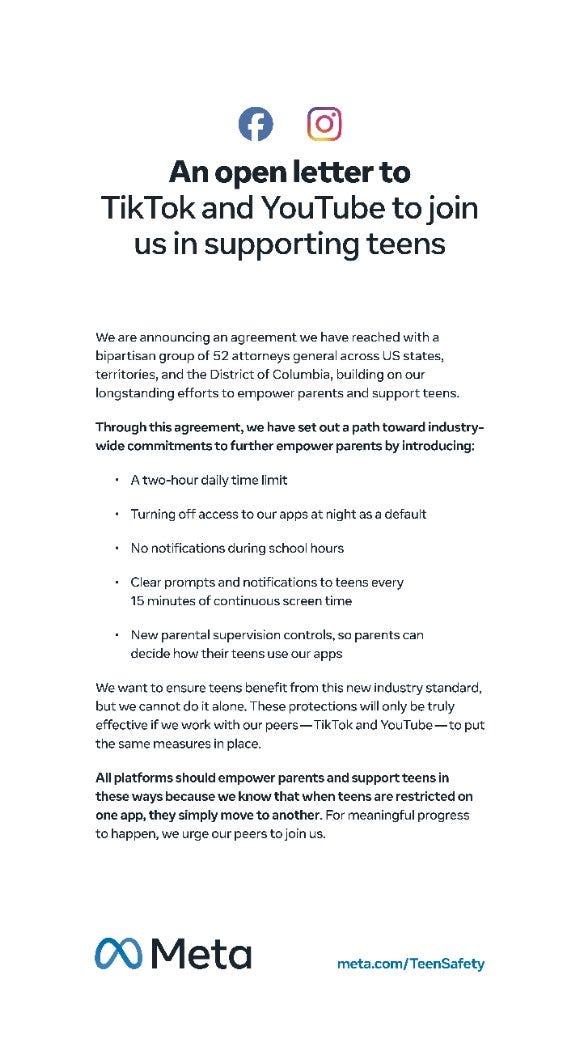
Meta’s $18 billion teen-addiction settlement makes $5.3 billion contingent on YouTube and TikTok adopting matching restrictions, while…
$META has been pulling back on their Anthropic spending a bit this summer but is still spending hundreds of millions per month "Nat Friedman, Meta’s head of A.I. product, has told some employees that if Meta uses only its own coding tools or ones from OpenAI, it could lower Anthropic’s revenue before its public offering, the people said." -- NYT Curious what the S-1 will have to say about this
*META COULD SPEND UP TO $10B/YEAR ON ANTHROPIC AI: NYT So $META is like 15%+ of Anthropic's ARR? "At one point this year, Meta internally projected that it could spend as much as $10 billion annually on Anthropic’s A.I. models, said two of the people, who declined to be identified discussing private information. That would have formed a major chunk of Anthropic’s yearly revenue, which the start-up estimated in July would pass $65 billion." - NYT
META AGREE TO SETTLE CLAIMS THAT PLATFORMS HARMED CHILDREN -- COURT FILING Does this mean $META can finally go up?
META, STATES HAVE DISCUSSED SETTLING TEEN SOCIAL MEDIA CASE Possibility of a mid-trial settlement has reportedly been discussed between $META and the 29 states seeking financial penalties worth up to $1.4T
From $SNAP Q2 shareholder letter: In scheme of things, the stock barely budged. How much would $META or $AMZN be up if Zuck/Jassy had said the same exact thing? Hint: they would be up many multiples of $SNAP's entire market cap. https://t.co/8QeDQq1LFy
$META prepares to launch consumer AI offerings https://t.co/cB3kWOricw
Meta’s 2022 selloff bottomed near $90 after Apple privacy changes and metaverse spending.
@Mike10947310 This is the comp set for those looking to do more work. $APX was not always a market pariah and, at one point in time, traded at 5x sales. In the unlisted space, $META bought comp ScaleAI at over 10x revenues this time last year. https://t.co/p91qIkSPgL
The question needs to be asked: Why haven't $META and $GOOG done more to control the narrative around data center construction? They literally can amplify whatever news, posts, and videos they want. We've learned that. Don't tell me they've learned their lesson about meddling (there's a $1T+ court case ongoing that tells me otherwise). Instead we're hearing narratives about China and Tiktok, when two MAJOR AI players own the pipes that serve every other social media post and video in this country. It's a strange set of circumstances. Would $GOOG and $META benefit if @AnthropicAI and @openAI go through the windshield? Of course, but it's not obvious how a backlash against data centers helps these hyperscalers otherwise. Thoughts?
The $3T “hidden AI debt” number is not the story WSJ just put a headline on the shadow capex we’ve been tracking for a while. Purchase commitments + leases that have not started. Most of it never hits the balance sheet. The $3T is real. The interpretation is not. Add the explicit debt-like items on the books of $GOOGL $MSFT $META $AMZN and you get ~1.69x. Widen the definition to implicit / off-book instruments and it can balloon to 8.36x — approaching that $3T figure. That is the chart. It is not the economics. 1. Most of this is contract value, not a hard legal obligation to pay. A lot of it is pay-as-you-go. The commitments they actually have to fund already sit on the balance sheet. 2. The implicit load is shared. It is spread across financial players — private credit and equity — who are underwriting the build. Their IRRs are not insane. Current ROIC on this spend is still high. This is not a bubble from here. 3. AI ROIC can compress later. I would not be surprised. Near-term it is more likely to stay elevated or even rise. Compute is still short. Efficiency gains are raising, not lowering, the value of each incremental GPU-hour. 4. What the hyperscalers are actually doing: paying a bit more, accepting a slightly lower margin, and sharing a slice of the economics with investors who want the risk. That is risk offload, not hidden leverage. The cleaner setup is still the player that can keep building more capacity internally without leaning as hard on this structure. SpaceX is the extreme version of that. It also means more profit pass-through to the specialized GPU clouds sitting in the middle of this: $IREN $NBIS $CRWV and others. The $3T is a real number. Treating it as imminent balance-sheet stress is the wrong read. Pictures below are snapshots from our AI Bubble Barometer.

Hyperscalers’ off-balance-sheet lease and purchase obligations rose from roughly $1 trillion to $1.5 trillion, turning the AI buildout into…
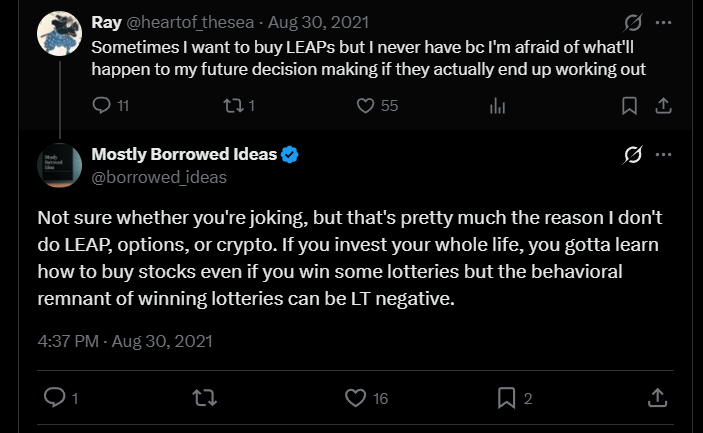
Options strategies will manage portfolio risk after Meta, Alphabet and Amazon calls drove gains, while Lululemon LEAPs produced an 80% loss.
Some interesting credit stats: > Hyperscalers are now ~20% of the entire 30-yr IG bond bucket > ~40% of all 30-yr IG deals this year came from hyperscalers > $AMZN and $META each make up more than 5% of long-end bonds individually
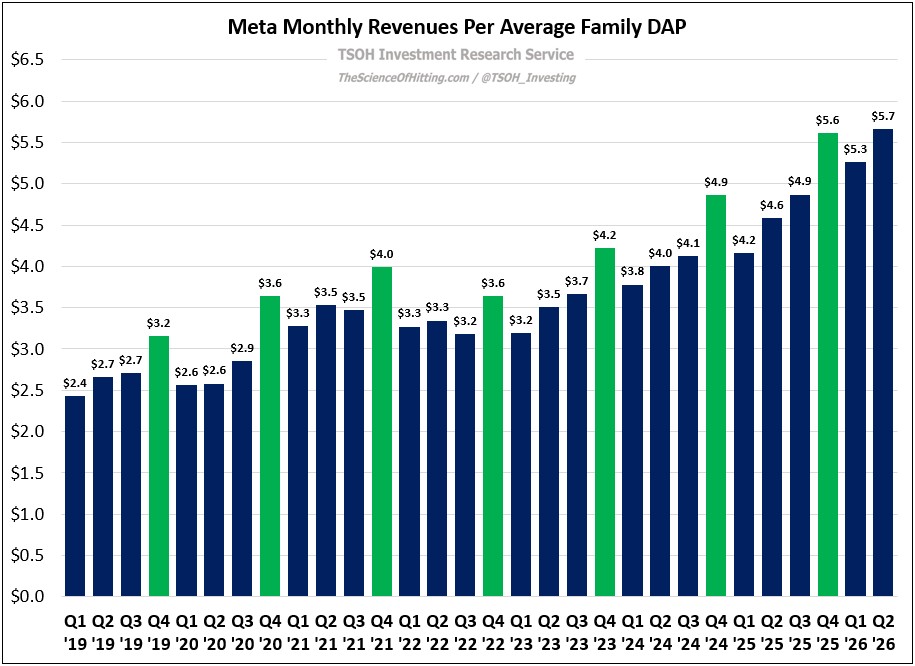
Meta is again prioritizing long-term investment over near-term profitability, testing investors’ trust in Zuckerberg as the company’s…
@dalibali2 $META $AMZN $HONA $PM $COF $GSHD $523A.JP
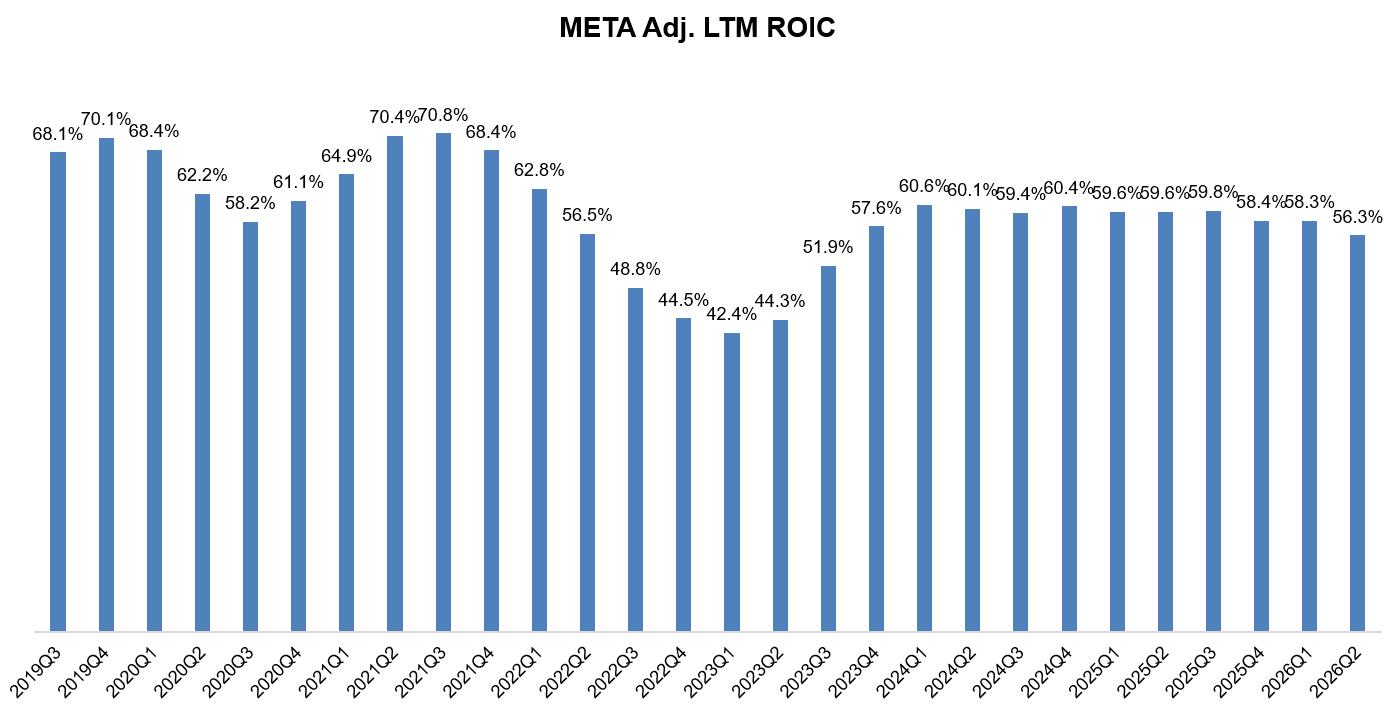
Meta’s adjusted LTM ROIC is in the mid-50s after excluding $80 billion of construction in progress; that capacity will lower returns as AI…

Meta's Q2 advertising revenue rose 27% to $59.4 billion, while costs climbed 55%, cutting operating margin to 31%.

Meta's 2Q26 revenue rose 27%, but capex, depreciation and nascent cloud and AI ambitions raise margin and return risks as it maximizes…

Meta’s $140 billion 2026 capex plan pressures earnings while it bets on AI products and cloud sales to monetize excess compute before…

Meta’s Q2 2026 revenue beat was offset by one-off costs and softer guidance, while generative ad ranking lifted conversions and Family of…
Letters that discuss META.
Companies the stories above are also about, besides META.


