New Ask Claude or ChatGPT about any stock, using Bullpen. Bullpen in Claude or ChatGPT. 7 days free

Monday, September 28

Monday, September 28, 2026

Everything we published on this day.

71 stories — the front page that day →

@aleabitoreddit

Serenity on X

Everyone is asking "Where is Serenity" or "Who is Serenity". But nobody is asking... "How is Serenity"? I do read things from $AMD $8.2B acquisition of World Labs... but feeling pretty sick right now, so taking a little break. I remember saying physical AI + world models would major shift way back when, so maybe I should have invested in private companies at the time... Apart from that... other interesting news: - Some channel checks from ECOC was that $NVDA apparently secured 50% of $LITE Greensboro UHP laser capacity? And possibly contracts that allow them to secure the remaining capacity per Barclays. That's $5B in lasers (annual capacity)... so it's hilarious to see Nvidia go out and bottleneck the rest of the industry by doing this. But this just puts more strategic value on other merchant laser suppliers + more visibility for Lumentum. It's kinda game theory over allocation, since if you secure all the HBM, lasers, and others it inadvertently makes it much harder for competitors to scale their programs. - Then there's your massive $150B Nvidia authorized buybacks (just look at $AAPL when they did buybacks..) They're printing too much. - What's also interesting is that Samsung Electro-Mechanics is expanding their FC-BGA substrate capacity today... but customers are the one funding this. I also remembered $MRVL in SEC filings cited large body substrates as one of the core bottlenecks of their program (alongside $TSM sole source dependencies). So they also went out and did some other expansion agreements with related companies like AT&S recently. - OpenAI delaying Astra-6.1 October release over safety concerns just now. Nvidia also happened to launch an AI safety platform. I don't think this is meaningfully bearish that the models are just getting 2 good.

Agentic AI: Winners and Losers

Meta’s Muse reached 3 million downloads and 700,000 daily users within 10 days, with forecasts of up to $28.5 billion in annual revenue…

The Week Ahead

Micron’s November revenue guide will test whether an 86% gross margin reflects a structural memory shortage or a cyclical peak, while…

@leevalueroach

Lee Roach on X

The management team running $SGA is filled with idiots. These guys took 50 years to realize that radio was dying and then they decided to switch to a digital first strategy. And guess what their digital strategy is? Search and display ads for websites. Idiots. Probably something that is going to die faster than radio now that AI exists. CEO lives in Florida and calls Saga the greatest media company in the world. It’s deep value here. But you need an activist investor so bad. The board is filled with guys who probably still use a fax machine and use Outlook for their emails. Some really ancient guys running this company. Some would say the most ancient.
@convequity

Convequity on X

The $PLTR and $NVDA work on Nemotron, NVIDIA's open model family, is still under the radar, unlike partnerships that promise more than they deliver. In our view it could be industry-transforming, because each side needs the other: Nemotron is the Western open model that fits, and Palantir is the only vendor that can put a model into an enterprise securely, safely and privacy-first, and limit it to what each person may see and change, which is why AIP, Palantir's AI platform, took hold and why NVIDIA needs Palantir. Palantir has no proprietary model and leans on closed models from OpenAI and Anthropic. Chinese open models are almost certainly off the table for a U.S. government contractor. On August 26 Jensen Huang said every major company needs its own proprietary AI, and open models make that possible. On June 29 Palantir launched an engine that runs custom Nemotron models for U.S. agencies and critical industries on networks cut off from the outside. The customer can train this American open model further on its own data and keep the weights, the trained model. On September 10 they announced a supply-chain stack, first on NVIDIA's own supply chain. On July 14 NVIDIA said other companies already specialize Nemotron for their own domains. The test is whether that stack moves from NVIDIA to named customers in manufacturing, energy, healthcare, automotive or aerospace.
@convequity 1 click

Convequity on X

An optical circuit switch never converts the light. A conventional switch takes light in, turns it into electricity, makes a decision, turns it back into light. An optical circuit switch steers the beam. The principle in the note: rather than optimizing a difficult conversion step, remove it. Three constraints follow. 1. Power. A 100-terabit-class silicon photonics OCS consumes only 200–300 W, against roughly 6,000 W for an equivalent electrical switch. More than a 20× advantage. The 200–300 W figure is measured with the amplifiers already in place. 2. Rate. The switch is optically transparent, so the same module supports 800G, 1.6T, 2.4T and 3.2T. It does not have to be replaced each time the transceivers get faster. 3. Insertion loss. Silicon photonics currently loses more light in transit than the MEMS alternative, so semiconductor optical amplifiers are added to restore optical power. That adds system complexity. Google buys these switches from optics makers, not from the usual switch-chip vendors. Calient, Lumentum ($LITE) and Coherent ($COHR) supply Google ($GOOGL).
@convequity 4 clicks

Convequity on X

Natural gas itself has not been the scarce input. The turbines have. Once AI data-centre load outran what the grid, renewables, and near-term nuclear could cover on a GW scale, gas became the compromise — and turbine demand surged from 2024–2025. Lead times still run roughly three to five years, with manufacturers already sold out into 2029–2031. That puts the first large batch of those ordered turbines on a delivery horizon closer to the next twelve months. As they arrive, and as behind-the-meter projects sit at or near gas fields, the incremental gas draw is likely to show up in a concentrated window, not a smooth ramp. Storage has grown only modestly while demand has risen, and drilling and pipeline buildout have stayed slow. New customers do not want to wait another three to four years for later turbine slots, so they are also exploring workarounds: reciprocating engines — internal combustion units closer to older, smaller airplane engines than to jets. The tech is not high-end blade metallurgy, so these generators can be mass-produced. They still prefer natural gas (more energy at the same density, and cleaner). Slightly less efficient than a turbine, but available sooner — and still burning gas. Either path concentrates the fuel draw. $AR, $EXE and $CRK are the producers sitting on that timing gap.

On’s Premium Playbook

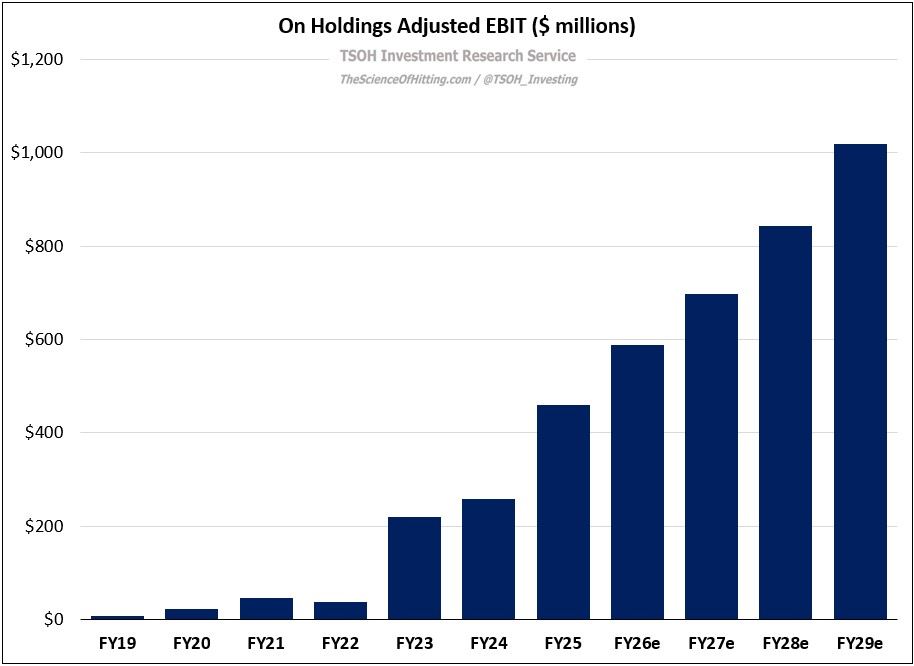
On Holdings targets premium growth through 2029, using LightSpray soccer cleats and higher pricing, with ASPs rising from $145 to $170…