NYSE

Rayonier INC

RYN

13 stories

$5.6B Market cap · 2026-10-23

@leevalueroach 1 click

Lee Roach on X

On timber companies $RYN and $WY. If the long end keeps going up. 6-7% which I think is definitely possible. Then timber companies will get crushed. But my overall thesis remains and is happening in real time: energy-driven inflation, fiscal deterioration, failed treasury buybacks, the Fed losing the long end. Right now the market is repricing duration before it reprices scarcity. This gap can run for decades. Equities were destroyed in real terms through 1973 and 1974. But hard assets won the decade. I’m praying both of these timber companies keep going down. Land is my favorite asset to own. You can see it. You can touch it. You can hunt on it. You can fish on it. And you can grow productive timber on it. Huge swaths of land have massive optionality. Let’s hope Scott “I am the house” Bessent continues to lose the bond market. I want to see a bloodbath here.
@leevalueroach 3 clicks

Lee Roach on X

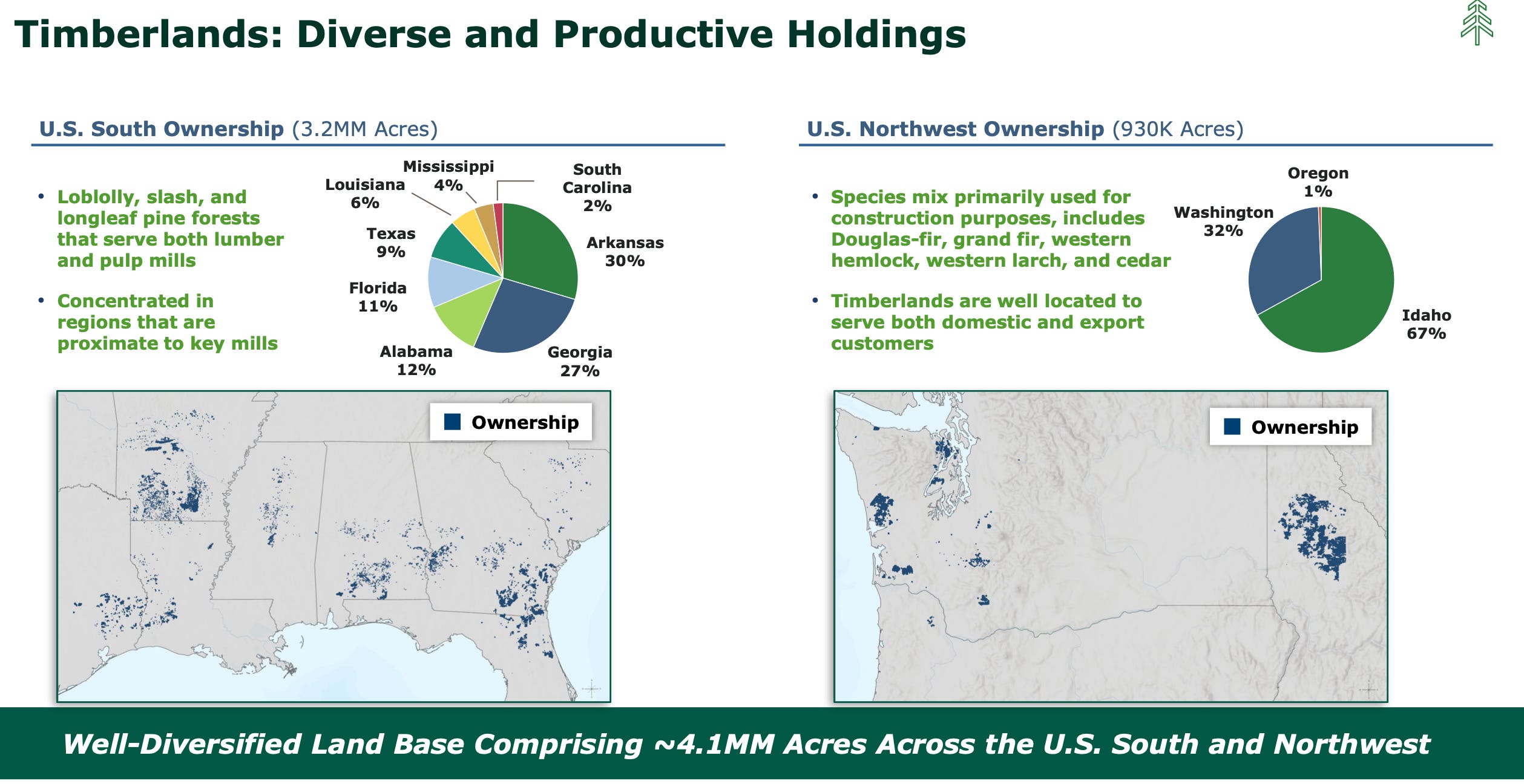
Rayonier $RYN owns 4,003,000 acres across eleven states. Here's what happens when you value everything else on the balance sheet and subtract it. Enterprise value is $7.64B. Market cap $6.19B plus $1.45B of net debt. Now take out the pieces that aren't dirt: Six sawmills and a plywood mill, $1.0B. Cross-checked two ways. Replacement cost runs ~$700/MBF on 1,155 MMBF of capacity. Mid-cycle EBITDA of $175M at 6x gets you the same place. Three master-planned communities, $482M. Wildlight north of Jacksonville, Heartwood next to Hyundai's $7.59B plant in Georgia, Chenal Valley in Little Rock at 70% sold out. DCF'd at 12%. The rural land program, $650M. They sold 7,490 acres at $5,439 last quarter against a portfolio the market marks at $1,447. That 3.7x spread on ~30,000 acres a year, decayed and discounted over a 13-year runway. Solar options on 77,000 acres, $125M at a 25% conversion assumption. Carbon storage across 154,000 acres, $80M. Smackover lithium, $30M. Real geology, ten cents a share. The below-market debt mark, $130M, audited on the balance sheet. That leaves $5.14B for the timberland. Now subtract the trees. 188M tons of standing merchantable inventory at current TimberMart-South stumpage, with pine sawtimber at $23.34/ton and pulpwood at $5.40, is $3.57B. Residual: $1.57B of bare land across 4,003,000 acres. $393 an acre. Cutover land in the South, meaning ground that was just harvested with zero merchantable timber on it, transacts between $1,200 and $1,800. Three marks you can check yourself: In August the company sold 36,000 Washington acres at $4,028 and bought 57,000 Texas and Alabama acres at $2,561. Same month, same management. They paid 77% more than the market credits them for what they already own. Morgan Stanley's fairness opinion produced $47.55 to $55.80 on a DCF and $20.85 to $25.20 on trading comps in the same document. The stock is at $20.81. That gap is institutional cost of capital at 7% versus public equity demanding 9 to 10%, applied to an asset with thirty-year cash flows. Management bought back 4.9M shares for $103.5M in H1 and repaid a $200M term loan with cash rather than refinance it. I built the whole thing a second way, from transaction comps by state instead of tons and dirt. $31.80 versus $31.66. Bear case marks the entire South at $1,700/acre, puts the mills at a trough multiple, converts solar at 15%, and still lands at $24.74. Every case sits above the current price. One caveat I'll state myself: the $393 assumes rural HBU is a separate asset. Treat it as embedded in land value instead and you get $555. Still under cutover. The conclusion holds either way. Full work, every input shown, plus the part about the debt structure that I think almost nobody is modeling, linked below.
@leevalueroach 1 click

Lee Roach on X

Owning timber REITs here seems like a no brainer. $RYN has an enterprise value of $7.4 billion. They own four million acres. You are buying this for $1,817 per acre. That is dirt cheap. Find me anywhere else you can own a large swath of land for $1,817 per acre. You can’t! The public market will punish RYN for owning a large amount of land. Lower valuation and will call it a value trap. But imagine the optionality of owning this large amount of land. Texas Pacific Land owned a large amount of land and look what happened to their stock price. One of the best performers ever. I’ve done well owning land banks. This one pays a fat dividend. Rare. Market is asleep at the wheel with their pants down and drooling.

Investor Letters

Letters that discuss RYN.

Tickers on this page

Companies the stories above are also about, besides RYN.