
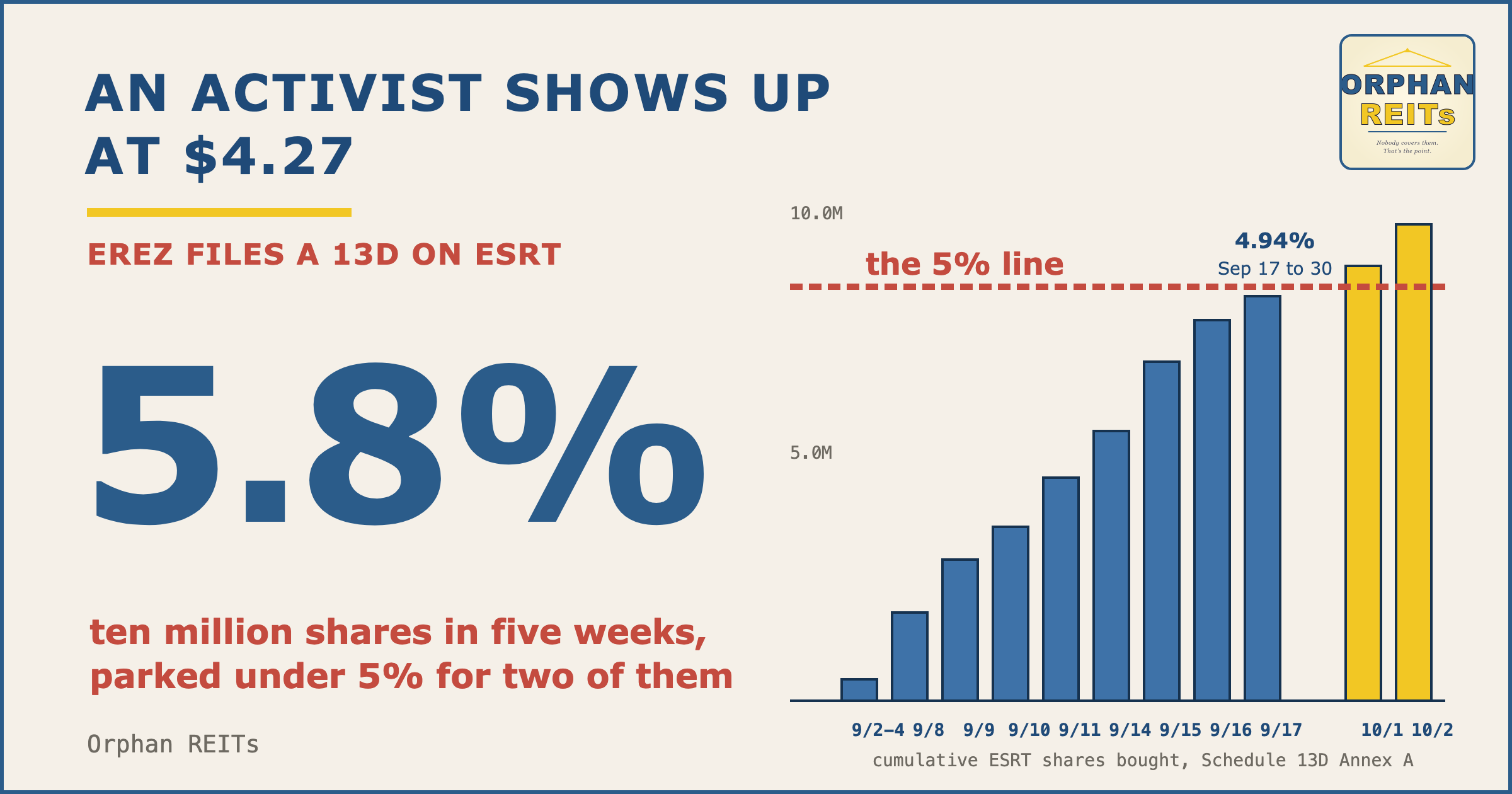
An Activist Shows Up at $4.27
Erez Asset Management bought 5.8% of ESRT at $4.27 and urged a potential strategic review of some or all assets.
Monday, October 5
Everything we published on this day.
83 stories — the front page that day →
Erez Asset Management bought 5.8% of ESRT at $4.27 and urged a potential strategic review of some or all assets.
Erez Asset Management built a 5.8% ESRT stake in five weeks and has discussed a potential strategic review with the company.
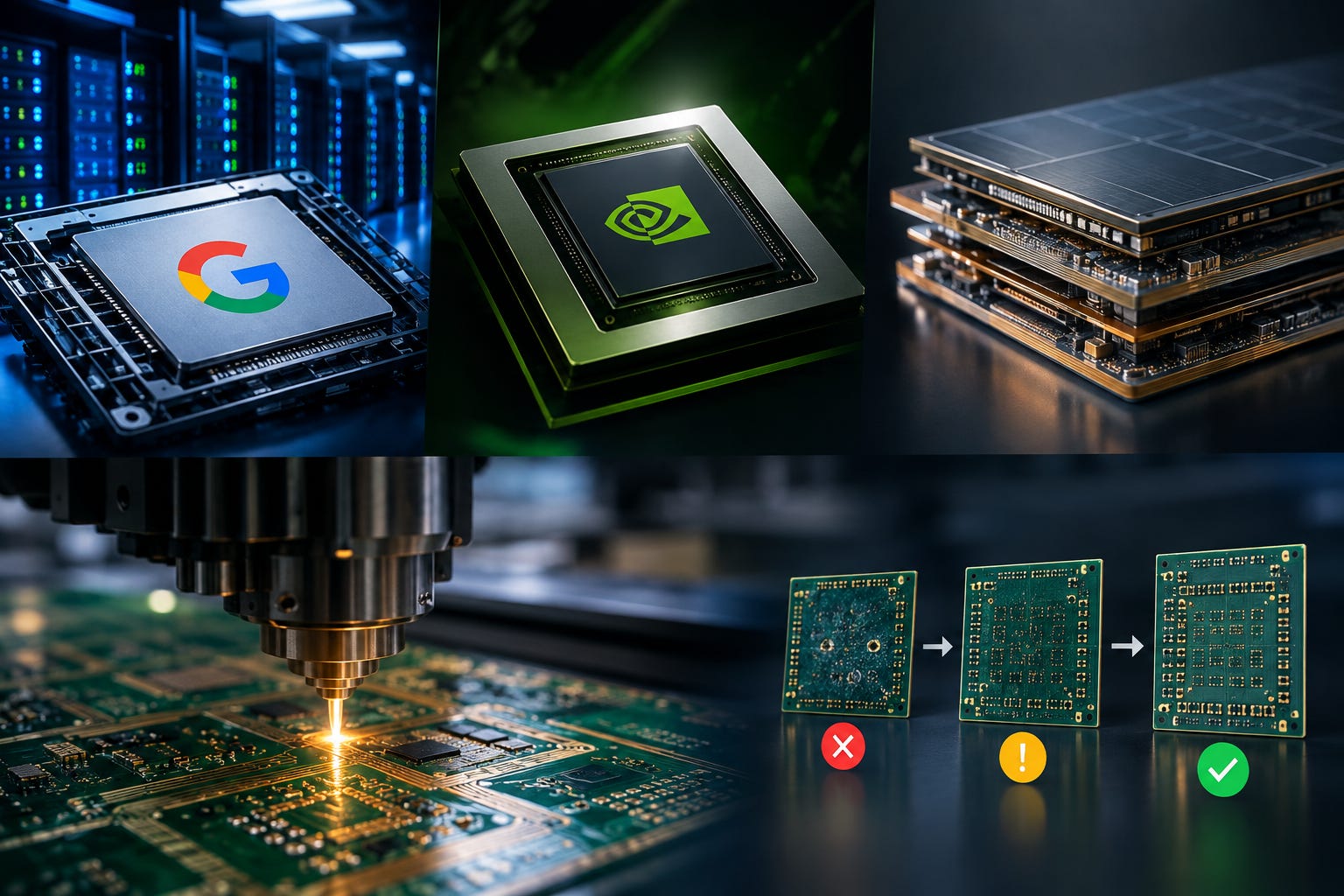
Google TPU and Nvidia Rubin demand are testing HDI PCB capacity, yields, pricing and equipment supply through 2028.
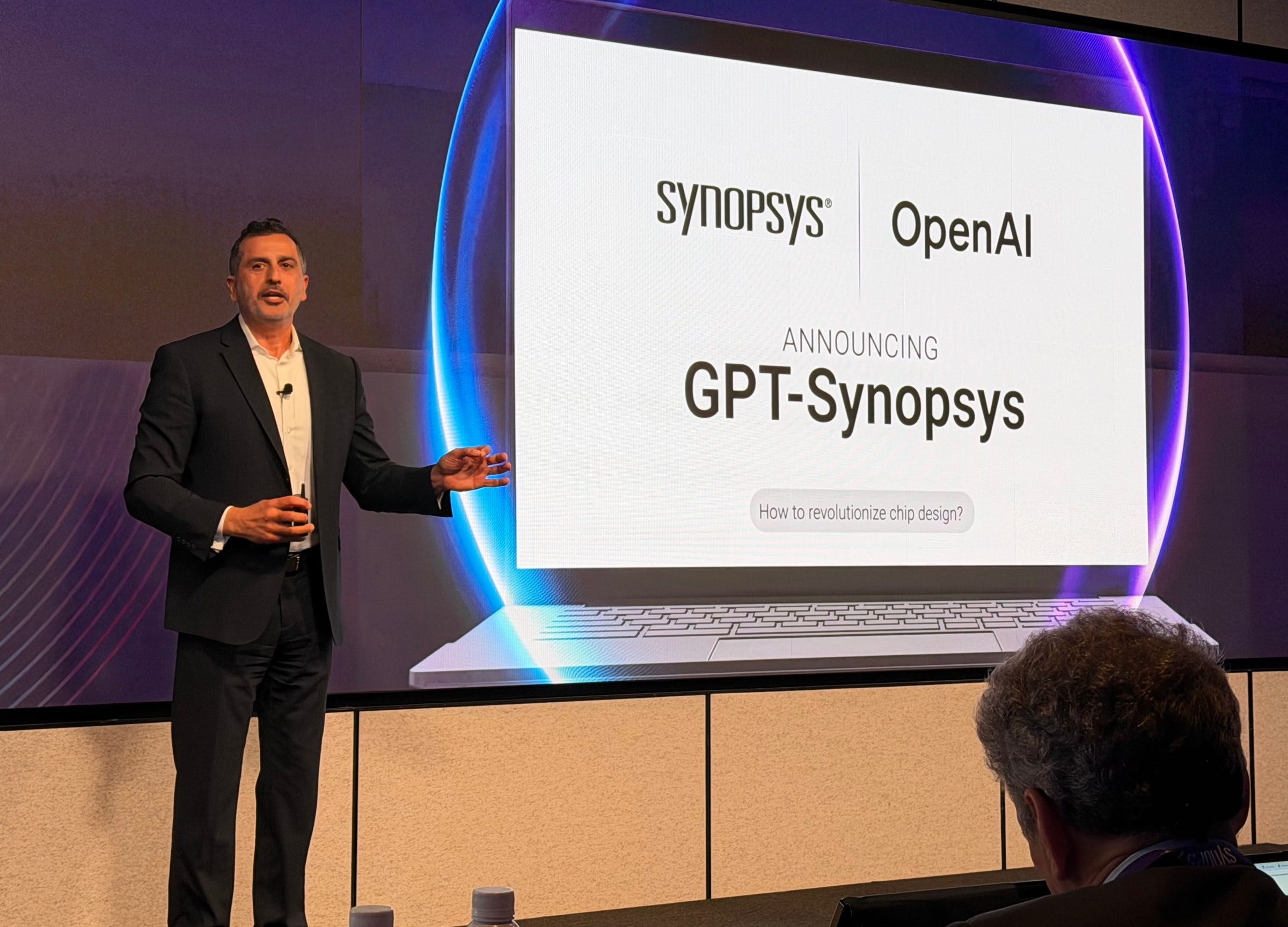
Synopsys and OpenAI will share revenue from GPT-Synopsys, an AI chip-design model built on Synopsys’ licensed EDA tools rather than…

@Blinklebloop I think we’ll go back to regularly scheduled programming now It’s just that ATM was holding $AAOI back for the longest time
$AAOI is... finally... done... With their $600m ATM program, turns out it's ~$105.36 average. I do think AOI outperforms $LITE, as long as they stop filing these ATM programs. Just due to their sheer magnitude of ramp with $471m/month transceiver revenue + 400K/month ELSFP coming up.
Digimarc’s gift-card watermark pilot found zero fraud at Schnucks, while its retailer pipeline rose to 31 from one in 2025 despite…

That last line almost reads like a rallying cry to short sellers. No position but have been watching the founder/CEO fight his way back into the top role. Beyond company specific issues, this has been a tough space over the last year for $BETR, $OPEN, $Z and $CSGP
This is indeed highly unusual. I have seen billionaires get involved in actively buying a stock (Alfred Mann with MannKind $MNKD , Philip Frost with Opko Health $OPK, Harold Hamm with Continental Resources, etc.) but they are usually companies they founded or are deeply involved in.
Links to the podcast on Spotify, YouTube and Apple Podcasts can be found here: $NVDA
We are back for the third season of the The Special Situations Report podcast and kicked off episode 71 with four key stories: 1. An update related to Liquidia $LQDT, a company that we discussed with @Steven_Kiel and @CFAs4CFPs earlier this year. 2. A potential deal for the healthcare technology company Waystar $WAY 3. A sudden CEO departure at the database company MongoDB $MDB 4. NVIDIA’s massive $150 billion stock buyback
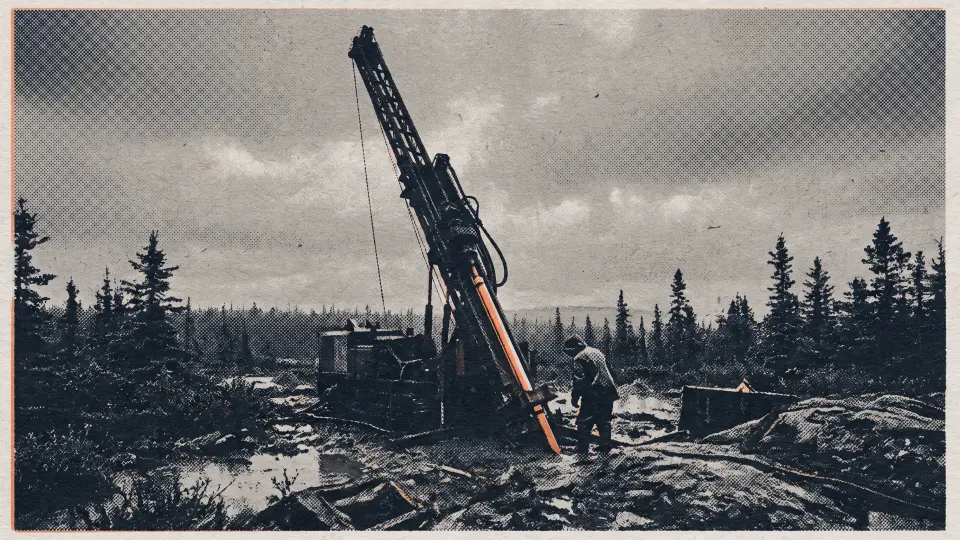
Canterra Minerals increased Lundberg indicated tonnage 55% to 26.1Mt, with 226.2Kt of contained copper equivalent, supporting a Buchans…

Franco-Nevada bought 10.0 million Kenorland shares, a 12.4% stake, for C$22.2 million in a secondary transaction that issued no new shares.

Makes sense when $UUUU revenue is still all uranium, Q2's $25.1M came from that segment. Tho the rare earth product is already proven, ~1.2t of their NdPr oxide became ~3.0t of magnets at South Korea's largest EV drive-motor core maker and passed every qualification benchmark.
@EmmaStockNotes Maybe im stupid but $docu biz model just seems like a shitco to me 😬
@EdgeCGroup $chgg kick em while theyre down
Quick $BRUN 8-K update released today. P.S. Got the info and analysis done instantly via SECSift, then sent to my email! 👀
The restart study due in the first half of October at Levack, the flagship mine of Magna Mining $MGMNF (TSX: $NICU), leaves out a zone where a hole reported in June cut 29.7% copper equivalent over 3.4 meters. Magna found the zone itself. In July 2025, a hole drilled into the footwall below Levack’s No. 3 orebody hit nickel-rich veins. Magna calls the area R2, short for “Rob’s 2,” and says R2 resembles the top of the Morrison deposit, where the nickel-rich veins of Rob’s Zone gave way to copper- and precious metal-rich veins at depth. As of June, R2 spanned ~300 meters vertically and ~150 meters north-south, and all 14 holes Magna had reported hit metal-bearing rock. The June hole’s 3.4 meters included 57.0% copper equivalent (CuEq, which converts every metal into copper at set prices) and 44.3 grams per tonne (g/t) of gold over 1.5 meters. In September, another hole extended R2 ~30 meters toward the No. 3 orebody. The veins are narrow. Magna reports lengths along each drill hole and estimates the veins’ true widths at 30-80% of those lengths, so the June hole’s 3.4 meters could be a vein 1.0-2.7 meters wide (30% × 3.4 and 80% × 3.4). In August, Magna finished a 2950 Level drift (a horizontal tunnel) that stops ~300 meters short of R2. CEO Jason Jessup said on September 24 that Magna plans to extend the drift to R2 “sometime in Q4.” From there, Jessup says Magna could start mining along the veins “as early as Q1 of 2027” and ship the ore to Vale $VALE, ahead of a resource estimate “potentially by the end of 2027.” Jessup says R2 can’t go into the restart study, a preliminary economic assessment (PEA), because it isn’t in a resource estimate yet. Once it’s added, he expects R2 ore to “displace some material in the PEA,” meaning replace some of the plan’s lower-grade tons, since it’s “much much higher margin.” Even after mining 1-2 tons of waste rock with every ton of vein (100-200% dilution), Jessup expects R2 ore to grade “10 to 15% copper equivalent,” 3-4.5x the 3.3-3.4% at McCreedy West, Magna’s producing mine (10% / 3.4% and 15% / 3.3%). Jessup also says “there are no streams or royalties on the precious metals” at R2. Franco-Nevada $FNV, the royalty and streaming company, holds a precious metals stream on two areas of Levack, but the technical report doesn’t publish their boundaries, so for now, investors only have Jessup’s word that R2 sits outside the stream.
The CEO of Nubeva Technologies $NBVAF (TSXV: $NBVA) owns 25.4% of the shares, and a 12% holder keeps buying more. Investing in Nubeva largely means trusting Randy Chou. He’s been CEO since the 2018 listing and sits on the board. Per the company’s site, he built SSL (web encryption) security at Alteon WebSystems, which Nortel bought for $7.8B in 2000. He then joined the founding team at Aruba Networks, a Wi-Fi company started in 2002 that HP $HPQ bought for $3.0B in 2015. In 2008, he co-founded Panzura, a cloud storage company that private equity firm Profile Capital Management bought in May 2020 for $225M, per Nubeva’s July 2023 investor deck. Granted, Panzura replaced him as CEO with Patrick Harr in May 2016, a month after Nubeva was incorporated, and the sale came four years later under Harr. Regardless, every company Chou helped build before Nubeva ended in a sale, and a partnership or sale is Nubeva’s own fallback if AI doesn’t fix its costs. Canadian insiders report their trades on SEDI, and Nubeva’s file since January 2024 has one active buyer. Clayton Davis, an Edmonton-based individual investor, crossed 10% on September 8, 2025 with 7,038,268 shares (10.03%), per the Form 62-103F1 he filed a year later, on September 10, 2026 (the disclosure Canada requires from anyone who crosses 10%). He then made 96 open-market purchases on 46 trading days through September 4, 2026, buying 1,755,797 shares for ~CAD$306K at CAD$0.09-0.26. Net of four small sales totaling 134,500 shares, he now holds 8,659,565 shares (12.34%). Davis’s latest purchase, on September 4, came a week after Nubeva filed its FY2026 results. In other words, he kept buying after seeing the full-year numbers. Chou hasn’t bought or sold in the open market over the same period, and Nubeva’s annual meeting filings list the same 17,797,741 shares for him in 2024, 2025, and 2026. In April 2024, Chou moved 3,630,000 of those shares into a donor-advised fund he still controls, and in a February 26, 2026 interview on Nubeva’s YouTube channel, he said he’d have to pre-announce any sale by the fund.
Q2 2026 was the first quarter of positive FCF at Magna Mining $MGMNF (TSX: $NICU), but only because cash from March sales arrived in April. The quarter set Magna-era records for revenue and cash margin: → Revenue: US$21.5M, after the precious metals stream and higher smelting and refining charges. → Cash margin: Record US$6.4M, or US$1.41/payable lb, up from US$4.3M in Q1. → Operating cash flow: US$6.4M, including US$4.8M of March sales paid in April. → Free cash flow: US$3.7M, even though operating cash flow absorbed US$3.8M of exploration and evaluation spending, mostly at Levack, Magna’s flagship restart project. Adjusted for the US$4.8M of March sales paid in April, Q2 FCF was an outflow of ~US$1.2M, and H1 2026 as a whole was a US$10.5M outflow. At the mine level, McCreedy West (Magna’s producing mine) generated a US$10.8M cash margin in H1 2026, covering its US$3.6M of sustaining capital almost three times over. But Levack, corporate costs, interest, and working capital kept the company as a whole cash-negative. As of June 30, 2026, Magna held US$28.2M of cash. With net proceeds from Alpayana, the Peruvian mining group that bought 19.9% in August, the September deck puts cash at ~US$124M. Magna’s only debt is US$16.9M of unsecured 10% convertible notes due March 5, 2029, a third of which Dundee Corporation $DDEJF, a Toronto investment company, bought. They convert at CAD$2.00/share into 11.98M shares, or 3.8% of the current share count. Magna has funded itself mostly with equity, so the share count rose from 163.4M at the end of 2023 to 313.35M after Alpayana, up 91.8%. Options and share units add more. At June 30, Magna had 12.35M options at a weighted average exercise price of CAD$1.21 and 1.73M restricted and deferred share units. At CAD$2.45, 9.64M of the options are in the money, and exercising them would give Magna ~US$5.1M of cash. Counting the in-the-money options, the share units, and the notes, the diluted count is 336.70M (313.35M + 9.64M + 1.73M + 11.98M).
Revenue at Nubeva Technologies $NBVAF (TSXV: $NBVA) has fallen 76% since 2023, but it still has ~4 years of cash. Since losing Kroll, its biggest customer, Nubeva’s revenue has dropped from its FY2023 high of $2.07M. Expenses fell 66% over the same period, from $4.03M to $1.36M. Nubeva booked $500,586 in FY2026, across three revenue lines: 1) Software licenses ($204,055, 41% of revenue): Attributed in the MD&A “primarily” to NuRR, its ransomware-recovery product. 2) Subscriptions ($90,819, 18%): NuRR, down from $113,356 in FY2025. The December 2025 interim MD&A blamed the decline on fewer customers renewing. 3) Support and maintenance ($205,712, 41%): The last TLS (web-traffic decryption) customer, paying under a source-code and distribution agreement Nubeva kept when it sold its TLS technology in March 2024. Just two customers made up 82% of FY2026 revenue (41% each). While the concentration risk exists, both customers have continued working with Nubeva. The TLS customer has been paying since before the March 2024 sale, and the license customer since FY2025. Nubeva ended FY2026 with $2,489,316 of cash and money-market funds and no debt beyond a $12,262 pandemic-era SBA loan. Cash fell $600,162 over the year, which means runway is ~4 years ($2,489,316 / $600,162) if nothing material changes. CEO Randy Chou didn’t expect Nubeva to burn cash in 2025. In a March 4, 2024 video posted the day the TLS sale closed, he said the sale would make Nubeva cash-flow positive for calendar 2024, with 2025 “targeted to be the same.” Instead, cash fell $457,706 in the 12 months to January 31, 2026, the closest reported period to calendar 2025 ($3,184,879 to $2,727,173). In other words, the TLS sale didn’t make Nubeva self-funding, so the ~4-year runway is how long Chou has to automate support or sell. Even if both top customers churned, cash would still cover ~2.5 years of operations. Nubeva hasn’t raised equity since a CAD$1.59M private placement in February 2022, and the last warrants expired in FY2025, so dilution has been minimal.
Half the gold, platinum, and palladium in ore from McCreedy West, the producing mine of Magna Mining $MGMNF (TSX: $NICU), goes to Franco-Nevada $FNV for $1,200 per gold-equivalent ounce, 29.0% of the average gold price in Q4 2025. Magna inherited the deal, a precious metals stream, when it bought McCreedy West from KGHM $KGHPF, the Polish copper giant. A stream is a deal where a financier pays a miner upfront for the right to buy part of its future metal at a discount to market. Magna’s stream gives Franco-Nevada 50% of the gold, platinum, and palladium in ore from McCreedy West and “certain areas” of Levack and Podolsky, until the deposits run out or 2048. Franco-Nevada pays 60% of the monthly average gold price per gold-equivalent ounce (platinum and palladium converted into gold) from McCreedy West, capped at $1,200/oz once gold tops $2,000. In Q2 2026, the stream cut net revenue by US$3.9M, so revenue would have been ~18% higher without the stream. CEO Jason Jessup called the stream “a bit of an overhang” on McCreedy West, and in April said its terms are “definitely open for discussion” with Franco-Nevada. The higher gold climbs, the more the stream costs Magna, and I wouldn’t count on Franco-Nevada softening the terms. Crean Hill, Magna’s permitted nickel mine, carries no Franco-Nevada stream, and Jessup says R2, the high-grade zone Magna found at its flagship Levack mine, has none either. At Q4 2025’s gold price, Magna kept 64.5% of the value of McCreedy West’s gold, platinum, and palladium (50% + 50% × 29.0%). That means a stream-free ounce from Crean Hill or R2 is worth 1.55x as much to Magna as one from McCreedy West (100% / 64.5%). The stream also covers two areas of Levack, including the Morrison deposit. Franco-Nevada’s filings set the price for its Sudbury streams at $400/oz, rising 1% a year from July 2011, and its later increases applied to McCreedy West only, so Levack’s price would’ve reached ~$460/oz by Q4 2025 ($400 × 1.01^14). So at Q4 2025’s gold price, Magna would keep 55.6% of the value of Levack’s streamed ounces (50% + 50% × ($460 / $4,141.90)), less than the 64.5% it kept at McCreedy West.
Seems I quite underestimated mgmt's turnaround abilities at $QMCO back in late April, despite my deep dive. +370% since! 🤔

$MELI - Long term vision.
@AtlasShrug1 The JV with Sharon AI. Look into that. The PPA gives away 5% equity for the right for $NUAI to buy power from Vista.
Because they are bullshiting everyone. $NUAI

@TarekAntaki I bought $CHTR stock today as well, Godspeed!

When is the correct time to short $ARKG?

𝗣𝗲𝗿𝗰𝗲𝗽𝘁𝗶𝗼𝗻 𝗜𝘀 𝘁𝗵𝗲 𝗧𝗿𝗮𝗱𝗲. It’s funny: most people think the proliferation of information has made finding dislocations harder. I’d argue the opposite. When information was scarce, speed was the edge. Today the problem is information overload. Social media, AI, headlines, experts, hot takes. Just like different news organizations (CNN, Fox, MSNOW) can frame the same political candidate through completely different lenses, markets create narratives that can overwhelm the underlying facts. Every trade is a spread between perception and truth. Merger arb just makes that spread explicit because you have a relatively fixed endpoint (the deal consideration). Regular-way equities are harder because “truth” is a moving target. But you don’t need to know whether $TLN is worth $350, $370 or $390 to recognize when Josh Shapiro and data-center pushback have distorted perception enough to send it to $270. You don’t need to perfectly value every business line of $OWL to recognize when a Bloomberg story has caused the market to paint the entire business with the private-credit apocalypse brush. And it works both ways: $GLND wasn’t suddenly a critical-minerals bonanza because of a Trump headline. Sometimes the narrative creates the overvaluation. Having the best model or talking to the most experts helps you estimate truth. But truth without an understanding of perception isn’t a trade. You can be a little wrong on intrinsic value and still make a lot of money if you correctly identify that the market’s narrative has overshot reality. The edge today isn’t knowing whether something is worth exactly $37 or $39. It’s understanding why it’s trading at $27 in the first place, whether that perception is wrong, and what makes the gap close…
@BitcoinAIGuy @optionology What assets does $NUAI actually own? A few million of real estate in Texas? Why is everyone so bullish on a company that was run / pivoted into “power shells” by a shady oil field guy like E Will Gray II?

Iovance raised 2026 revenue guidance to $410–$420 million as Amtagvi adoption accelerates, with melanoma, lung cancer and international…
 Hunting Alphas 2 clicks

@paulcerro $evlv seems like a pretty difficult biz

Weyerhaeuser trades below recent timberland transaction values, while adjusted FAD covers only 59% of its $0.84 base dividend.
 Tim Travis 1 click

@MattJMcClintock you don't need to squint to see the underperformance of $RH vs the rest of sector over the past month or ytd 😉
Reminder: when going public in 2021, Lucid said to expect 251,000 deliveries in 2026. Just a tad short... $LCID
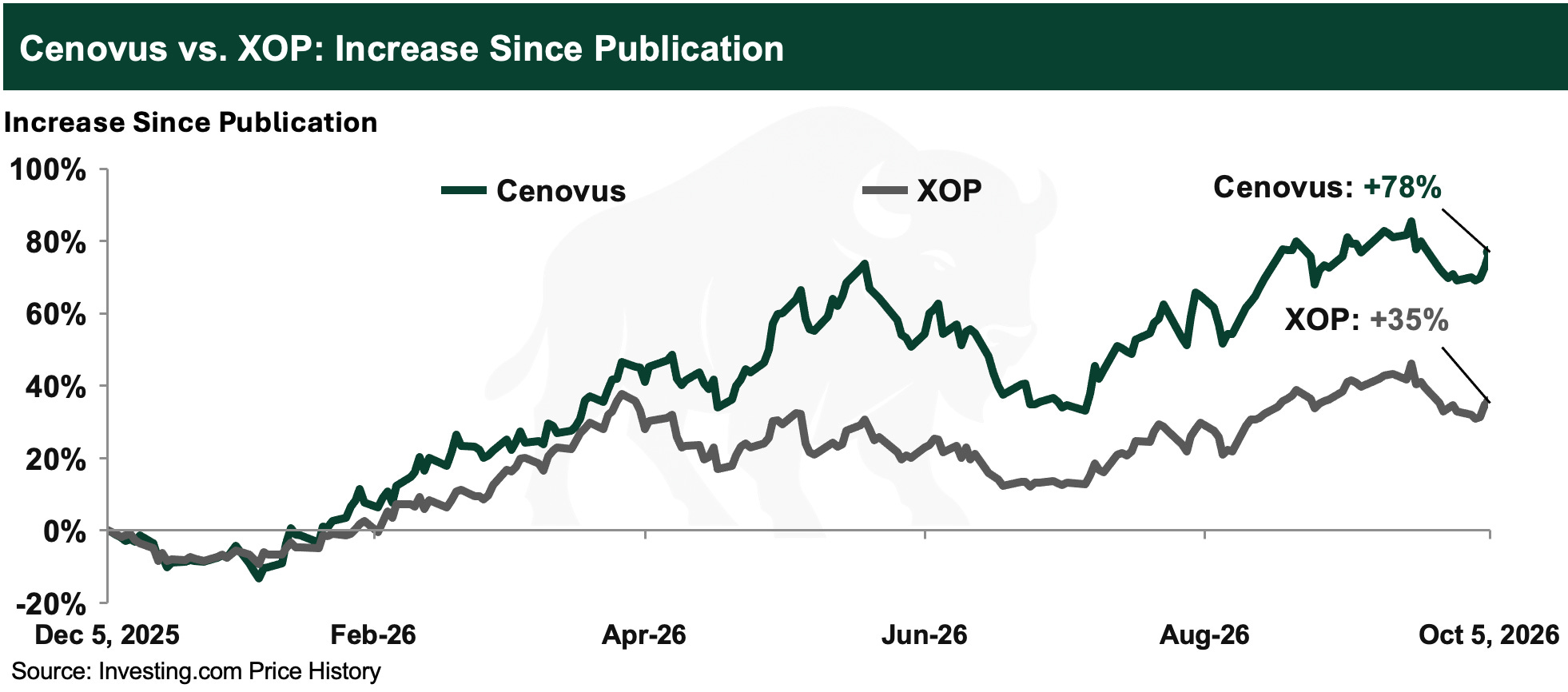
Cenovus Energy, up 78% in 10 months, is sold after agreeing to buy Athabasca Oil for $5.7 billion at a rich valuation.
$GNS is another bottom-rung shitco that looks like its about to make a run.

@RealSalesCrap i rarely pay attention to daily stock moves even on big positions like $AMZN . it’s a distraction
$FIRY raises $55m by selling noncore asset. I'm long.

Best to be long stocks like $NEU which have no analyst coverage. Can’t miss earnings if there is no earnings consensus…
@grok how has $LPLA performed since this tweet? Basically since the “Muse” scare?
Good article about how $CRDO is bringing together multiple layers of connectivity: “The operational angle is equally important. At 1.6T, the issue is not simply moving twice the data of an 800G port. Large AI fabrics can contain enormous numbers of optical links, making intermittent faults and link flaps increasingly consequential to cluster availability and troubleshooting. Credo is therefore positioning telemetry and diagnostics as part of the optical link architecture itself rather than treating observability as a separate management layer.” Having a full suite of connectivity options will give them a big advantage in 1.6T.
GFL Environmental’s take-private bids reportedly fall within $50 to $55, with a top-of-range offer likely needed to secure shareholder…
Good article about how $CRDO is being together the multiple layers of connectivity: “The operational angle is equally important. At 1.6T, the issue is not simply moving twice the data of an 800G port. Large AI fabrics can contain enormous numbers of optical links, making intermittent faults and link flaps increasingly consequential to cluster availability and troubleshooting. Credo is therefore positioning telemetry and diagnostics as part of the optical link architecture itself rather than treating observability as a separate management layer.” Having a full suite of connectivity options will give them a big advantage in 1.6T.

*META STAFF USING CLAUDE LOWER TO 30,000 FROM 60,000:INFORMATION *MICROSOFT LOWERS CLAUDE SPENDING BY OVER A THIRD: INFORMATION $META and $MSFT just doing their part in pacing the frontier. Good thing Q3 is in the books for Anthropic’s S-1

Long $CANE

$CHRW shareholders not buying. Incredible amount of uncertainty in brokerage and how that will look in a few years from litigation impacts on costs (insurance and liability) and AI on margins/take rates. It is a phenomenal deal for $QXO shareholders as they get to exit at cyclical high pricing into incredible uncertainty. (why CHRW down) Also in your multiple assessment above, you need to consider a whole bunch more factors than putting a multiple on a several year out synergy target number (1 chew trading under 20x forward 27' numbers), Ch share count will increase 16%+ (for accretion/dilution scenerios), debt costs will significantly increase (that is stripped out of there) as well as all the severance and integration costs they will incur in the next few years. This deal is quite risky in my opinion. I Also as someone in your shoes knows covering the industry for years, the history of Brokerage acquisitions paying off is quite poor (just see QXO's Coyote acquisition a few years ago)

Burry getting buried $NVDA

I went around to $GME stores and everyone said the exact same thing. They can't keep Pokemon cards on the shelves and the One Piece stuff is selling so fast that sometimes they can't even get product in.
Solid Power reported a $0.11 Q2 loss and $419.3 million of cash, with its electrolyte pilot line and BMW and SK On validation central to…
 Quad 7 Capital 2 clicks
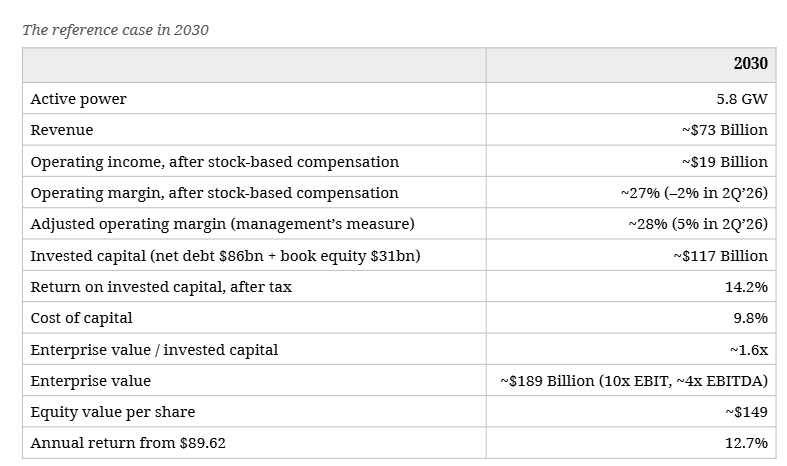
CoreWeave’s compute-selling economics face a narrowing margin of safety if new capacity closes today’s AI supply-demand gap.
$VEEA - Another short squeeze opportunity coming up as #1 on the Short Squeeze Tracker. Borrow rate at 780%. Tiny but recent news seems to be driving the stock.
$CRDO Just loves the vol doesn’t it. Up 5% / down 4% / up 5%. It’s like it wouldn’t be surprised if it closes at $218 after being down 3% already.
@shallowdives1 @peter_mantas Yeah it’s a nice little industry bubble forming. $DNA is also a Shitco

$BBGI diluted 27% (assuming warrants exercised) through that, some asset sales and share sales they generated $19m in cash. It was with an institutional investor. I don’t like getting diluted especially this early. I also don’t like what it implies which is that the liquidity of there assets is not good. There’s a chance this is just evilness by the Beasley family and they are trying to keep the company, the Crown Jewels and fuck shareholders. A more positive read is they think the assets are worth a lot and aren’t being offering competitive prices for them so they chose this instead.
$DNA - Looks like another genetics short too.

@valuedrift $CAAP up 4% but $ASR flat because apparently it is better to own 1 Brazilian airport today than own a dozen Brazilian airports in three months once the M&A deal closes.

Huron Valley Bank to merge into Bank of Ann Arbor. A few $OXBC holders may be pleased to see it transact for 180% of book value.
When rates jerk higher and everything rate-sensitive gets smoked together, that’s when you want to swoop in on the names where you actually have conviction. Rates spike. $FTAI, $CORZ, $CIFR, $OWL all gap down 5%. Did anything change in the catalyst? No? Buy the dislocation.
$DNA another perfectly rational move, happens daily across this low quality business, low quality balance sheet biotech tangential name space (ironically while actual biotech names sell off due to rates). My biggest question is why are these co. not raising $$$, all of them need money in this basket and their stock prices are up 100's% points in a very short period of time (few months). Wh not stretch the life of the company and fix the balance sheets?

Maybe I'm being too simplistic, but it seems like it's going to be hard for the market to have a sustained move higher if $GS doesn't start acting better.
Should probably look at $FSLR < $175… Just saying.

$FOUR trading on ME headlines is one of the dumbest things in this dumbass mkt
No clue how this plays out, but $ABG CEO during Q2 earnings what seems to have played out at $AN in Q3... So some of it seems like poor execution/mngmt?
Will be interesting to see Q3 results, but $AN built up used inventory and apparently had to liquidate wholesale at a loss in Q3. But, that seems like an $AN issue... Look at this comment from $ABG's CEO:
Why is $SPCX up 12% in the last two days
$ABG bought back 7% of shares in H1, $LAD hammered the buyback in Q1 before stock ripped. Robert Penske/Mitsui wants to take over $PAG (at a fwd PE of 15x). Meanwhile rest of sector starting to trade closer to 6x, after $AN CFO spooked mkt.🧐
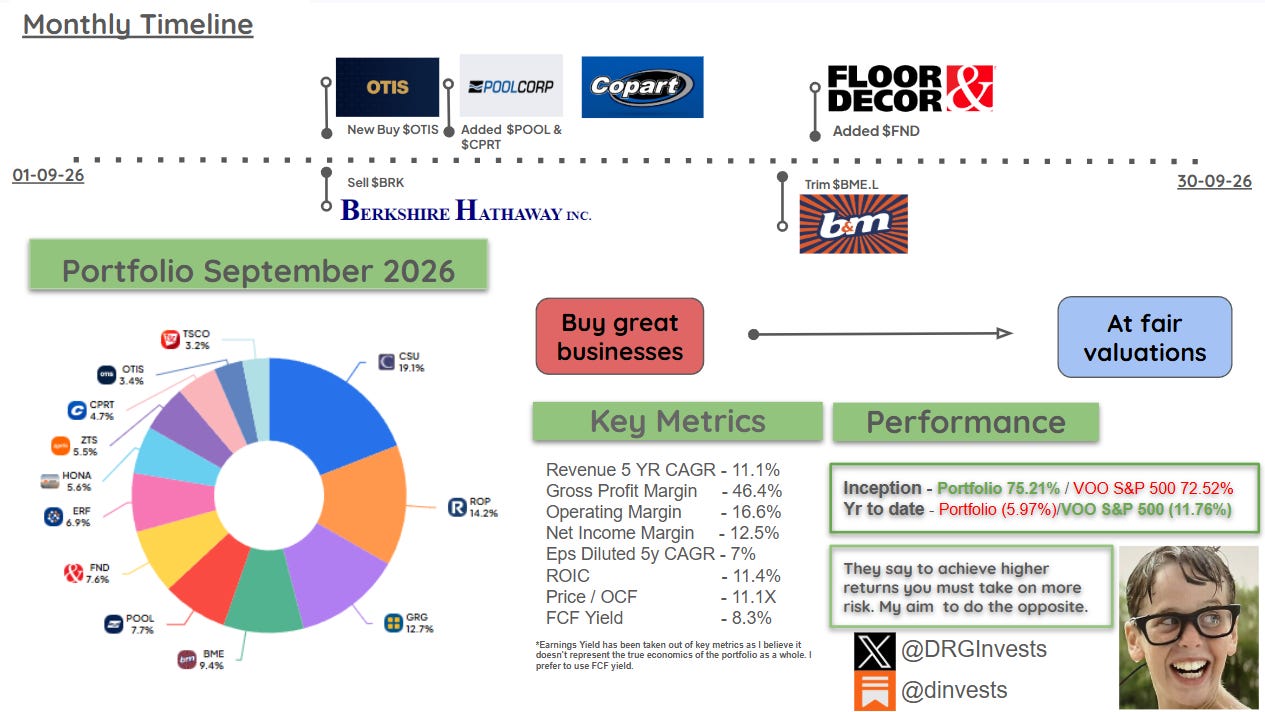
Portfolio added Otis Worldwide in the mid-$60s, increased Pool, Copart and Floor & Decor, and sold Berkshire Hathaway.

High-bandwidth memory generally costs about 5x more per GB than conventional DRAM. As AI systems support longer context windows and more complex reasoning, memory demand is spreading into conventional DRAM and NAND. The mechanism is a tiered memory system. HBM holds active model weights and the context needed now. External DRAM holds a broader pool of context that the model can retrieve, while NAND-based SSDs store less frequently used context and model checkpoints. This keeps more context accessible at a lower cost, with a latency trade-off. Memory producers are operating at approximately 80% gross margins and 60%+ EBIT margins. The industry's through-cycle average gross margin has been 35-40%, and past peaks rarely exceeded 55-60%. Supply explains much of this. Samsung, SK Hynix and Micron invested heavily in capacity during the 2021-2022 boom. That capacity came online in 2023 and 2024, when smartphone, PC and non-AI server demand was weak. All three cut production, recorded operating losses and set conservative capex plans. Samsung cut DRAM output by approximately 15-20% in 2023. The capacity response as of mid-2026: 1. Samsung has targeted a roughly 50% increase in HBM production capacity this year. 2. SK Hynix has accelerated its HBM4 ramp through the M15X fab, while reportedly redirecting some planned HBM4 capacity toward DDR5. 3. $MU has accelerated DRAM and HBM output in Taiwan. Meaningful wafer starts from its new US and Singapore facilities are not expected until 2027 and beyond. These additions are weighted toward HBM and high-end server DRAM, not broad conventional memory capacity. They appear insufficient to close the gap in the near term, so the unusually high margins look likely to persist for several more quarters.
$MELI - Excellent Brazil outcome. Stock was at a technical bottom of its consolidation wedge. Business results will begin inflecting as the credit portfolio growth slows due to it’s now to size. Very bullish: Economic Backdrop, Business Results forward, and technicals
Ciena’s optical networking equipment sales to stronger telecom customers underpin a 2027 long thesis, unlike its 2000-era boom.
 Marc Gerstein 2 clicks
$NET's AI hosting is limited by the physics of its edge footprint and by the role of its products. Carrier-hotel sites built for fast network traffic are a different proposition from purpose-built AI datacenters. Cloudflare’s own engineering disclosures acknowledge power constraints, and management distinguishes its strategy from the hyperscalers’ GPU spending race. Our assessment starts with a two-H100-per-server edge configuration. H100 PCIe and NVL-class cards operate around 350–400 watts per GPU, versus up to 700 watts for H100 SXM. Hyperscalers commonly pack eight SXM GPUs into a machine and connect those machines into dense clusters. The distinction is power, cooling, memory bandwidth and GPU interconnects — not simply whether a model can run. The existing edge footprint cannot acquire hyperscaler-class cooling and power density through server upgrades. Dense, liquid-cooled Blackwell and Vera Rubin systems require a different infrastructure commitment. We see little chance that NET’s existing edge footprint becomes a competitive home for those dense clusters. For sustained, large-model inference, our assessment is that sparse edge GPUs cost more per token than dense AI clusters. Geographic proximity saves network transit time, but it does not guarantee a faster first token or a cheaper response. Greater compute capacity, faster interconnects and efficient batching can outweigh the edge’s network advantage. We expect heavy training, frontier-scale hosting and the most demanding next-generation inference to remain concentrated with hyperscalers. Workers AI’s progress with larger open models is real. Hosting those models does not establish an economic advantage over dense clusters. AI Gateway also lets customers route requests to external providers, matching the model and infrastructure to the task. Cloudflare can still win substantially. More agents mean more requests to secure, more Workers executions, more orchestration and more demand for fine-grained access controls. Those workloads build on infrastructure and capabilities Cloudflare already has. On the SaaS Survival Scorecard, we score $NET at 2.5 for Model-Layer Leverage. That reflects its substantial work building an agent harness across inference, orchestration and execution, while stopping short of model post-training and reinforcement learning.
Harley-Davidson $HOG flying into the open as the sell side capitulates into the third straight quarter of positive comps after insisting it was a dying brand for years. Cranking my hog here.
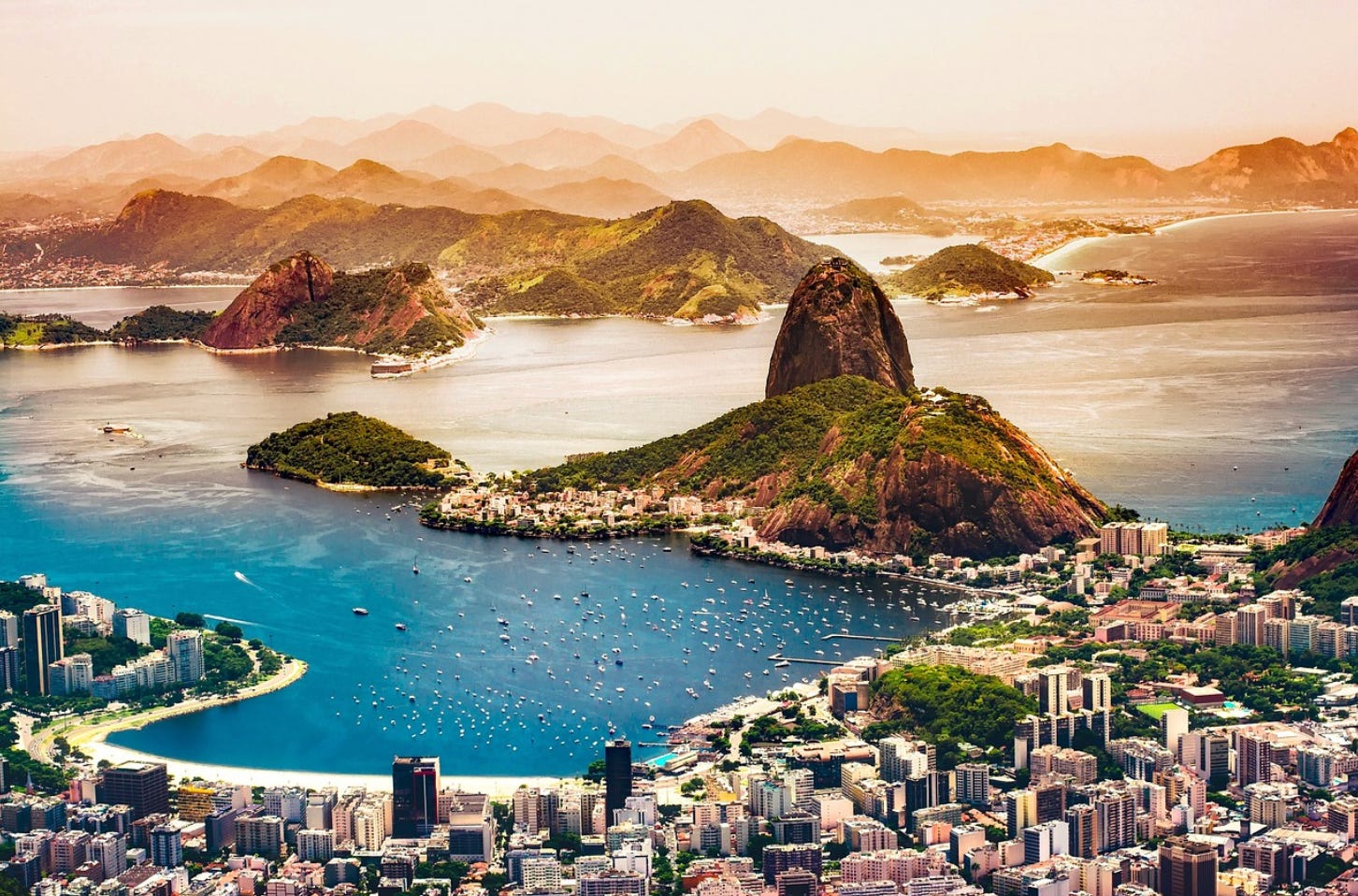
Brazilian fintechs NU, INTR and PICS stand to benefit from a Bolsonaro-led runoff surprise that lowers fiscal risk premiums, rates and the…
Seems like as good a week as any for $META to raise $50B or so in equity

Nyxoah's Genio implant could reach CCC patients after an FDA label expansion, targeting 30% of the obstructive sleep apnea device market by…
 Stephen Tobin 3 clicks
Meta and Alphabet can fund AI with core profits, proprietary data and in-house infrastructure, giving META and GOOG pricing and…
 Cain Lee 2 clicks

@FedexSTi $NU back to the price it was three weeks ago.
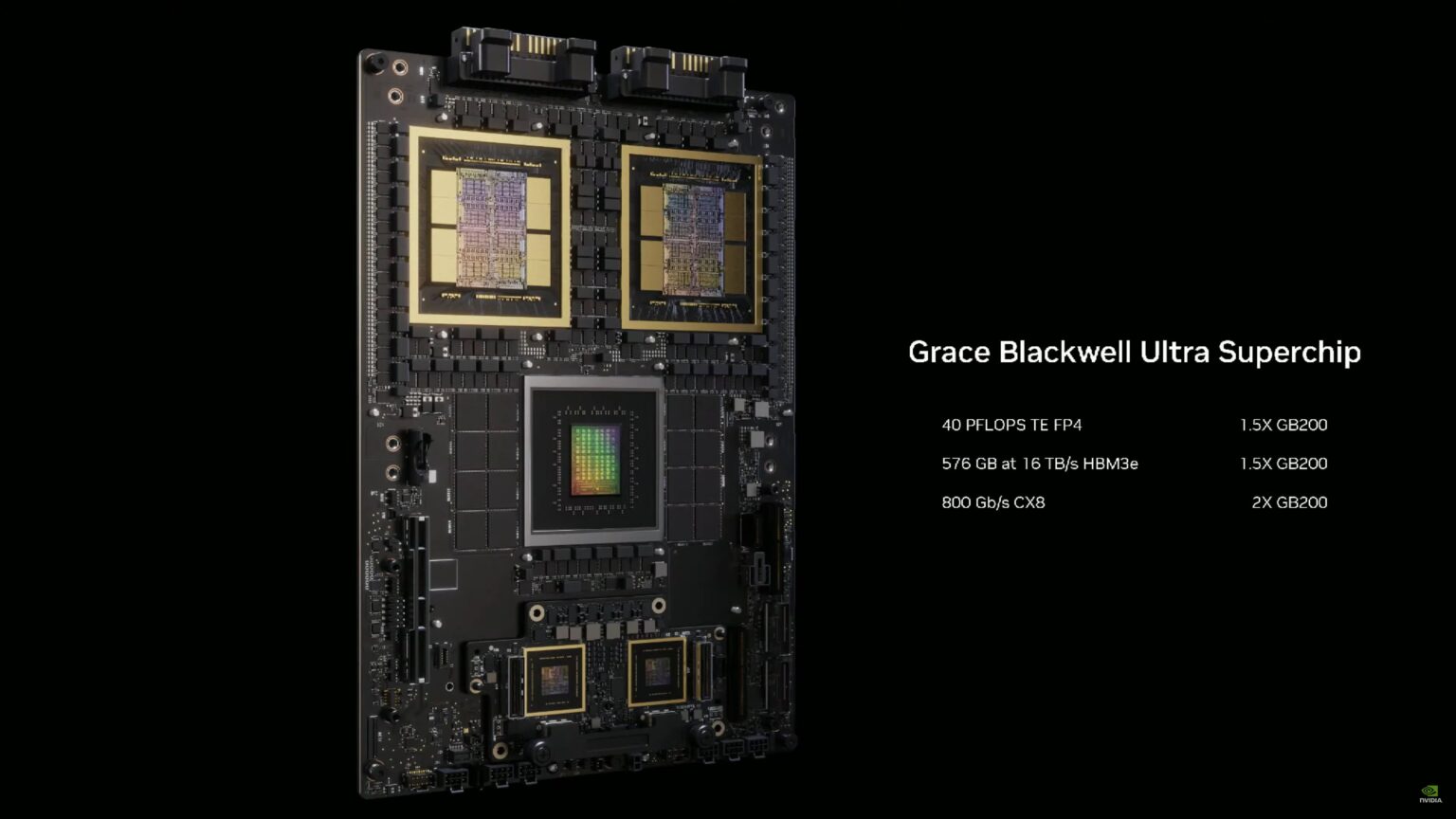
Nvidia’s Blackwell GPU rollout created an AI compute oversupply after customers preordered millions of chips amid expected shortages.
Anthropic's $518bn of planned compute obligations is about the same size as $AMZN's entire stack of debt, leases and purchase commitments. Convequity's ABBX barometer adds up borrowings, leases, purchase obligations and leases not yet started for each hyperscaler. On that all-in measure, AMZN and Anthropic are roughly level. 1. Against valuation, the number looks normal. At the $2 trillion valuation being debated, Anthropic's obligations are about a quarter of its value. That is close to $GOOGL's ratio and inside the range of the four big hyperscalers. 2. Against revenue, it is large but not extreme. Anthropic told investors its annualized run rate was above $65bn at the end of July. The obligations are about eight times that, spread over roughly a decade. A run rate is the latest month multiplied by twelve, not full-year booked revenue, and the hyperscalers fund their stacks from large, established cash flows. 3. Reuters reports that about 80% of the obligations are non-cancelable or payable regardless of usage, while many of Anthropic's largest customers are not on long-term contracts. I think the size is about right. It fits a $2 trillion company, and at the July pace Anthropic can grow into it. The risk is in the terms: most of the cost is locked in for years, while much of the revenue can leave at short notice. The number to watch now is how much of Anthropic's revenue is under long-term contract.
Alliance Resource Partners has 2026 coal sales fully contracted and is expanding oil and gas royalties through AllDale, supporting its 9.8%…
 Timur Mekhantev 4 clicks
Blue Lagoon (BLAGF) is cash flow positive from high-grade gold and silver at its Boulder Vein, with just 10% of its property explored.
 Patient Tech Investor 5 clicks
Latticework’s briefing questions AI capex returns while featuring Close Brothers, Green Landscaping and OMS Energy Technologies.
