

Tesla Vs. Alphabet's Waymo: Battle Of The Robotaxi Behemoths Post Cybercab Launch
Tesla’s camera-only Cybercab enters a U.S. robotaxi market where Waymo already delivers 500,000 weekly rides, pitting scalable autonomy…
 Doron Levin
NASDAQ
GOOGL
172 stories
$3.5T Market cap · 2026-11-06
Get GOOGL news in Claude, ChatGPT or your own code. See plans
Tesla’s camera-only Cybercab enters a U.S. robotaxi market where Waymo already delivers 500,000 weekly rides, pitting scalable autonomy…
Doron Levin *GOOGLE, BLACKSTONE VENTURE FACES DELAYS AT DATA-CENTER SITES "Alphabet Inc. and Blackstone Inc.’s new cloud venture has hit delays for major data-center locations that were supposed to run Google’s chips, underscoring the obstacles standing in the way of Big Tech’s AI ambitions." - BN If $GOOG and $BX can’t get by without delays it’s hard to imagine other neoclouds getting by without issues

Latticework’s Labor Day briefing covers Alphabet’s TPU roadmap, HAL Trust’s asset-value discount, UMG’s buybacks, and AI data-center…
Open weight model to Nvidia ls kerosene lamp to Standard Oil. Free access to models = more demand for underlying infra. What's better is $NVDA can make this Lamp tailored and optimized for Nvidia stack such that users have to pick: Free model + $NVDA stack or Expensive model + Non-NVDA stack. The question is more about if $NVDA can deliver frontier open weight models or not. I am still a bit skeptical about it because it takes an elite dedicated team to do that and $META learned that hard lesson. And it also requires visionary mgt directly leading the elite team which $GOOG and $MSFT failed, while $SPCX realized it and back up again.
FT: Big tech giants booked a $160B+ windfall last qtr from investments in other AI companies. $GOOG, $AMZN, $NVDA, & $MSFT all had lg boosts to their pre-tax profits from ‘other income’ in theory P&L, due largely to valuation gains on equity stakes in other leading AI companies
The AI build is moves more aggressively off the balance sheet Convequity’s debt scan across $MSFT $AMZN $GOOGL and $META: what these companies borrow in public is rising slowly. What they have promised to spend later — leases not yet started, equipment orders, contracted compute — is rising much faster. In 2Q26 that gap is the widest in four quarters. Off-book commitments are running toward +316% year-on-year. On-book debt is barely moving. If you only watch headline borrowings, you miss the cycle. MSFT is the clearest case. On-book debt +15% YoY. Off-book commitments +138%. That is why its all-in financing load is about 17x reported borrowings. Microsoft is under pressure from two sides: shareholders who want more AI spend, and shareholders who want less capex and faster returns. The compromise is to slow the capex it puts on its own books and lock in capacity from $IREN, $NBIS and other neo-clouds instead. How that works: IREN or NBIS borrows, builds the site and owns the chips. Microsoft signs a multi-year contract to pay for the capacity. Microsoft does not put the building on its balance sheet. It takes a future bill — rent and service payments that show up later as operating cost. Asset risk moves to the neo-cloud. Payment risk stays with Microsoft. GOOGL looks similar on a multiple and is doing something different. All-in commitments are 10.2x borrowings: $100bn of headline debt, $121bn including leases, $902bn off-book. $811bn of that off-book pile is purchase orders for its own stack — TPUs and the kit around them — not rented neo-cloud sites. On-book +190% YoY. Off-book +836%. That multiple is Google buying the factory, not renting it. META is closer to Google than to Microsoft: on-book +127%, off-book +680%. Some of Meta’s orders are reserved compute from CoreWeave and Nebius, which Meta will expense as it uses the capacity. Most of the pile is still Meta committing to build and buy for itself. AMZN is the most balanced of the four (+59% on-book / +80% off-book). Both lines are rising together. If the cycle breaks, Microsoft is less stuck with buildings and chips it owns. It is more stuck with bills it already signed. Google is more exposed because more of the capital is already spoken for on its own account. If compute gets scarcer, the extra megawatts IREN and NBIS have not yet sold can go to whoever pays more. Microsoft then has to wait or pay up. Because it owns less of the physical stack, it has less spare capacity it can simply switch on — which means higher compute costs and tighter margins. Powerful cycle. Not a broad bubble. The heat is in the promises, not the 10-Q debt line. Full AI Bubble Barometer available at Convequity.
It's these types of ads that $GOOG Google won't be able to get away with long term anymore. This always degraded the user experience. Which was fine when they were a monopoly. But they are not a monopoly anymore. How much will this hurt their revenue?
Market already confirming this idea. $GOOG $AMZN $MSFT up since that beat. "Neoclouds" should be big winners too. I prefer to bet on the proven big, scale advantaged operators. But if the neoclouds are much cheaper per unit of compute, they could be the better risk adjusted return.
@Ross__Hendricks @DratchCap @WarrenPies Equity is abundant even while absolute debt issuance skyrockets. I would think prudent capital allocators would tap the former… (see $GOOG, $ORCL as of late)
The question needs to be asked: Why haven't $META and $GOOG done more to control the narrative around data center construction? They literally can amplify whatever news, posts, and videos they want. We've learned that. Don't tell me they've learned their lesson about meddling (there's a $1T+ court case ongoing that tells me otherwise). Instead we're hearing narratives about China and Tiktok, when two MAJOR AI players own the pipes that serve every other social media post and video in this country. It's a strange set of circumstances. Would $GOOG and $META benefit if @AnthropicAI and @openAI go through the windshield? Of course, but it's not obvious how a backlash against data centers helps these hyperscalers otherwise. Thoughts?
The $3T “hidden AI debt” number is not the story WSJ just put a headline on the shadow capex we’ve been tracking for a while. Purchase commitments + leases that have not started. Most of it never hits the balance sheet. The $3T is real. The interpretation is not. Add the explicit debt-like items on the books of $GOOGL $MSFT $META $AMZN and you get ~1.69x. Widen the definition to implicit / off-book instruments and it can balloon to 8.36x — approaching that $3T figure. That is the chart. It is not the economics. 1. Most of this is contract value, not a hard legal obligation to pay. A lot of it is pay-as-you-go. The commitments they actually have to fund already sit on the balance sheet. 2. The implicit load is shared. It is spread across financial players — private credit and equity — who are underwriting the build. Their IRRs are not insane. Current ROIC on this spend is still high. This is not a bubble from here. 3. AI ROIC can compress later. I would not be surprised. Near-term it is more likely to stay elevated or even rise. Compute is still short. Efficiency gains are raising, not lowering, the value of each incremental GPU-hour. 4. What the hyperscalers are actually doing: paying a bit more, accepting a slightly lower margin, and sharing a slice of the economics with investors who want the risk. That is risk offload, not hidden leverage. The cleaner setup is still the player that can keep building more capacity internally without leaning as hard on this structure. SpaceX is the extreme version of that. It also means more profit pass-through to the specialized GPU clouds sitting in the middle of this: $IREN $NBIS $CRWV and others. The $3T is a real number. Treating it as imminent balance-sheet stress is the wrong read. Pictures below are snapshots from our AI Bubble Barometer.
Hyperscalers need so much capital they're exporting their financing needs to...Australia $GOOG just mandated its first AUD deal. Issuance (called Kanagroo bonds) is up 40% y/y to ~A$60B (a new record)

Hyperscalers’ off-balance-sheet lease and purchase obligations rose from roughly $1 trillion to $1.5 trillion, turning the AI buildout into…
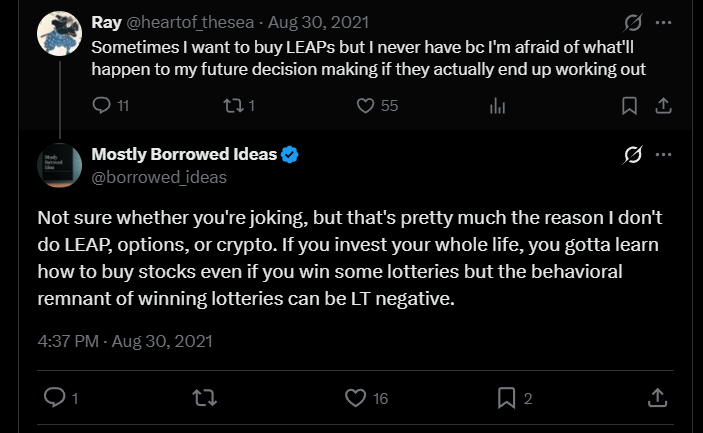
Options strategies will manage portfolio risk after Meta, Alphabet and Amazon calls drove gains, while Lululemon LEAPs produced an 80% loss.

Alphabet's Google Cloud swung from a $3.1 billion operating loss in 2021 to $13.9 billion profit in 2025 as Search revenue grew 13.2%.
Jeff Dean’s departure is a seminal moment for $GOOG I’ve been watching this closely and the picture keeps getting clearer — and more concerning. Google is still treated as the safe consensus AI bet. Full-stack ecosystem, consumer reach, TPU muscle. But the competitive status of its frontier models looks increasingly dubious. The one-way talent flow tells the story. Google has seen massive outflows to OpenAI and Anthropic (reports put the numbers in the high hundreds to over a thousand in recent periods) while inbound from those labs remains tiny. This is not normal churn. It signals a structural talent problem that shows no sign of being fixed anytime soon. Jeff Dean leaving with Sanjay Ghemawat, Quoc Le and Oriol Vinyals, while Demis Hassabis steps back from day-to-day leadership, is the clearest signal yet that the research edge has peaked. Top talent does not want to waste cycles inside a large, conservative organization when the progress window is this narrow. We’ve flagged Google’s cultural and leadership issues in our recent rebalancing work. This just cross-validates it hard. What’s especially striking is the internal dynamic. All signs point to Koray Kavukcuoglu having been central to the environment that produced these outcomes — yet he has now risen to Chief AI Architect and the unchallenged operational AI leader, reporting directly to Pichai. The research org is fraying rapidly while the executive who oversaw much of that period moves up the ranks. That is a strange incentive structure. Large orgs struggle to deliver breakthrough AI. Talent density, bold vision and nimble execution matter more than scale. Meta rebuilt around an independent lab. SpaceX is doing the same with xAI. Google may eventually follow, but the current setup still seems unwilling to fully accept the reality. That said, the TPU and infra side continues to execute well with far less leakage. The competitive edge is shifting toward infrastructure, chips and consumer distribution — not frontier model leadership. This remains the biggest news of the week for a reason.
Kurian laid out the GCP margin expansion playbook a few years ago $GOOGL
$TSEM + $SOI: positioned on both sides of the biggest shift in AI datacenter interconnect — and Google's new TPUv8i just supercharged the story. Leg 1 — Smarter optics, much bigger chips. Next-gen optical links ("coherent-lite") encode data far more densely than today's IMDD links. But the sophistication has a physical cost: the photonic chip needs roughly 2–2.5x more silicon area per port, because it packs in multiple modulators, splitters, and detectors where today's simpler links need one of each. Factor in that bigger dies yield worse, and you need ~3–4x the wafer starts per port. More area × more volume × worse yield = several-fold growth in SiPh wafer demand over the cycle. Leg 2 — The switch itself goes photonic. TPUv8i connects its chips through an optical circuit switch (OCS) built from silicon photonics — a genuinely new thing. $GOOGL's old scale-out OCS used MEMS mirrors: zero SiPh content. The new one puts a very large photonic die (300–450mm², heading toward 500–800mm² — near the reticle limit) in every pod. That's a brand-new ~10–20% layer of demand on top of the transceiver story, and it scales faster than linearly as switch radix grows from 64×64 to 128×128. The elegant part: Leg 2 forces Leg 1. The optical switch loses 5–10dB of light — 70–90% of the signal is gone by the time it exits. Today's IMDD transceivers can't read a signal that weak; coherent ones can. So every transceiver plugged into the switch fabric has no choice but to go coherent — and coherent means the 2–2.5x bigger chips from Leg 1. Google's switch decision doesn't just create its own SiPh demand; it automatically triggers the transceiver upgrade too. Tower has manufacturing flows for both legs: high-speed modulator + Ge flows for transceiver PICs, AND mature passive flows for the huge fabric dies. Soitec supplies the photonics-SOI wafers upstream either way — it wins regardless of which foundry takes the socket. One more kicker: Celero, the Alphabet-backed startup tipped for Google's coherent DSP socket, has no fab of its own — its companion photonic chip has to land somewhere, and an open specialty foundry is the obvious somewhere. Risks: coherent modulators migrating to InP/TFLN would leak the PIC leg out of silicon photonics; Marvell verticalizing into its own photonics partially bypasses the open-foundry path.
Thanks again to @realsteveeisman for having me on his podcast again. It's always fun chopping it up with Steve. We talked about a lot of things: the ever shifting dynamics of the residential real estate market ($Z/$ZG, $COMP $RKT, $CSGP etc.), structural problems in for-profit education (it's not just AI), and why I'm short $GOOG among other things. You can listen to the episode here!
Alphabet’s $132 billion AI capex produced an estimated 49% post-tax incremental ROIC once only in-service assets are counted, versus a…
The capex spend is mind boggling, but I held my nose and bought $META today around $590-600 I don’t how the AI bet will shake out, but I do know that… - $META Reels is sucking up engagement share from everyone, even $NFLX - $GOOG search refers are in free fall, which should benefit $META’s ad network - Zuck is the best owner-operator in the business who is willing to pivot if necessary - There are tremendous AI cost efficiency opps in core $META operations (Note: I have a long and fruitful history with $META and my family members still own their shares going back to 2013, knock on wood)
Alphabet’s Q2 EBIT rose 24.8% excluding one-offs as Search, YouTube Ads and Cloud grew, while higher AI capex drove a 6.9% share drop.
Remember the good ole days when covering internet meant you just needed to have a view on: - If $GOOGL Search was going to accelerate or decelerate and what the opex was likely to be - $META fxn ad revs...how big a beat? Opex? - $NFLX are they going to beat on subs? - $AMZN AWS to accelerate? How much? Margins? EBIT guide? - $BKNG room nights ! I started my career covering these companies and a bunch of other internets....at that time capex was not something we cared about bc it didn't matter. It was a simpler time.
@FrostByte123456 Yes. $GOOGL needs to feed TWO capex intensive businesses: 1. Search (Gemeni) and 2. Cloud. $AMZN needs to only feed one, which is AWS.
Letters that discuss GOOGL.
Companies the stories above are also about, besides GOOGL.


