
BDC on X
$SNAP will generate more FCF this year than $GOOGL and maybe more than the hyperscalers combined in the 2H ex MSFT! Just sayin...
NASDAQ
GOOGL
172 stories
$3.5T Market cap · 2026-11-06
Get GOOGL news in Claude, ChatGPT or your own code. See plans
$SNAP will generate more FCF this year than $GOOGL and maybe more than the hyperscalers combined in the 2H ex MSFT! Just sayin...
Good point here re how OBBB flatters cash flow. $GOOGL
NVIDIA’s Feynman: CPO Inside, OCS Outside According to supply-chain sources, $NVDA’s 2028 Feynman architecture is planning a dual-layer optical design around the NVL576 rack. An inner layer of Co-Packaged Optics will handle high-density, short-reach connections within and between racks. An outer layer of Optical Circuit Switching will manage larger-scale cluster connectivity, supporting flexible topologies at the 100,000-GPU level. In this framing, CPO and OCS are treated as complements rather than substitutes. CPO addresses density and power at short reach; OCS provides flexibility at longer distances. NVIDIA’s near-term path appears to favour mature MEMS switches to secure delivery schedules, with silicon photonics as the longer-term option once insertion loss improves. Higher insertion loss in SiPh currently requires more optical amplification, adding power, noise and cost — which is why MEMS remains the lower-risk choice for large deployments in the near term. $GOOGL’s earlier move into silicon photonics for inference is expected to help mature the supply chain, potentially making it easier for NVIDIA to follow later. Huawei, Oracle and others are also advancing along related paths.
Photonics Pt.4: OCS Roadmaps Are Splitting Convequity’s latest note examines how Optical Circuit Switching is diverging by workload. High-radix MEMS remains the practical choice for scale-out and training clusters that prioritise scheduled reconfiguration. Lower-latency silicon photonics is being pushed into the scale-up layer for inference, where millisecond switching is no longer acceptable. $GOOGL's V8i architecture is the clearest example. It moves OCS down into the scale-up domain for the first time and pairs it with 2.4T Coherent Lite modules that dramatically reduce fiber and port consumption. The combination is designed to close Google’s main networking gap versus NVIDIA. $NVDA's Feynman (2028) appears to be taking a dual approach: CPO for dense short-reach connections and OCS for larger cluster-level scale-out. Near-term deployments will likely rely on mature MEMS, with silicon photonics as the longer-term path once insertion loss improves. The broader OCS market is projected to grow from ~$400M in 2025 to over $2.5B by 2029 (58% CAGR). Silicon photonics offers a relatively open competitive field compared with MEMS, where incumbents hold stronger positions. We also re-examine CPO’s path forward and assess microLED as a more radical parallel alternative — one that inverts the industry’s “fewer, faster lanes” assumption and is physically confined to short-reach scale-up links. Full Part 4 is now live. Link in the comments.
@kermankohli GCP is baked into $GOOGL's price already. $META's cloud optionality is obviously not. You may prefer the known thing but its the unknown things that over much more asymmetry.
This is obviously unsustainable. The larger the gap, the worse the crash. Semis are printing cash now - but for a buyer and seller relationship to be healthy over a long time, everyone, both sides, needs to make $. I think $AMZN can make $ because their flagship business sells compute capacity and their capex ramp has funded more capacity to sell. $META can work because their flagship biz benefits from internal AI and they may in fact have excess compute capacity to sell - which is a positive pivot. $GOOGL is less clear to me. Their flagship biz is soaking up internal compute because new entrants in search, gPT for one, have $750B in capex earmarked - not to sell compute but to improve their own frontier capabilities. At the same time, $GOOGL's external compute biz is going to do great - but in this theater they are also competing with AMZN/MSFT etc. So for $GOOGL there's no pivot opportunity akin to $META and there's 2x the capex need as the arms race accelerates for both internal and external needs.
@benbstwits Warren Buffett is 96 years old. He had every opportunity to buy $GOOGL over the last 20 years and didn't. The fact that he is showing up now is not the flex you think.

Alphabet’s 2Q’26 revenue rose 24% to $119.8 billion as Google Cloud grew 82% and tripled operating income, while heavy investment drove…
So is $GOOGL going to tap their ATM now? Or wait for it to go lower?
To me, $GOOG faces a "red queen scenario" or a "pyrrhic victory". For the moment, it appears I'm not the only one that shares that sentiment. 13% paid click growth was solid in 2Q26, but CPC slowed to 3% YOY. Not a huge deal, but warrants close attention. I still think we see massive deceleration on paid clicks. Then what?
Ok so $GOOGL beat on every KPI that they told you mattered for the print. And yet the stock is off 6% and nuking the market with it. This is bad for the AI cycle for two reasons: 1. Credit markets were already revolting vs hyperscalers capex spend. 2. Now if equity markets revolt too - where does the funding come from? Either CEO's like Sundar who get paid 10s of millions / year need to make an actual attempt to quantify expected CASH ROIC to the market OR markets might just say they've had enough...we see the $ out the door and have no line of sight as to when it comes back in. We selling. @ajassy take note.
@LogicalThesis Market might sell $AMZN some here. But the distinction that should be made is that a massive amount of $GOOGL's capex is funding internal compute needs. The majority of AMZN's capex is for external.
Ok so $GOOGL says: -capex materially higher -Q3 cloud margins lower due to 3P capacity used at higher cost -search revs to slow on tougher comp -ambiguous word salad wrt to capex ROIC -ATM not used yet (maybe that's a mistake?) -No buyback in the Q
Sundar on ROIC: "It's very early" "still supply constrained" "multi year view" That should help everyone understand $googl
Google’s delayed Gemini 3.5 Pro raises questions about its AI position, Search and GCP growth as its $4.3 trillion valuation leaves little…

Alphabet rents scarce AI compute to rivals while DeepMind faces internal capacity constraints, weakening Google’s AI position and long-term…
Good question. As I mentioned, all of my checks suggest they're gaining wallet share with small businesses at the expense of $GOOG. There are other big issues around regulatory recourse, stalling user growth in an increasing number of markets, and of course capital allocation. The multiple reflects the magnitude of unknowns or lack of visibility. Changing that to some degree would be a start.
In the case of $GOOG, Adwords, which in my view is the greatest business model ever created is now being replaced by something quite different and considerably worse. In the case of $META, there's a long list. I don't share your view of the caliber of that business even while I recognize the considerable ad share gains they continue to get. The toxicity of the platform matters greatly if you're thinking of this business in any kind of longer term context.
I've been short $META for a while as I mentioned in previous posts. I'm fully aware that $META has been benefitting in continued shift of ad dollars away from $GOOG (I'm also short $GOOG) as we transition away from the SEO/SEM world to AEO/GEO. However, nothing can mess up a good fundamental story like poor capital allocation and Zuck and co. have demonstrated time and time again that they're willing to pull defeat from the jaws of victory. This latest effort to go and compete with Kalshi, polymarket, and even the traditional broker/dealers to get into betting markets is just another example. Betting markets doesn't represent the existential risk to the biz like AI does, why even consider getting into this now? Based on chatter about their upcoming AI model updates, it seems CAPEX at $META is poised to go way up, yet again. Will the street like that? I guess if their latest model is Mythos quality or better, maybe it will be tolerated. Maybe, but probably not. What is it about Zuck that he feels the need to be all things to all people? Does he not understand the strengths of his own business or is he worried about the duration of those strengths? Maybe it's just ultimate hubris. Either way, at some point soon he probably pulls the reigns back as the market continues to penalize $META for the absurdities of their capital incineration.
Bubble Spidey sense is starting to tingle pretty hard here! $GOOG and $META secondaries, silly SpaceX IPO valuation, Anthropic and OpenAI IPOs coming. Who is going to soak up all of this incremental equity supply? If investors start to balk, the music stops pretty quickly!
Quick thoughts on the $GOOG raise: 1) Management is old enough to remember when this stock traded at much lower multiples for YEARS, good time to raise capital and it's not that much relative to the market cap. 2) The demands of data center build out/token cost are even more insatiable than we thought (see $HPE, $DELL, or the $NVDA overnight news) 3) Profitability/cash flow could be headed lower in a meaningful way at some point in the not too distant future for the search business. This is the most important take away IMO. Someone explain to me how you take the greatest business model ever created in Search/Adwords where you have 90% share and replace it with LLM's/AEO, while somehow maintaining the same profitability. The structural economics are WORSE and market share is materially worse. Search traffic is DOWN in many categories and that will only get worse from here as consumers engage with #openAI, #claude, #gemini at higher rates. Honestly, I don't know why this isn't the primary narrative around $GOOG currently. I'm sure there are people that will have different perspectives on this, but ask around to people that rely on search. Volumes are down in many areas already.
11 reasons for why i'm long $goog:
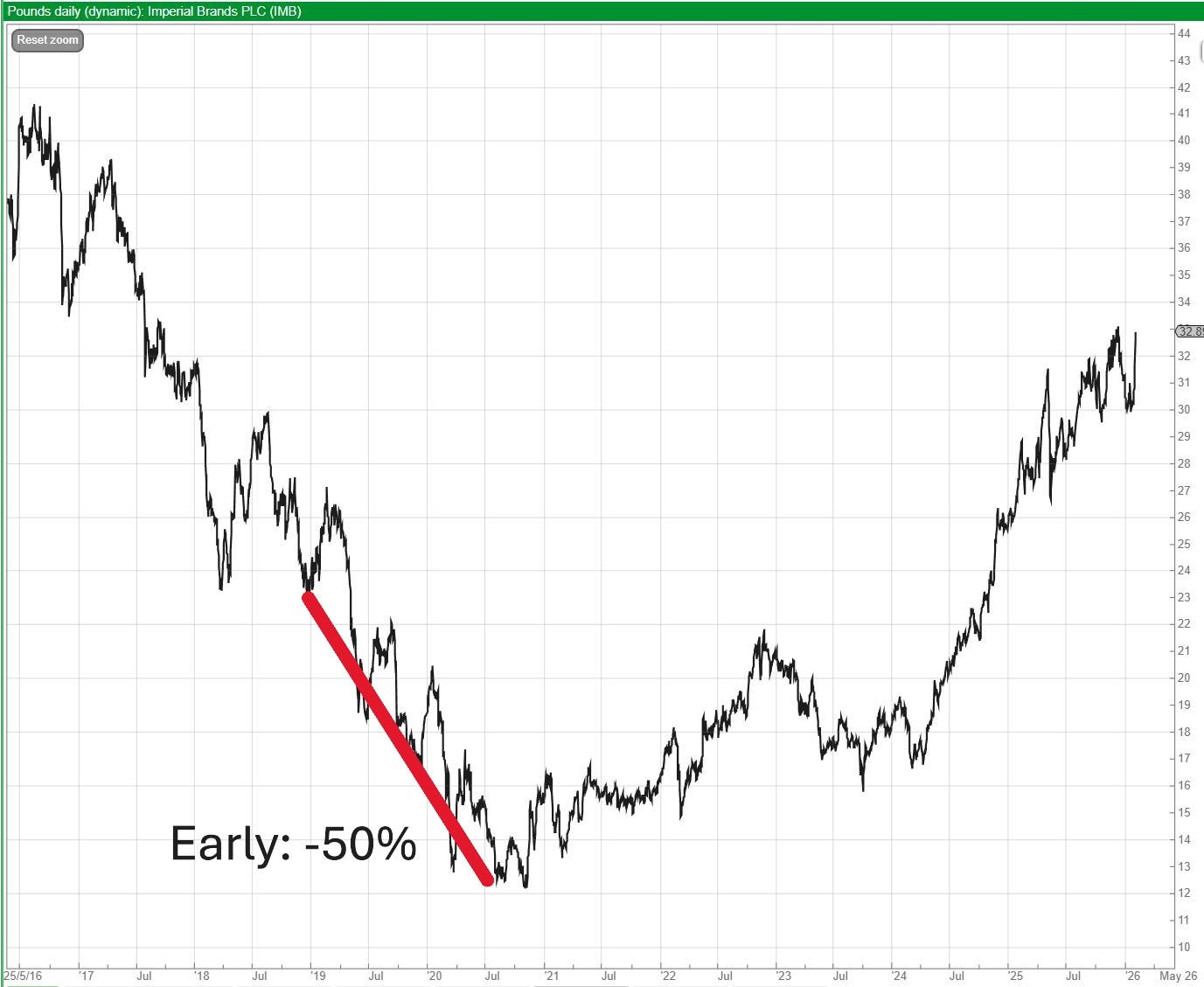
RELX and Sage have fallen 46% and 35% as markets label them AI losers, creating potential value opportunities alongside risks of genuine…
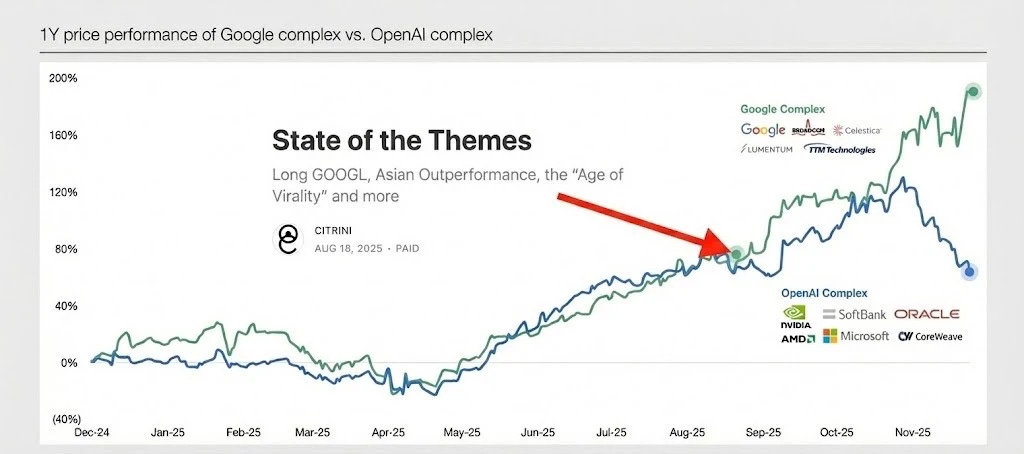
Google’s TPUs give it vertically integrated AI training and inference economics as Anthropic and Meta consider adoption, challenging…
Letters that discuss GOOGL.
Companies the stories above are also about, besides GOOGL.


