
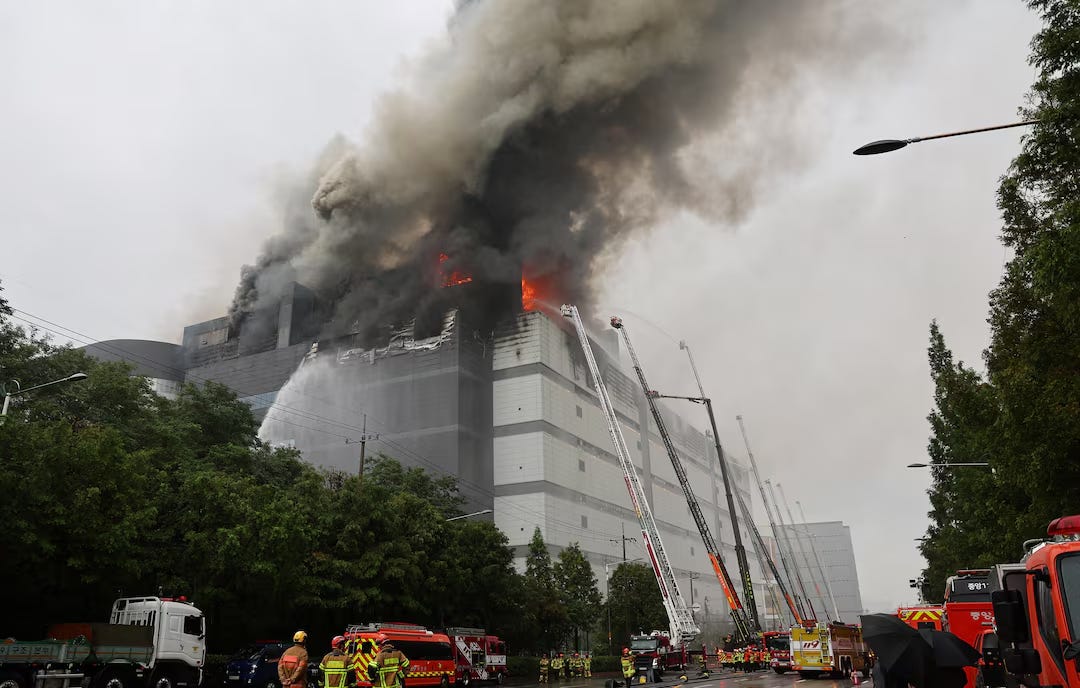
Coupang: Normalization (Ticker: CPNG)
Coupang says customer demand is normalizing after its 2025 data leak, while Q1 vouchers and underutilized capacity pressure margins.
Friday, July 24
Everything we published on this day.
18 stories
Coupang says customer demand is normalizing after its 2025 data leak, while Q1 vouchers and underutilized capacity pressure margins.
@FFairing Nice call on $INTC
Nebius opens a series arguing Nvidia-backed neoclouds absorb the debt and construction risk of AI data centers while driving GPU demand.
NVIDIA’s Feynman: CPO Inside, OCS Outside According to supply-chain sources, $NVDA’s 2028 Feynman architecture is planning a dual-layer optical design around the NVL576 rack. An inner layer of Co-Packaged Optics will handle high-density, short-reach connections within and between racks. An outer layer of Optical Circuit Switching will manage larger-scale cluster connectivity, supporting flexible topologies at the 100,000-GPU level. In this framing, CPO and OCS are treated as complements rather than substitutes. CPO addresses density and power at short reach; OCS provides flexibility at longer distances. NVIDIA’s near-term path appears to favour mature MEMS switches to secure delivery schedules, with silicon photonics as the longer-term option once insertion loss improves. Higher insertion loss in SiPh currently requires more optical amplification, adding power, noise and cost — which is why MEMS remains the lower-risk choice for large deployments in the near term. $GOOGL’s earlier move into silicon photonics for inference is expected to help mature the supply chain, potentially making it easier for NVIDIA to follow later. Huawei, Oracle and others are also advancing along related paths.
Photonics Pt.4: OCS Roadmaps Are Splitting Convequity’s latest note examines how Optical Circuit Switching is diverging by workload. High-radix MEMS remains the practical choice for scale-out and training clusters that prioritise scheduled reconfiguration. Lower-latency silicon photonics is being pushed into the scale-up layer for inference, where millisecond switching is no longer acceptable. $GOOGL's V8i architecture is the clearest example. It moves OCS down into the scale-up domain for the first time and pairs it with 2.4T Coherent Lite modules that dramatically reduce fiber and port consumption. The combination is designed to close Google’s main networking gap versus NVIDIA. $NVDA's Feynman (2028) appears to be taking a dual approach: CPO for dense short-reach connections and OCS for larger cluster-level scale-out. Near-term deployments will likely rely on mature MEMS, with silicon photonics as the longer-term path once insertion loss improves. The broader OCS market is projected to grow from ~$400M in 2025 to over $2.5B by 2029 (58% CAGR). Silicon photonics offers a relatively open competitive field compared with MEMS, where incumbents hold stronger positions. We also re-examine CPO’s path forward and assess microLED as a more radical parallel alternative — one that inverts the industry’s “fewer, faster lanes” assumption and is physically confined to short-reach scale-up links. Full Part 4 is now live. Link in the comments.
TSOH Weekly Roundup covers the Paramount-Warner court block, Xbox Game Pass’s subscriber shortfall and pricing reset, and Red Bull’s 28%…
Stripe and Advent’s reported $53 billion bid for PayPal follows a decade in which Stripe’s payment volume outgrew PayPal’s Braintree.

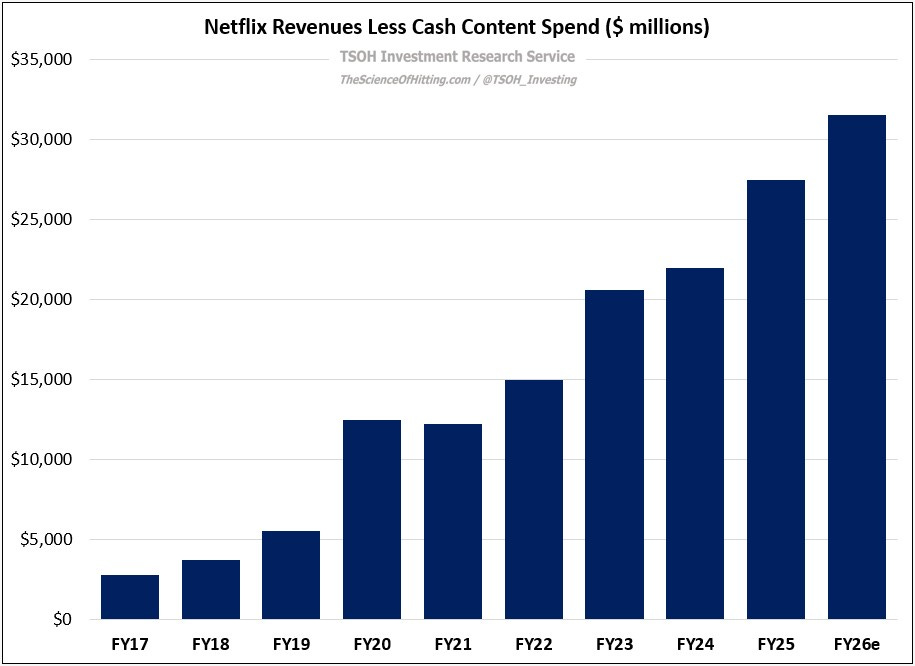
Netflix's Q3 guidance points to sub-12% growth as viewing hours rise about 2%, increasing reliance on pricing, paid sharing and advertising.
Netflix trades below 20 times forward earnings despite $51 billion in revenue, 31.5% guided operating margin and ad revenue expected to…
Anybody like $DOMO here? Trading at $3.67 when they will have circa $4.84 in net cash after the sale closes + $900m in NOLs (at a 21% tax rate, that's worth $4.50 to the equity) https://t.co/UwaAd0UkLL
Good, solid quarter from $BWMX https://t.co/rRzlwT85tX
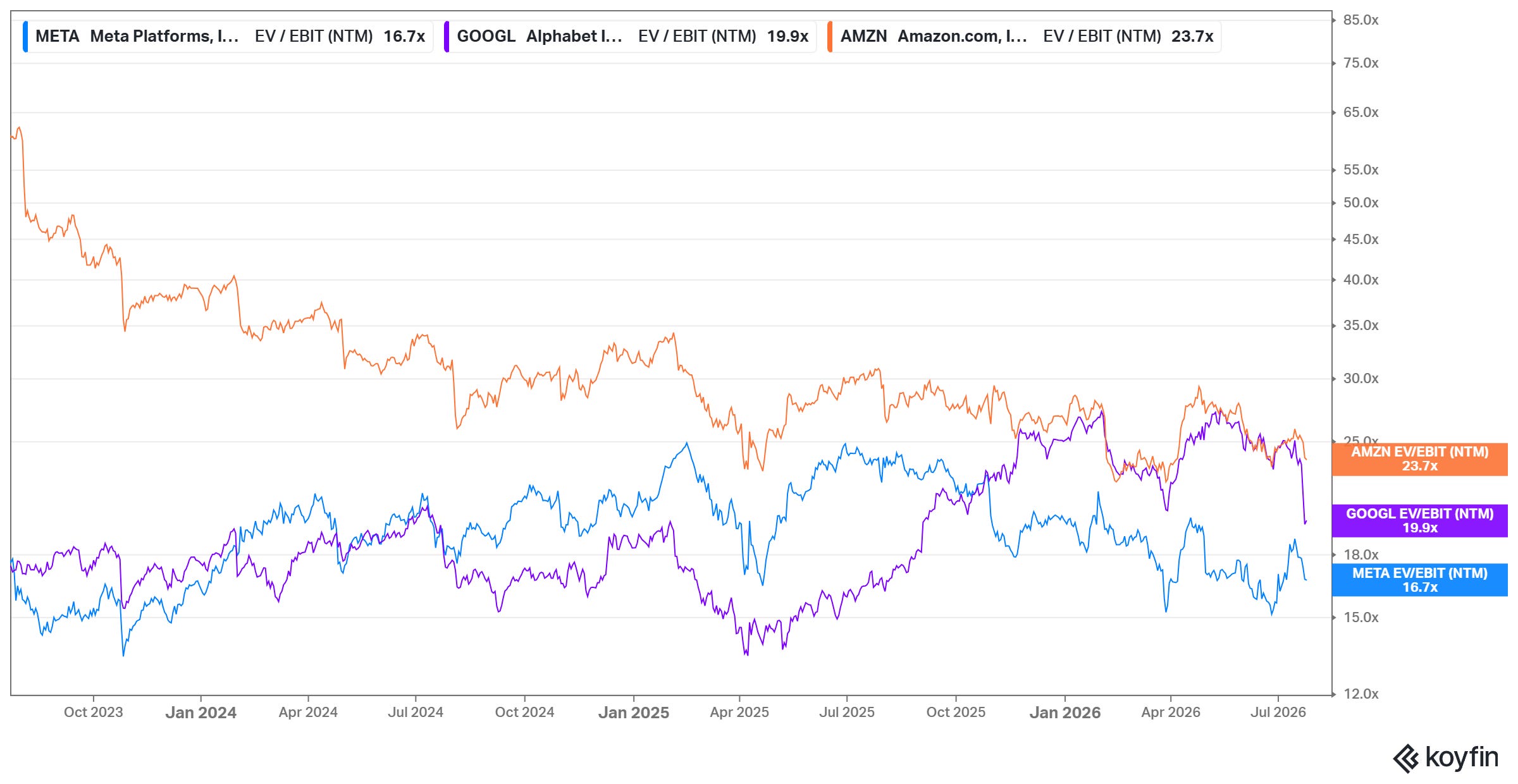
Remember the good ole days when covering internet meant you just needed to have a view on: - If $GOOGL Search was going to accelerate or decelerate and what the opex was likely to be - $META fxn ad revs...how big a beat? Opex? - $NFLX are they going to beat on subs? - $AMZN AWS to accelerate? How much? Margins? EBIT guide? - $BKNG room nights ! I started my career covering these companies and a bunch of other internets....at that time capex was not something we cared about bc it didn't matter. It was a simpler time.
@FrostByte123456 Yes. $GOOGL needs to feed TWO capex intensive businesses: 1. Search (Gemeni) and 2. Cloud. $AMZN needs to only feed one, which is AWS.
$SNAP will generate more FCF this year than $GOOGL and maybe more than the hyperscalers combined in the 2H ex MSFT! Just sayin...
Good point here re how OBBB flatters cash flow. $GOOGL https://t.co/MkSPZ5NNOZ
$STIM https://t.co/VyAQNzsKuH
$THC smoked the hospital narrative and HCA, with a beat, raise and $2 Bn additional buyback. Bears might not be ambulatory for long… https://t.co/Jqp3snqr1l
Tesla and SpaceX are increasingly integrated through Terafab, Optimus, Grok and Starlink, strengthening the case for a merger to pool…
