

Alphabet: Why I'm Buying The Free Cash Flow Scare
Alphabet's EPS miss came from a SpaceX stake loss, while 24.7% revenue growth and a $561 billion Cloud backlog counter free cash flow…
 Cain Lee 1 click
NASDAQ
GOOGL
172 stories
$3.5T Market cap · 2026-11-06
Get GOOGL news in Claude, ChatGPT or your own code. See plans
Alphabet's EPS miss came from a SpaceX stake loss, while 24.7% revenue growth and a $561 billion Cloud backlog counter free cash flow…
Cain Lee 1 clickApparently $AMZN forgot to raise capex guidance. Who’s gonna buy all them chips if $GOOG and $META also forgot to raise guidance?? Maybe it’s finally over... 5 years from now we’ll play paintball in old data-centers, just like dead malls…🤣🤣
$GOOG is an example where I think the bears are wrong fundamentally long term. But I quit the bet anyway short term because I thought it would sell off short term for the reasons they gave.
Alphabet’s Search growth slowed to 12% as Cloud revenue more than doubled, while quarterly free cash flow stayed negative amid the capex…
The Artificial Analysis (AA) Intelligence Index update is interesting, and the right reading is more nuanced than its one headline number. AA is an amateur score, aimed mostly at non-specialists. It is not the most authoritative benchmark, the most professional one, or the most accurate one, partly because of how AA sets up its own tests. On FrontierCode-AA, GPT-6 Luna (medium) is the language model that grades the answers of frontier models including GPT-6 Astra, Claude Fable and Claude Opus. AA uses that judge on FrontierCode 1.1 and 2.0. On FrontierCode 2.0, Luna scores about 25, while Claude Opus 5.5 scores about 46, GPT-6 Astra about 42 and Claude Fable 5.1 about 36. So the judge scores below each of the frontier models it grades. People still use AA because it turns "which model is better" into one number. That number is easy to quote, so labs put it in launch announcements and buyers use it to compare models quickly. Many labs intentionally overfit: they train a model on the answers and the tests from the benchmarks that made up AA's score, so it scores well on those tests without getting better at the work. About 60% or more of the benchmarks that constituted that score were public. On a public test, the questions and answers are published, so a lab can put them into training data and the model can memorize them. The published score then rises because the model has already seen that test, and that score is the number the market will quote. Labs under pressure to show a strong result overfit those public tests hard. The result is high scores on the tests and low scores in actual use. Real work brings new code, documents and problems the model has never seen, so memorized test items do not carry over. So far, $META's Muse, $GOOGL's Gemini and Moonshot's Kimi seem to be the most aggressive. Meta and Google face the most pressure to show they are back on top. They gamed the tests heavily, and their actual performance remains weak. A performance claim is now easy to check in actual use. Right after Opus 5.5 shipped, Anthropic's token use jumped and many people moved back to Claude Code, while Muse Code and Google Antigravity remain weak. Token spend and the coding product people actually open show what customers do with their own work, and a model trained on a public test cannot produce that shift. If Muse and Gemini had the lead their test scores implied, use would have moved toward Muse Code and Antigravity, and it did not. Benchmarking remains one of everyone's biggest problems. Weak benchmarks saturate. A weak test has a ceiling, and once the top models all reach the maximum score, the ranking stops separating them, even if one model is still better at the work. Strong benchmarks with public questions get gamed, because labs can train on the published questions. Closed benchmarks keep the questions hidden, which makes them harder to train on. The cost is weak transparency and reproducibility, and they are harder to treat as independent. A buyer cannot see the items, rerun the test from those questions, or check that the lab and the scorer stayed apart, so the result is less trustworthy. AA's new v5 index is 60% private or held-out, meaning the questions in that 60% are kept out of public view, and this is the first time a majority of the index is private. That private share is a different figure from the 60% or more of the earlier tests that were public. Even with that cost, I think AA made two right moves. It now uses more closed benchmarks, and it dropped its own poorly designed special benchmarks: GDPval-AA v2.1, SciCode and AA-LCR v1.1. Apart from the single headline number, the leaders on each test are still informative: Real code-repository development (FrontierCode): Claude Opus 5.5, 46% on FrontierCode 2.0 at max effort, the same result as above Terminal engineering tasks (Terminal-Bench): Kimi K3.1 Pro, 67% on Terminal-Bench 4.0 Terminal scientific research (Terminal-Bench-Science): GPT-6 Astra, 63% at max effort Complex physics research questions (CritPt): GPT-6 Astra, 72% on the private hard subset at high effort Enterprise knowledge work (AA-Briefcase): Claude Sonnet 5.5, 1,812 Elo Enterprise SaaS automation (AutomationBench): Gemini 4 Argon, 78% Complex PDF understanding (GDP.pdf): Muse Wonder Full, 33% all-pass HLE-Diamond, the refined hard-exam set: Claude Opus 5.5, 68% at max effort Knowledge reliability (AA-Omniscience): Claude Opus 5.5, 48 on AA-Omniscience v1.1
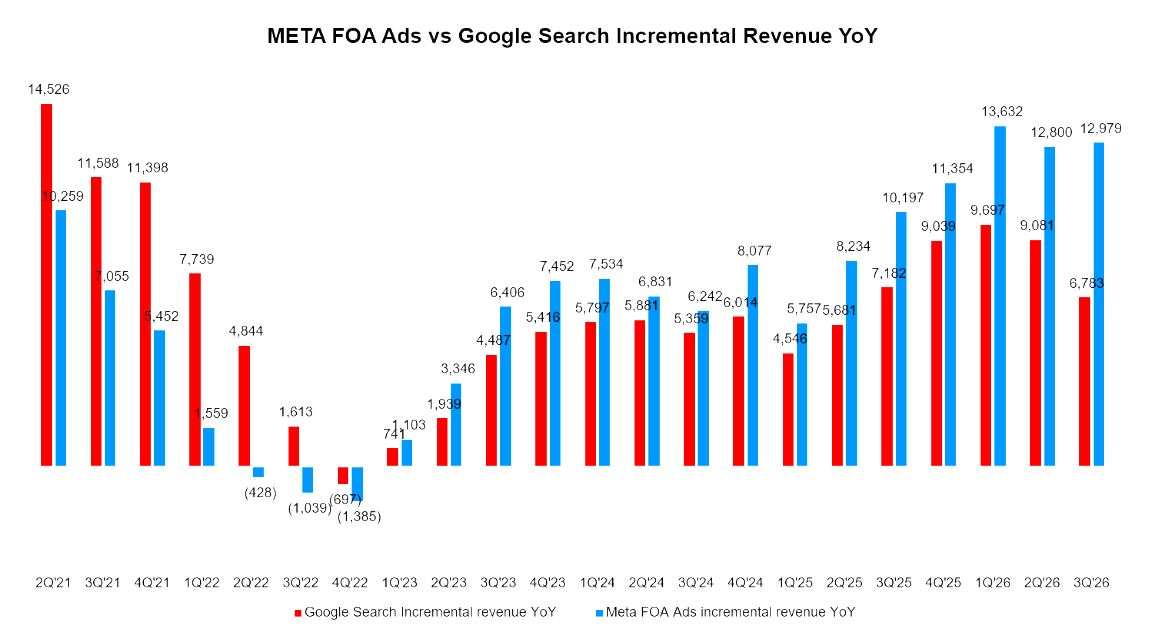
Next quarter, for the first time ever, $META ad business will be larger than $GOOG search, and it is also growing at >2x the rate.
Factor and sector rotations off of day to day and often conflicting data points have been a hallmark of the 2026 market. Not sure if its algos or just heavy retail participation or both. But I would say this: stop reacting to the daily data points - especially during earnings. It's stupid and a recipe for getting chopped into oblivion. While earnings reports are useful for directional trends on sectors, every company is different. Obviously. And different things impact quarters. To wit - its Thursday. Sunday night: AI trade over. Monday after Anthropic S1 out: Oh there's a healthcare TAM here and inherent operating leverage on compute, buy AI! Tuesday: AI stable, sell $SPOT! Weds: Send AI Weds PM: $GOOGL sucks, puke it, its over. Buy $META (why? idk). $NOW sucks puke it. Capex peak in sight (in line with consensus) puke AI. $MSFT good, buy it. Thurs: AI over, software over buy $SPOT. $MSFT good but its AI and software, sell it. Try and have an investment view anchored in what you believe to be confirming data points you expect to see in coming weeks, months, years. Hedge tactically as the data points inevitably aren't linear. Barbell core investments with tactical trades to hedge and take advantage of the rotational chop. Such trades are best in highly liquid securities. But if you trade like a bipolar lunatic - much like the market has traded - you will not do well.
Great news Evil corporations like Vanguard, BlackRock, State Street, Fidelity lost $61.3 billion in $GOOGL today Good riddance
Alphabet reported $127.6 billion in revenue, up 25%, as Google Cloud doubled to $30.7 billion and 36.2% margins.
$NOW $FTNT $GOOG $CTSH All abysmal. The factors are going to be really confused today
Google’s AI search could improve ad economics, while Amazon protects its retail ad funnel from shopping agents and specialty insurers face…

Alphabet’s $200B 2026 capex and weaker AI-search monetization contrast with Microsoft’s accelerating Copilot and Azure momentum; the review…

Alphabet’s Q3 long-term debt jumped 479% amid AI spending, reviving concerns over AI-funded leverage even as a Fed policy update lifted…
 Uttam Dey

Alphabet missed Q3 expectations as $51.4bn capex and AI spending pushed free cash flow to negative $9.1bn, despite Google Cloud revenue…
@808_38hz @realsteveeisman Interesting insights. I agree that people will be reticent to hand over their life to Muse (but already handed it to $GOOG). $META
One year later, and it’s become apparent that the whole fucking market is basically a binary bet on AI capex. $GOOG capex is now at ~40% of sales in Q3, $MSFT at over 42%, and $META at over 52%😵💫 And we’re talking about quarterly capex bills in the $30–50B range for each co.
@apmoww @realsteveeisman I've been talking about this for a while in our work, but please dismiss my comments if it makes you feel good. Better yet, go talk to some people who rely on SEO/SEM and ask them what's going on in the funnel. Plenty of third party data points you can find as well. $GOOG
$GOOGL Cloud revenues...+103% Y/Y growth...wow
I've been short $GOOG for 6-9 months now. It's been on our Watch List and I mentioned it on the @realsteveeisman podcast over the summer. The thesis is pretty straight forward: The best business model ever created is now in secular decline and is being replaced with something that is far less compelling financially. Then you add in all of their issues around Gemini, CAPEX, slowing growth at Youtube, the prospects for dilution... I honestly don't believe this statement: "Google Services revenues increased 11% to $96.3 billion, led by 12% growth in Google Search & other with the year-over-year Search query growth rate the highest it has been in the last five years." The last part in particular. There's no way the query growth rate is the highest it has been in the past 5-years unless there are bunch of agents conducting searches, which is possible.
$GOOGL Q3 Earnings: *ALPHABET 3Q REV. $127.58B, EST. $127.96B *ALPHABET 3Q EPS $2.12 VS. $2.87 Y/Y *ALPHABET 3Q OPER INCOME $40.58B, EST. $43.16B *ALPHABET 3Q GOOGLE CLOUD REV. $30.71B, EST. $29.1B *ALPHABET 3Q CAPEX $51.36B, EST. $55.78B
Ramp data shows VC-backed companies are spending 10x more per employee/month on AI vs. PE-owned and other companies. A bearish interpretation could be: token spend is being driven by VC-backed companies, making demand vulnerable to swings in capital cycle. Valid! However, on a longer timeframe, I think this is quite interesting as a leading indicator for the direction of software companies (VC-backed companies are mostly software or service-as-software companies). New companies are being built with a larger ratio of tokens vs. humans. Look at Anthropic itself, which pays 1/6 as much on intelligence as its customers (since it sells tokens marked up at 85% GM): Anthropic is spending ~9x more on compute than human salaries despite having access to tokens at cost. Cash payroll is annualizing ~$2B for a company with ~$60B of run-rate revenue in 1H26. Anthropic employs just 5k people. Wild efficiency in human capital. I suspect that the great software companies of the next decade, both new and incumbent, will insert AI into every aspect of their products so that using them feels like magic, and work happens seamlessly. Building a presentation in Claude feels like magic: I tell it what I want to put on a slide, and it appears like magic. As a user of Ramp, their products feel the same way: I make a purchase, take a picture of a receipt, and the expense is logged into my accounting system appropriately without the need for a human to type into a blank box. I think we will see most software become AI-native or be replaced by software that is. This is a significant opportunity for incumbents and startups alike. And I think this is a huge source of future token spend that will go to $AMZN and $GOOG where most software companies are built (on AWS and GCP) and where AMZN and GOOG are building the platforms for software companies to build AI capabilities into their products with choice around compute and model, embedded safety and governance, and unlimited scale. Amazon CEO @ajassy said on a podcast this week that AI spend is currently a "barbell-shape" with insatiable compute appetite of the AI labs on one side, and corporates using AI for cost savings on the other. In the middle is tokens embedded into "core workloads" which he says is growing but small today, but he thinks in 5 years might be the biggest category of token spend.
The main takeaway here is that one week OpenAI has the best model, then it's Anthropic, then it's Google, in a never-ending cycle of incramental model improvements. Feel very lucky to be living through this. PS: feels like this is an early signal that $GOOGL will announce increased CapEx in Q3 earnings later today.
Google issued equity before SPCX was public. And they’d have had to wait until after a lockup expiry, as will AMZN if they want to sell $ANT. Google also paying some spot compute at $50B/GW so timing of cap raise matters more. And I think just a bit more balance sheet conservative culture, and stock was up 100% in a year and at valuation range highs. I have no issue w/ decision $GOOG made in context.
Significant step in externalizing the TPU business for $GOOG - $ORCL announces Google TPUs to be available through Oracle Cloud Infrastructure (OCI) - Marks the first time Google TPUs will be offered on a hyperscale cloud platform outside Google. - Google TPUs on OCI will be available in calendar year 2027, ramping over a multi-year period to meet customer needs.
Letters that discuss GOOGL.
Companies the stories above are also about, besides GOOGL.


