

Calvin Blissett on X
@SteinHajek $YB has been ready for AI and using it since 2019 I believe is the year. Leveraging it nicely today
NASDAQ
Cap as of Nov 16 13 stories
Get YB news in Claude, ChatGPT or your own code. See plans
@SteinHajek $YB has been ready for AI and using it since 2019 I believe is the year. Leveraging it nicely today
I spoke with the $YB CFO and IR team. Regulation was what worried me most going in. It worries me a lot less now. My takeaways:
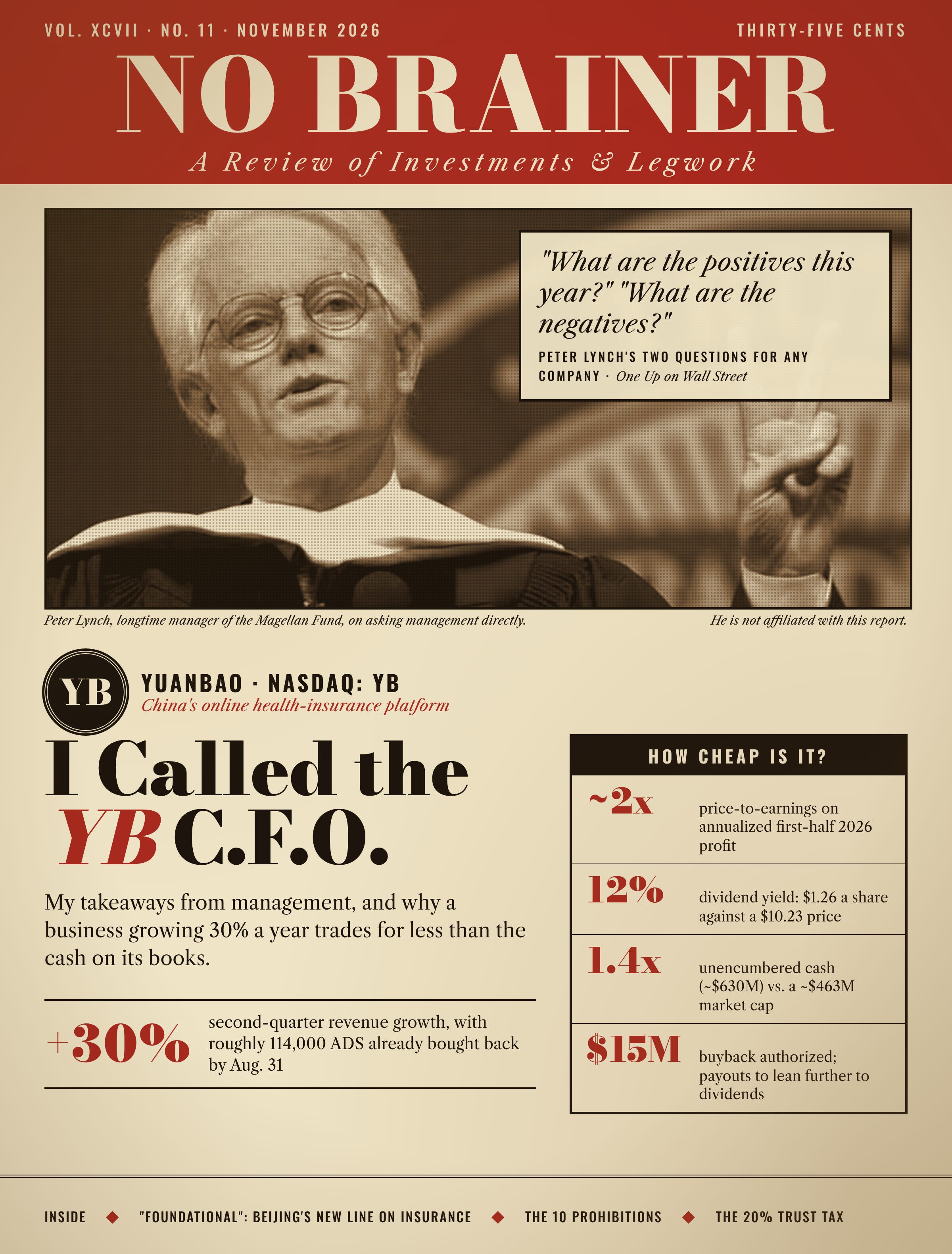
Yuanbao’s CFO says China’s new online-insurance rules target abusive sales practices, while Beijing increasingly frames commercial health…
I listened to a Bill Gurley @bgurley interview on @TKPPodcast, great interview by the way Bill. He compared the US AI labs to farmers who go to the market and just trade goods, whereas in China the farmers go to the market, trade goods, and are forced to share best practices and help each other implement them. In his words: “The competitive dynamic in China is more intense. Because it is more intense, everyone has chosen to go open source. That creates a system that is capable of innovating far faster than the competitive system we have here.” China’s way results in exponential learning and growth, which is pretty clear. Charlie Munger was a notorious China bull late in life: “The reason that I invested in China is I get so much better companies at so much lower prices.” Sentiment has also got to account for something. China’s CSI 300 just confirmed a bear market, down 20.2% from its June peak, and 19 years later it has still never closed above its 2007 high. On October 23 the Hang Seng Tech index fell 5% to a two-year low and the CSI AI index fell 3.3% in a single day. I am expressing this macro view through a bottoms-up investment I found: a shareholder-friendly, founder-led company paying an 11%+ dividend and authorized to buy back about 3% of its market cap. Revenue grew 33% in the first half of 2026, net income grew 34%, and paying users went from 3.8 million in 2021 to 18.2 million in 2025, a 48% CAGR. It has been preparing for AI since the beginning. The founder: “From the very first day of the company’s founding, we had our own AI algorithm engineers and big data team… we began applying these cutting-edge technologies as early as 2019.” Today about 70% of staff are R&D, AI-generated code is approaching half of all R&D code, and net margins run near 30%. All for the grand price of about 2.5x earnings, with a ~$494M market cap sitting below roughly $630M of unencumbered cash. Did I mention there are forced sellers selling for completely non-economic reasons because they are VC investors? VCs including Hike, Northern Light, Qiming, SIG and Sequoia China owned about 55% of the company after the IPO. Qiming alone has sold 43% of its stake in nine months, from 19.4M shares to 11.1M, per its 13G filings. Here is my writeup on Yuanbao $YB:
$CCLD $YB $CCOI $BOC $AMR $HCC $CNR $METC $USIO $HHS $HY $ARKO $SLM
@sidecarcap This is exactly what I think is happening with $SLM $KSPI and maybe $YB. $KNSL too
I kind of love this, sets up the capital slosh effect that happened in 2000s with the great rotation from tech to value. I think something similar happens here eventually and offers uncorrelated returns which will be more valuable. I will be eating dirt on value until then, clipping my coupons and buybacks. $KSPI $BOC $SLM $HHS $ZIM $CCLD $WU $HY $AMR $CNR $METC $HCC $FISV $YB $BTU $CNRD
@InverseMax @grok all management quotes on buybacks future and past for $YB
$YB 5% of my portfolio. See writeup for evidence and anecdotes of the quality of the founder
@JordanBoekel I have skimmed over $FINV, $LX made good money in $YUMC, looked at $PDD. I think management is even more important given regulatory risk and China and that is partly why I like $YB
I feel AI can answer this better than me, kind of just giving more context on my other response. 54 sources used. Good read for $YB investors: Acquisition tactics repeatedly described as traps Chinese media, Black Cat (Heimao) complaint records and consumer-association notices describe a variant of the industry “magic-cube” (魔方) funnel that regulators have tried to curb since 2020–2021: - Pop-up and short-video/mini-program ads offering “first month ¥0.6 / ¥1,” “free claim,” or “¥1 for high coverage.” - Low-friction flows (SMS code, minimal identity checks) that default or bury auto-renewal, password-free WeChat/Alipay debit and upgrade from a one-month “experience” policy to a full-price monthly plan (often ¥90–800+). - Terms, health declarations and price jumps placed in small print or behind easy “next” clicks. Elderly users in lower-tier cities are disproportionately cited; children frequently discover multi-month or multi-year deductions only when reviewing bank or Alipay statements. - Documented examples include continuous deductions totaling ~RMB 1,500–2,200 over months and one multi-year case claimed at ~RMB 22,400; several policies sometimes opened on the same person. Refunds are often obtained after platform or media complaints, sometimes with partial fees withheld until complaints are withdrawn. A 2022 Shaanxi banking-insurance regulator fine (RMB 10,000 on the brokerage entity plus warning/fine on an executive) cited failure to conduct internet brokerage business as required. In 2024 the Gansu Consumers Association publicly criticized a related agency (Shouxin) for enrolling and debiting a consumer without authorization. SEC 20-F risk factors discuss dependence on third-party traffic channels, evolving CBIRC/NFRA online-insurance rules (including limits on intermediary marketing of personal lines), reputation harm from complaints, and the need to retain consumers, but do not specifically disclose the auto-debit or “first-month” funnel controversies. Not unique to YB The same pattern is widespread among Chinese internet insurance intermediaries. Waterdrop (水滴保) has drawn larger complaint volumes on the same platform (reports of 2,300–3,200+ entries) and has received larger fines (including a RMB 1 million penalty tied to “first-month zero” sales). Zhonghui Mutual and other carriers appear in parallel cases. Regulators have repeatedly flagged “first-month ¥1,” default upgrades and unperceived auto-debits; a 2026 multi-agency network-marketing rule (effective 30 September 2026) adds mandatory reading timers, bans one-sided promotion of the first-period premium, requires one-click popup closure, and prohibits default bundled sales and unauthorized automatic charges. Management statements and evidence of change - 2022 company responses (Sina Finance and others) defended “first-month ¥1” products as carrier-designed and regulator-filed, said many listed complaints predated tighter rules or were mis-attributed, and claimed near-100% resolution of its own cases with relatively low complaint counts versus peers. - August 2026 responses to Pengpai/The Paper on a specific ¥0.6-to-full-premium case asserted that backend logs showed completed login, disclosure reading, health notice and bank authorization, called the enrollment compliant, and issued a full refund “to resolve the dispute and improve service,” not as an admission of fault. The company stated that 2026 flows added mandatory reading countdowns and stronger confirmation steps; independent media tests of the WeChat mini-program confirmed longer forced-read sequences and the removal of some ¥0.6 experience creatives. Quantitative signals are mixed. Black Cat counts cited across 2022–early 2026 cluster around 850 rising to ~1,200 and then largely plateauing while new policies scaled into the tens of millions (one outlier report cites a much higher cumulative figure under broader search terms). Absolute complaint volume is therefore small relative to 30 million+ annual policies, yet the cases that surface are concentrated on elderly users, multi-month silent debits and difficult cancellation—exactly the pattern that generates media coverage. Many disputes end in refunds once escalated. High marketing intensity continues, consistent with reliance on low-friction paid traffic. How large is the problem? It is real and recurring, documented in complaint platforms, consumer-association notices, small regulatory actions and consistent anecdotal patterns, but it is amplified by media focus on elderly victims and by the emotional visibility of “unknown deductions.” It is an industry feature of high-CAC internet insurance distribution in China rather than a YB-only practice; peers show comparable or higher complaint intensity. Upcoming 2026 marketing rules directly target the tactics described. Filings treat the issue mainly as general regulatory and reputation risk rather than a disclosed operational failure.
Yes, obviously some nuance depending on what site but I see what you mean, one listing 1,217 complaints. They did have a 100% resolution rate which was nice to see. Also the article in June 2026 about a women’s complaint. This is a risk to watch as it mostly stems from them selling low priced first month policies (0-1RMB) which then go to say 100RMB a month that people get blindsided by. This is also a regulatory risk as regulators have mentioned against this. $YB

Yuanbao pairs a 10.2% dividend and cash exceeding its market value with 33.5% first-half profit growth from AI-enabled Chinese insurance…
Companies the stories above are also about, besides YB.
