
Aya Gold & Silver Stock: The Story Just Got Better
Aya Gold & Silver quadrupled Zgounder production, lifting shares 331% since early 2025, while Boumadine targets another fourfold increase…
 Laurentian Research 2 clicks
Sector
Everything our editor has picked under this sector, best first.
169 stories
Aya Gold & Silver quadrupled Zgounder production, lifting shares 331% since early 2025, while Boumadine targets another fourfold increase…
Laurentian Research 2 clicksOur least-favoured bet on next-generation nuclear: light-water SMRs. Smaller does not automatically mean cheaper. A 50–300 MW small modular reactor produces far less power than a 1 GW plant, but containment, site infrastructure and other costs may not shrink proportionately. Factory production and simpler safety systems can help, but those savings must outweigh the loss of scale. The result could be a higher cost per installed kilowatt, not a lower one. Advanced alternatives offer higher temperatures and more industrial uses. But we think many face a bigger obstacle than licensing: securing enough fuel. To understand the investment trade-offs, separate two questions: what cools the reactor, and what fuels it? Light water → Proven technology, established fuel supply. Uses ordinary water and fuel typically enriched below 5% uranium-235. Runs at around 300°C under pressure, producing electricity and lower-temperature heat. Its advantage is maturity; its limitation is that it cannot directly supply the hottest industrial processes. Shrinking it does not necessarily improve its economics. Sodium → Higher temperatures without high pressure. Transfers heat efficiently and operates near atmospheric pressure, reducing the need for heavy pressure-containing equipment. The catch: sodium burns in air and reacts violently with water, requiring strict separation and additional safeguards. Helium → High-temperature heat without a chemically reactive coolant. Can reach roughly 750°C or more, supporting more efficient electricity generation and industrial heat. Helium does not burn or react chemically, but the system operates under pressure and must stay leak-tight. Leading designs also require specialised TRISO fuel. Fluoride salts → High-temperature heat at low pressure, without sodium’s fire risk. The challenges are corrosion, suitable materials and preventing the salt from freezing. Some designs, such as Kairos Power’s, use salt to cool solid TRISO fuel. Others dissolve the fuel in the salt itself. These are different designs with different fuel requirements. Then come two separate fuel bottlenecks: HALEU is about uranium enrichment. It contains more than 5% but less than 20% uranium-235. Many leading sodium-, helium- and fluoride-salt-cooled designs need it, although not every advanced reactor does. Western production remains limited. Centrus Energy ($LEU) has produced small quantities with demonstration equipment and targets new enrichment capacity in 2029. We do not expect sufficient supply for broad deployment before the late 2020s at the earliest. TRISO is about fuel manufacturing — not a type of coolant. Tiny uranium-bearing particles are wrapped in carbon and ceramic layers designed to retain radioactive fission products even at roughly 1,600°C. That is a major safety advantage, but manufacturing and quality control are demanding. US production already exists, but capacity needs to expand substantially. X-energy’s ( $XE) larger TX-1 facility is still under construction. Helium-cooled and some salt-cooled designs therefore face both bottlenecks: getting HALEU, then turning it into finished TRISO fuel. For investors, a reactor licence is not a fuel supply chain. And a smaller reactor is not automatically a better investment.
Dorchester Minerals' 9.5% normalized yield and debt-free royalty model are offset by limited upside at $29.71, as extraordinary…
 Atlas Diary 3 clicks
Alcoa Posts Higher Third-Quarter Profit, Sales on Increased Production $AA https://t.co/4VwFeELF1e
Adjusted EBITDA should be lower than Q2 and last year's Q3 (this year's Q2 was actually higher than last year's Q3!). But EPS should definitely be above analyst estimates and could possibly top Q2 EPS. Market doesn't understand how the hedges on the specialty alcohol work. Q2 EPS were penalized simply because the price of ethanol fell a bit during Q2. Well... during Q3, the price of ethanol rocketed higher. Therefore, even though Q2 had a much better average crush margin than Q3, it's possible Q3 could have higher EPS due to how these hedges work. To be clear - on an annual basis - the hedging has no impact. $ALTO is just locking in profit margin. But since it's not hedge accounting... it has an impact on each quarter's earnings. ALTO's business is operating very well. They're posting quarter after quarter of profitable earnings. Q4 should be solid as well and crush margins are strengthening again. Once California E15 kicks in (1/1/2027) then margins will strengthen further. Additionally: It sounds like passage of farm bill that includes E15 is very likely by end of this year. Check out this Politico article highlighting how the GOP is likely to pass a ton of stuff before the end of the year: https://t.co/3VL4DjDnzy "Such a bill, he added, would be “giant” and would include “all the Republican priorities that we can get done.” The House approved a framework for a party-line bill over the summer that includes war funding, farm aid and election integrity incentives. But the push has so far run aground in the Senate Moreno said the threat of imminent Democratic control of either the House or Senate would jump-start matters — and potentially push Republicans to include a debt-ceiling increase as well." "Moreno said if Democrats win control of both chambers, Republicans should stay in session nonstop to pass GOP legislation — which could be a tall order given worries about poor post-election attendance. “If we lose the House and the Senate, we should be here from Nov. 9 until Dec. 31 with no break at all,” Moreno said. “Like, we’ll have turkeys here for Thanksgiving because we have to get this done.”"
Example: $FMC down ~40% premarket on "horrendous" guidance https://t.co/EvQvUTqGV0

Peabody Energy’s recovery case hinges on Centurion, coal-market leverage, capital allocation and balance-sheet strength amid commodity…
 CAN Analyst 1 click
Definitely some insider trading yesterday prior to the news today as ethanol prices rocketed higher (Nov jumped nearly 6 cents). October crush margin for the 2nd half jumped to $0.42 yesterday... we'll see if ethanol rallies again now that the news is actually public. $ALTO $GPRE
Huge news for $ALTO and $GPRE https://t.co/yM3rX4dAh8
Palm Valley Capital Fund bought even more of their largest position, Rayonier $RYN, during the quarter. The Fund estimated that the timberland REIT is trading at a meaningful discount to its estimated value, driven mainly by weak lumber prices. Shares continue to derate even as the company generates strong free cash flow. It now has a 5.6% dividend yield.
Albemarle posted a 20-fold Q2 profit increase and $638 million of free cash flow as lower lithium prices drove its shares down 40%.
 The Supercycle Investor 2 clicks
$FF: $195m EV, 30-40m current EBITDA est at RIN prices. 30m in hidden Arkansas land value (1.7k A out of 2.2k not being used) Thesis: Future Fuel's economics are primarily a bet on biodiesel margins. FF owns a relatively high-cost 59-million-gallon-per-year biodiesel plant, so it generally needs stronger industry margins than larger competitors to justify running at high utilization. The reason a high-cost producer like FF can still matter is the Renewable Fuel Standard (RFS): refiners must satisfy EPA-mandated renewable-fuel volumes, either by blending fuel or acquiring RIN credits. When mandated demand approaches or exceeds economical industry supply, the D4 RIN price rises until the marginal/high-cost producers have enough incentive to restart. FF is one of those marginal producers. That is the core thesis today. D4 RINs have risen sharply from roughly $0.50 in the depressed period to around $1.50, reflecting tighter expected supply/demand, while the EPA's much higher 2026–27 requirements should require substantially more biomass-based diesel production. If the industry remains short of required supply and the RIN bank is drawn down, RINs and therefore biodiesel margins should remain high enough to keep FF operating profitably; roughly speaking, every $0.10/gallon of sustainable margin on ~50 million gallons equals ~$5 million of annual operating profit. A return toward $0.30–$0.50/gallon margins could mean ~$15–25 million of biodiesel operating profit, versus very little or losses when margins collapse. The catalysts are higher plant utilization, continued tight D4 RIN supply/2027 RIN-bank depletion, and stronger chemicals earnings; the major risk is the opposite—RIN prices fall because supply increases, EPA policy weakens demand, exemptions expand, or renewable-diesel capacity overwhelms the market. In simple terms: FF is the expensive factory that the market may now need to run, and the RIN price is effectively what determines whether it gets paid enough to do so.

Brazil Potash has secured court support and a power agreement, but financing, dilution and potash-price-sensitive EBITDA remain central…
 Wolf Report 3 clicks
The S&P 500 lost 18% in 2022, and the Bloomberg U.S. Aggregate, the main U.S. bond index, lost 13%, its worst year since it began in 1976. Over the same year, $XLE, the S&P 500 energy sector ETF, returned 64%, gold was flat, and cash earned ~1.5%. Now what if I told you there's a framework that would've said to own cash and energy in 2022, not stocks and bonds? That framework is called Gave's Four Quadrants, after Charles Gave, co-founder of Gavekal, a macro research firm. It uses two ratios built from market prices, the S&P 500 vs. Oil and Gold vs. Treasuries, to place the economy in one of four environments, and it describes what to own and what to avoid in each. Here's how stocks, bonds, gold, and cash tend to perform in each environment: → Deflationary boom: Stocks, bonds, and cash rise, and gold underperforms. → Inflationary boom: Stocks and gold rise, cash does very little, and bonds fall. → Deflationary bust: Bonds and cash rise, gold stays fairly stable, and stocks fall. → Inflationary bust: Gold and cash rise, while stocks and bonds fall. In my backtest of Gave's rules from 1970 to September 2026, a portfolio split equally between cash, the S&P 500, and either 10-year Treasuries or gold, whichever the framework favored, would have returned 5.7% per year after inflation. Its max drawdown was 28%, vs. 54% for the S&P 500. As of the end of September 2026, the two ratios place the U.S. in an inflationary boom phase. But since January 2025, the S&P 500 to gold ratio has been below its 7-year average, which has often come a few months before the S&P 500 to oil ratio drops below its own 7-year average. If that happens, the U.S. is back in an inflationary bust phase, like 2022. So how do you read the two ratios yourself, and what do they say to own today? That's what I walk through in my new ~20-minute video!
Wow! $ALTO $GPRE https://t.co/Hj3xWMAbMH https://t.co/H0Giupx0ym
Wow - corn-o-plenty for $ALTO and $GPRE Shocking USDA numbers today.....
Probably nothing $2 trillion budget deficit for the FY Up 12% YoY During a “strong economy” (I am told) $GLD $IBIT https://t.co/mpwq2nmPOY
OceanaGold trades below its mine value despite US$655 million of cash and no debt, with production set to dip before Wharekirauponga begins…
 The Bullionaire 1 click
Namib Minerals posted H1 adjusted EBITDA of $19.0 million, up 76%, as higher gold prices offset lower production.
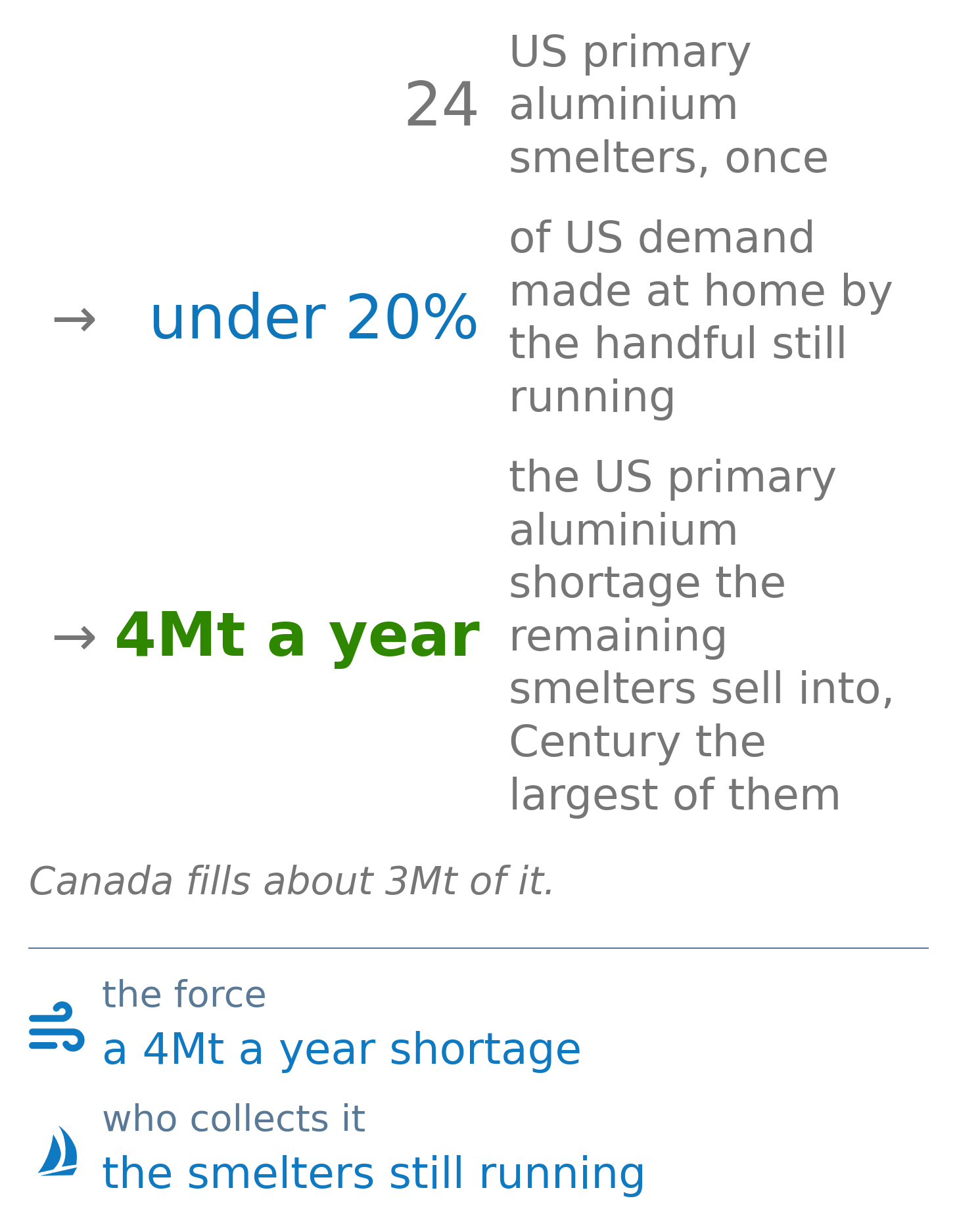
US aluminium tariffs, European glass automation and Foraco’s constrained drilling fleet create multi-year pricing tailwinds, with Century…
@ptuomov Are you talking about the NAV or what the vol would be if it were a publicly traded ticker? Things like $FPI and and $LAND could be a good guide if the latter.
Bernstein on China aluminum ceiling: The ceiling has moved from distant policy to binding constraint. China introduced a 45mtpa aluminum capacity ceiling in 2017, but the limit only matters now. Operating capacity reached 44.8mtpa in 2025, with utilization at around 98.5% $CENX https://t.co/MO6I7y1m2W
I listened to ~17 interviews with Jason Jessup, the CEO of Magna Mining $MGMNF (TSX: $NICU), from October 2025 to September 2026 (for my deep dive). For context, Magna owns McCreedy West, a producing copper mine in Sudbury, Ontario, plus Levack and Crean Hill, two past-producing mines it plans to restart. Here are the most important takeaways I got from those interviews: 1) Levack could be 2-3x McCreedy West: Jessup expects “possibly two to even three times” McCreedy West’s payable metal from Levack (The Resource Update, September 8). 2) R2 isn’t in Levack’s upcoming study: R2, a high-grade zone Magna found at Levack in 2025, could produce “10 to 15% copper equivalent material” even with 1-2 tons of waste mined per ton of vein (KE Report, July 10), 3-4.5x McCreedy West’s grades, and Jessup says the zone carries “no streams or royalties on the precious metals” (KE Report, April 20). 3) No more equity raises, he says: With CAD$140M coming from Alpayana, a private Peruvian mining group, for 19.9% of Magna, Jessup said “we could have five mines in production in 5 years and not have to ever do another financing again” (KE Report, July 10). 4) But three timelines moved back: (1) Levack commercial production went from “a good possibility” by the end of 2027 (KE Report, February 20) to 2028 (KE Report, July 10), (2) Crean Hill grid power from as early as Q1 2026 to Q4, and (3) the R2 resource estimate from the end of 2026 or start of 2027 to “potentially by the end of 2027” (Mining Stock Daily, August 13). 5) Skin in the game: Jessup says he owns ~10.6M shares, has “never sold a share,” and wants “a $5 billion company” by 2030 (Natural Resource Stocks, July 20), 6.5x Magna’s CAD$768M market cap at CAD$2.45/share. Levack’s PEA and Crean Hill’s pre-feasibility study are both due in October, and Jessup expects a formal Levack restart decision “shortly after seeing the PEA come out” (Mining Stock Daily, September 24). --- Link in bio to find the deep dive.
Seems like a real bull thesis for $CIBR and $GLD https://t.co/t08uLOuJfS
