

AppLovin Deep Dive
AppLovin rebuilt its ad model with AXON 2.0, lifting LTM revenue to about $7 billion and margins to 77% as Unity competition threatens…
Sector
Everything our editor has picked under this sector, best first.
162 stories
AppLovin rebuilt its ad model with AXON 2.0, lifting LTM revenue to about $7 billion and margins to 77% as Unity competition threatens…
I had an LP call my “shitco” … “snackwell”…. They can “snack” on this. $STGW @Mark_Penn @jayleveton @ballan11 Funny thing is it’s still 6x PE in 2027 ahead of a generational 2028 political year. $makeshitcosgreatagain $compoundersat30xPEnotthesamewith10yrat5pct $makingmoneythehardway. Or easy way?
$META bulls say its ad cash flow lets it undercut the AI labs on price. The Muse Wonder launch shows Meta matching their prices instead. Meta released Muse Wonder and Muse Wonder Full on Monday and says they score level with Claude Fable 5.1 and GPT-6 Astra on its own tests. Three details from the launch. 1. Wonder costs $4 per million input tokens and $20 per million output tokens on Meta's API. TechCrunch puts that in the same price band as GPT-6 Sol and Opus 5.5. Meta is pricing with the labs, not under them. 2. The stronger model, Wonder Full, is not on the API at all. It is only available to Muse Code subscribers. A developer comparing API models is not buying the model Meta uses to claim the frontier. 3. Both models are distributed only through Meta's own API and Muse Code subscriptions, and the launch says nothing about releasing the weights. I read this as Meta adopting the labs' business model rather than attacking it. The frontier model is a subscription product, and the API is priced at the labs' level rather than below it. That weakens one part of the bull case. If Meta is not undercutting, the price pressure on the labs that bulls expected has not arrived with this launch. The question for the results on 21 October is what Muse subscriptions, Muse Code and the API are earning against the spend on the Prometheus data centre that trained these models, not whether Meta can take the labs' customers on price.
We think Amazon ($AMZN) blocks Meta's ($META) Muse shopping agent partly to protect its advertising business, while Shopify ($SHOP) welcomes it to earn payment fees. Amazon cites authorization and security concerns. We also see an advertising business to protect. Amazon earned $68.6 billion in advertising revenue in 2025, including payments from sellers to place their products prominently in front of shoppers. An agent that selects products without taking customers through those sponsored listings could reduce sellers' willingness to pay for them. Amazon still handles payment and delivery, which gives it bargaining power even when an agent chooses the product and places the order. Shopify welcomes Muse through Shop Pay. It can keep earning payment-processing fees when agents complete purchases through its systems, and it has no comparable advertising business to defend. We think shopping agents could favor merchants whose products stand out for quality or features over merchants whose sales depend heavily on paid placement. That could give independent brands another way to reach customers, which would benefit Shopify as more purchases pass through its merchants' stores. Agents and established platforms could still agree to share advertising revenue. We are watching whether agents improve product discovery or simply become another place where sellers pay to be recommended.
@SowingAlphaSeed That's part of it, but my $SNAP thesis has always been that bulls don't understand the product or user base. There's very little ability to monetise the core product (picture messaging) and their user base ages out and is saturated in developed markets. NA MAU is declining.
$SNAP up 40% from the June lows and I'm seeing pitches popping up on fintwit. It may be time to reload the short. Reminder: $SNAP is a forever short. https://t.co/RawmZpUyLp
$SPHR Update on my old friend Sphere. The recent sell off seems to be directly related to some sell-side rerating of the stock based on "soft data". I find that kind of interesting because the data has been soft for many months (see daily ticket sales chart below), and among investors that I talk to, this isn't a "surprise". (Realistically that's why the stock traded down from $170 to $130). So this "surprise, the data is weak, stock rerates down 25%" is interesting to me, but also reminds me: it's always extremely hard to figure out what the market has or hasn't "priced in". The issue with the "soft data" is that my (and many) original projections was that WoZ would trough at around 1.4-1.6m/day of sales in 2027. By the summer we observed levels of ~1.2m so that likely wasn't going to happen. Towards the end of the year, the data has inflected upwards, we're down YoY (expected, given less hype than the launch a year ago). Some of this is likely due to LV weakness in general, but I think that's a relatively small fraction of the story. Personally, I find this data interesting because A) I think it's largely meaningless to value the company B) I think the market overreacts to it I think the Sphere business is humming along extremely nicely. The concert business is consistently improving (higher numbers, better acts, more utilization). The ads and bookings businesses are healthy/growing, there are 2 (and probably more unannounced) additional Spheres working through production. What WOZ did was prove that a "hit film" could generate enormous interest/revenues/visitors to the Sphere. Whether it "levels off" at $1m/day, or $1.2m/day or $1.4m/day, doesn't matter that much because the longer term model is to consistently launch NEW films launch and generate $1.5-$2.5m/day. And they have somewhere between 2-3 new films coming out next year, and probably another 2-3 films in 2028. AI is cutting their speed (and cost) of making films dramatically. Overall I'm a buyer at these $100-$120 price levels (We're long via some short Nov $120P's that are currently in the money). Given recent price action, it's hard to say how the market reacts to the November earnings release, but I think the earnings picture has stabilized from here and the stock is setup for good fundamental catalysts driving earnings growth in 2027.
Alphabet pairs 17% Search growth, 82% Cloud growth and 500,000 weekly Waymo rides with a $195–205 billion AI capex plan.

AppLovin's Ads Manager targets middle-market e-commerce advertisers as Q3 guidance calls for 47% sales growth, while legal and compute-cost…
 Jack Elias 3 clicks
Meta’s Reality Labs shifted spending toward smart glasses, accepting roughly $40 per-unit losses to build an eventual advertising platform…
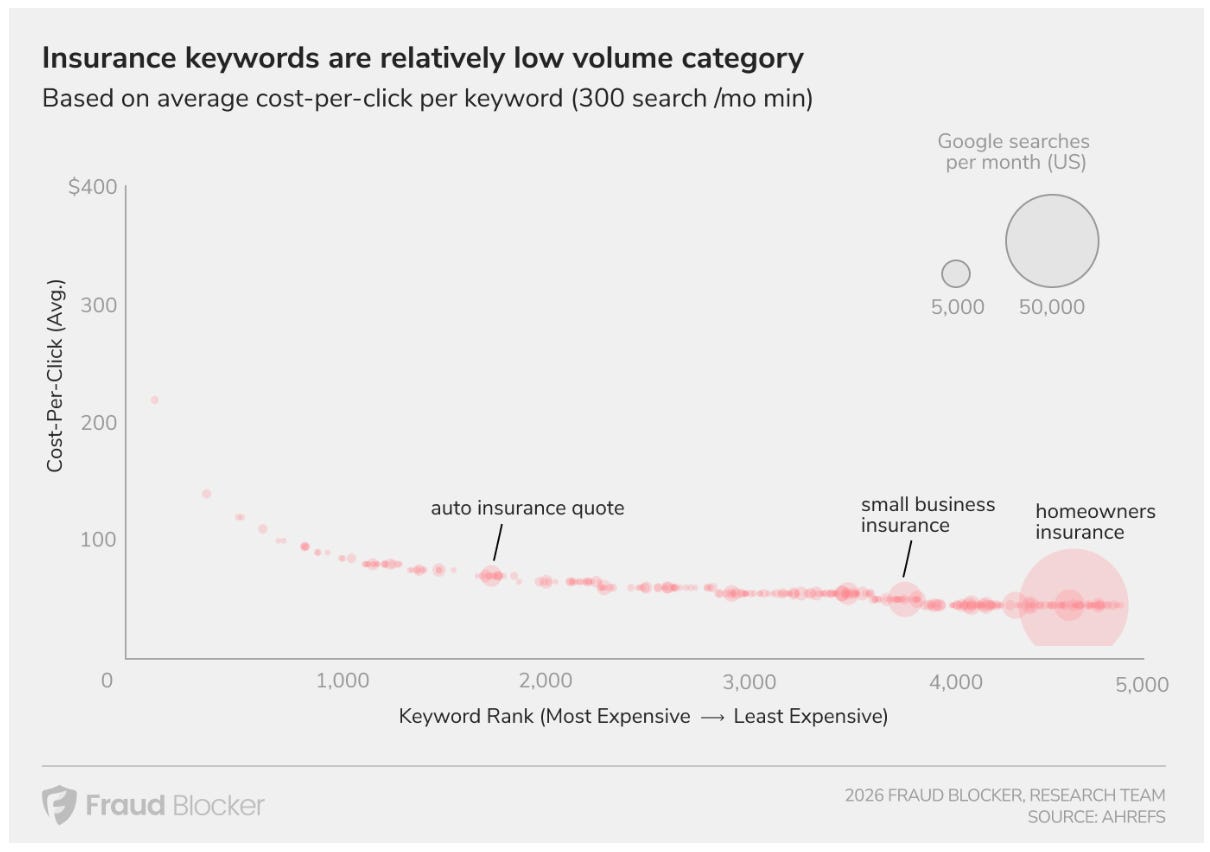
Meta’s Muse could place ads inside its AI agent by letting a private VM select offers from advertisers without sharing user data with…
Entravision $EVC down on the Univision deal as investors have completely forgot about the growing ad-tech business and are underwriting for a dying media company that plays non-stop Taco Bell ads.
Google $GOOG Key bear argument: Search is their largest business and likely faces a long term headwind instead of long term tailwind. At least probably, since they are doing a good job incoperating fast AI responses into search. Android (and iOS and Windows) are threatened. The work culture is weak (but seems to be improving). Key bull argument: Most of their other businesses are good/great and growing. A couple are big AI winners. TPUs in particular are a likely key AI ingredient if either/both inference and electricity efficiency matter a lot (I think yes to both). YouTube is a big AI winner. Cloud/compute biz wins from AI, deals are structured in a way with no downside for $GOOG (but plenty of downside for the companies locking into the contracts). Management are fantastic capital allocators.

Nike grew from a $1,000 shoe-distribution venture in 1964 into the largest sports brand, using athlete endorsements, product innovation and…
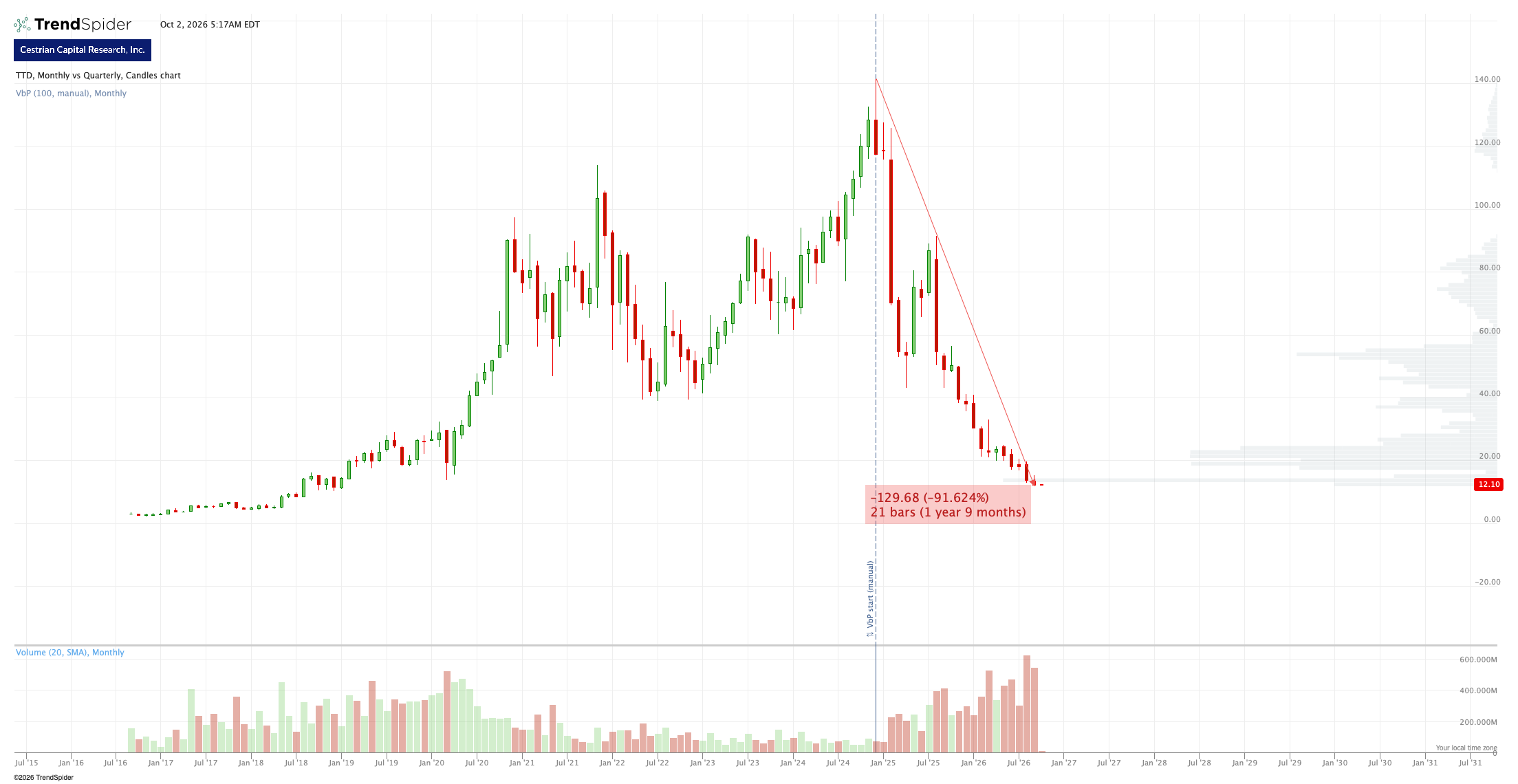
The Trade Desk's Q2 revenue grew 3% to $715 million as Q3 guidance called for a year-over-year decline; TTD has fallen over 90% from its…
Looks like $APP and $EVC are doing some things together. https://t.co/bzdFqKEJjL

Muse could sidestep ads by becoming a neutral commerce agent, while DoorDash and Airbnb build proprietary agents that steer users toward…
@teechongyen Terry Smith: Owned $ADBE much higher already sold. Recently bought $FICO and $APP just before they crashed. Man doesn't miss.
Q3 absolutely sucked, and my performance currently stands at 37.8% YTD versus 65.8% at the end of Q2, marking the worst drawdown from a high since I started sharing my buy/sell decisions on Substack. Apparently, the Market Gods decided this is what you get for calling your last portfolio update “Half-time Lead.” …I’m just glad I didn’t use a Buffett quote. That might’ve finished me off. While I barely felt the pre-2024 election volatility, the spring 2025 tariff scare, or the start of the Iran war in 2026, Q3 broke that pattern. $EVC, my largest position, fell more than 40% from its highs and made sure I felt this one. The portfolio’s relative resilience, something I’d come to appreciate, disappeared with it. Of course, I have plenty to say about Entravision, but I’ll save the fundamental developments for later in the article. Q3 was a season of portfolio pruning (wow, I never thought I’d use that phrase). I exited two winners, realized one loss, added to a large position, saw a rare billion-dollar-plus company find its way into my portfolio, and ended the quarter with 6% in cash versus 0% at the end of Q2. I ended Q3 with 11 holdings, with the top three accounting for 53% of capital and the top five for 70%. Portfolio beta also came down from 0.95 at the end of Q2 to 0.80 at quarter end. That is still elevated relative to the portfolio’s historical level, largely because my biggest position carries a beta of 1.68, while every other holding sits below 1. I’ll save the longer performance review for year end, when we can hopefully put what I still consider a satisfactory 2026 into proper perspective. For now, I think it’s better to focus on what actually matters for a concentrated stock picker like me: what has changed fundamentally, how those developments affect the risk/reward, and where my conviction stands today. As usual, at the link below I went through the portfolio from the smallest position to the largest.
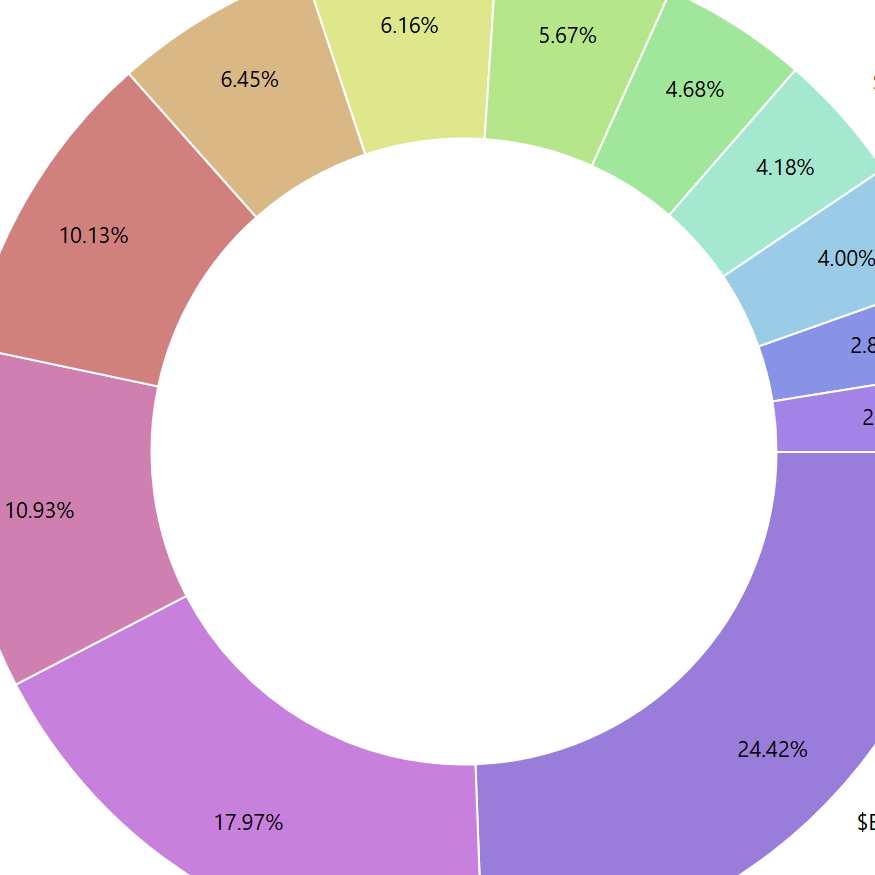
Entravision, the portfolio’s largest position, fell more than 40% from its highs as Q3 returns dropped to 37.8% YTD.
@NthObject89773 @pradeeepk Given $APP's sketchy history of using data, rather ironic that they would complain about a little turnaround of their tactics.
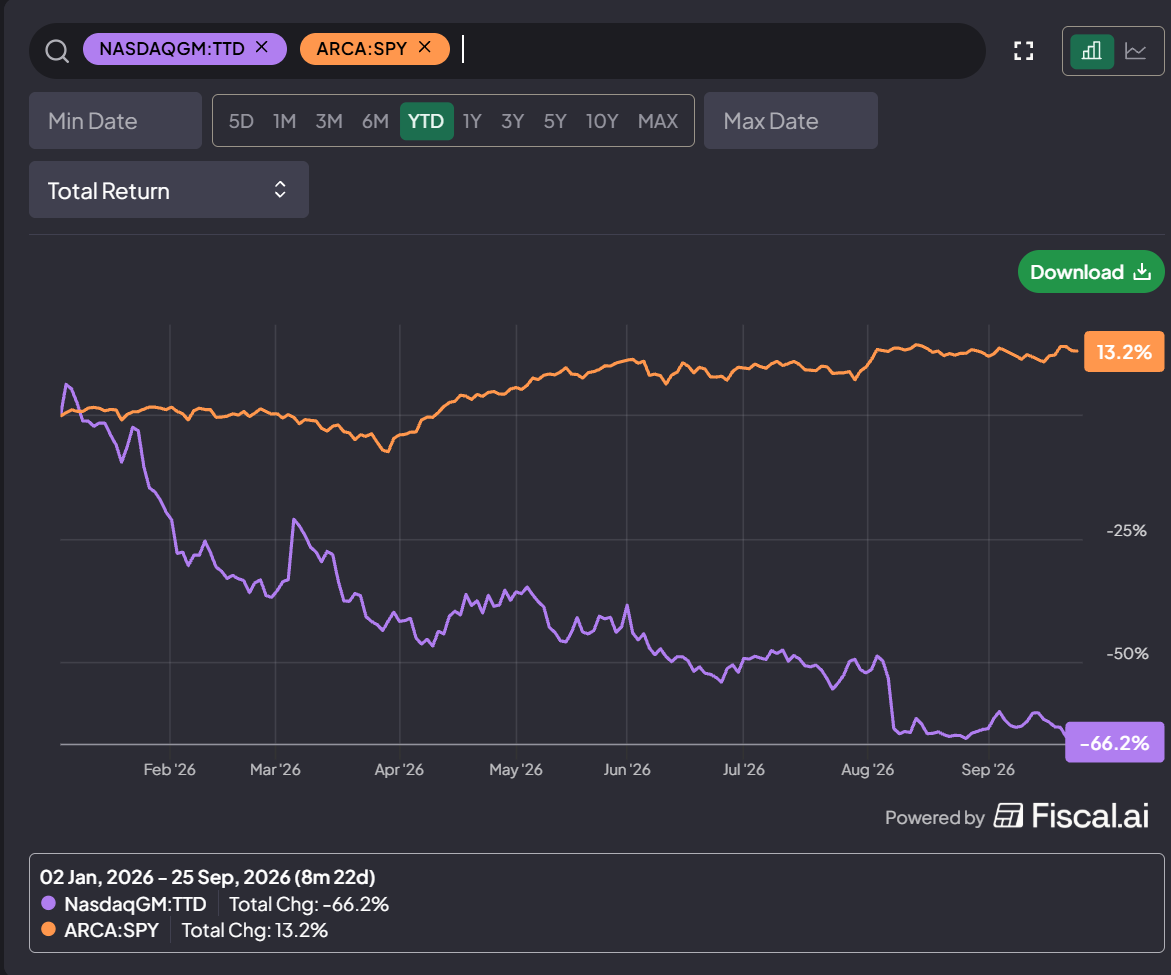
The Trade Desk’s CEO received a new 10-year option package targeting $105 per share as the company seeks shareholder approval to reprice…
The management team running $SGA is filled with idiots. These guys took 50 years to realize that radio was dying and then they decided to switch to a digital first strategy. And guess what their digital strategy is? Search and display ads for websites. Idiots. Probably something that is going to die faster than radio now that AI exists. CEO lives in Florida and calls Saga the greatest media company in the world. It’s deep value here. But you need an activist investor so bad. The board is filled with guys who probably still use a fax machine and use Outlook for their emails. Some really ancient guys running this company. Some would say the most ancient.
Gray Media $GTN just lifted their political revenue guidance for Q3. The prior political guide was $165-185 million of political revenue. The current guide is $188-195 million of political revenue. Market sleeping on how big midterms will be for media companies. $EVC should do well here.
