
NASDAQ

monday.com Ltd.

MNDY

8 stories

$4.5B Market cap · 2026-10-23

@BrokenMoats

Broken Moats on X

Have to give credit the squeeze in software is remarkable, they didn't even stop buying them with semis up n the open. Stocks like $MNDY flying 8% yesterday, $APPN up over 8% today (30% in a week after Barclays remained underweight with a price target roughly 40% current) after their closest comp reported very disappointing earnings and warned of demand and a restructuring.....truly incredible. Starting to give the $GRAL/ $TXG/ $TWST type manic move from a few weeks ago
@convequity

Convequity on X

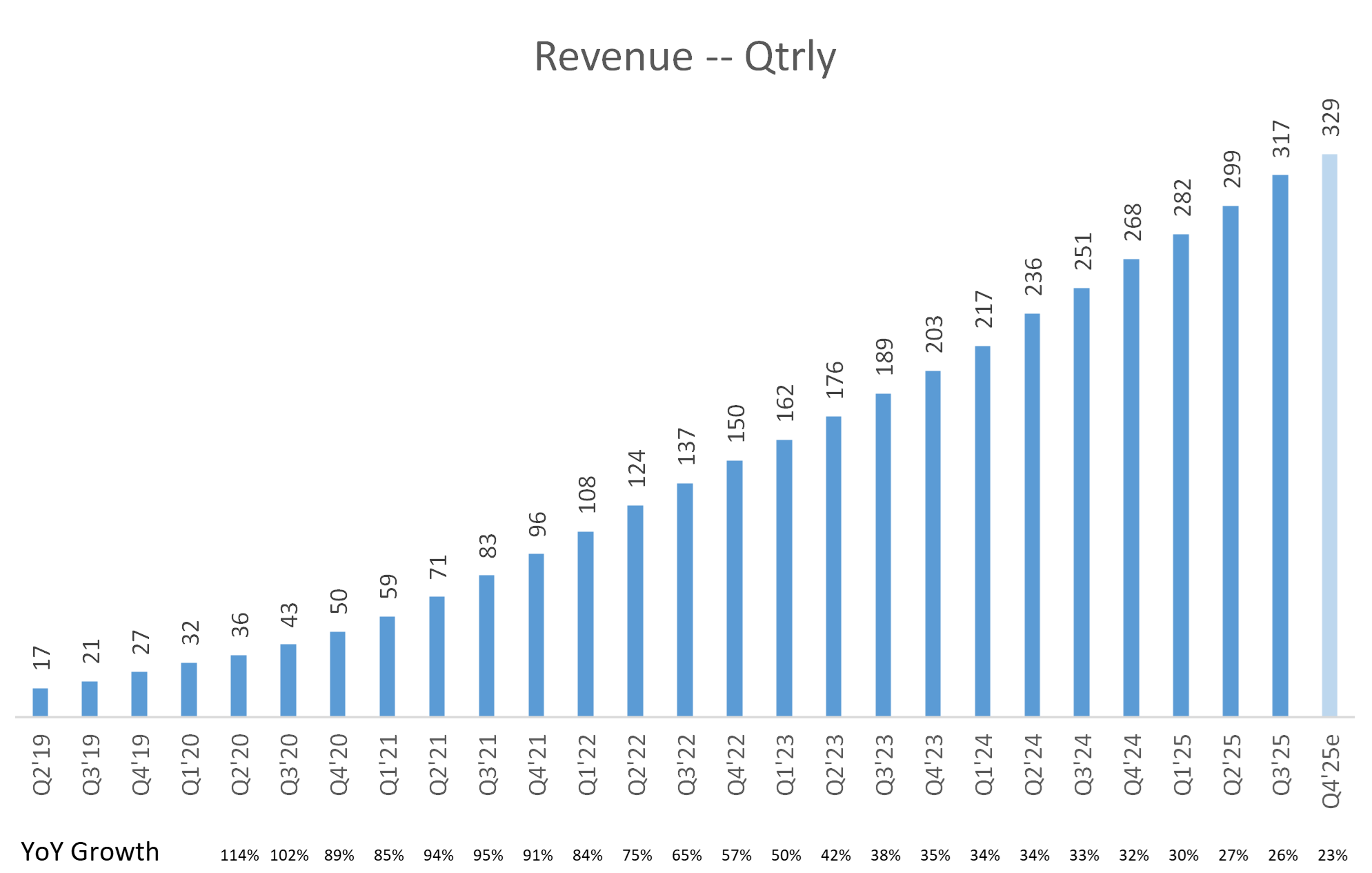
We think $MNDY needs to make its platform verifiable to lead work management. MNDY has not disclosed its AI ARR in dollars. Our recent SaaS Survival Scorecard report estimates it at about $20 to $30 million as of the end of Q2 2026. Leading AI-native startups in other fields are far larger. In coding, Cognition reported crossing $1 billion in annualized revenue run rate on 25 September 2026, company-wide across Devin and Windsurf. In legal work, Harvey reported on 1 October 2026 that it crossed $400 million in ARR during Q3 2026. We think MNDY has long been highly adaptive, with great leadership and a strong recent cadence of features and products. But revenue growth has slowed, and in our view it has gained little from AI so far, because work management is a hard area for AI. In our view, coding agents suddenly became highly effective around early 2026, and work management has not yet had its own coding moment. Verifiability is the key difference: code can be tested, while most work management outcomes are hard to check. Rather than wait for that moment, how can MNDY make work management more verifiable? It could track and measure the actions taken on its platform and their outcomes, so that everything that happens there is verifiable. MNDY can learn from Palantir. Palantir launched AIP in 2023, its AI platform built on its ontology, and we think that ontology helped Palantir succeed with models much weaker than today's. Could MNDY build a similar substrate or ontology for work management in order to make the work done on its platform more verifiable? We do not claim to have the answer. Our view is that to thrive, and not only survive, MNDY needs to lead work management by making its platform verifiable, however it chooses to do that.
@convequity 1 click

Convequity on X

Software multiples have fallen further since our January report. As of 7 Oct 2026, 238 companies in our all-software watchlist have EV/Sales (NTM) data on Koyfin. The median is 3.1x, down from 3.7x in January. The average is 5.4x, down from 6.2x. The 25th percentile is 1.8x, down from 1.9x. The 75th percentile is 5.5x, down from 6.1x. 191 of the 238 (80%) trade below our 6.7x private equity floor. 113 trade below 3x. The Bessemer Cloud Index shows the same pattern. Its median is 4.7x, down from 5.1x in January. 46 of its 68 companies (68%) trade below 6.7x. The cheapest are $CXM at 0.9x, $SPT at 1.1x, $MNDY at 1.7x and $WIX at 1.8x. In our watchlist, only 21 companies trade above 10x. The most expensive are $PLTR at 44.5x, $CRWD at 42.4x, $NET at 38.6x, $PANW at 24.2x, $DDOG at 19.5x and $SNOW at 16.3x. Growth still earns a higher multiple. The 44 names expected to grow revenue 20%+ a year over 3 years have a median of 5.2x. The 85 names expected to grow under 10% have a median of 2.6x. Even for the faster growers, the 5.2x median is below the floor. The market is paying up for very few names. We think that is right. Many software companies have slowing growth, high costs and no clear AI strategy. We would not buy the sector, or a cloud index, on valuation alone. In software, we focus on the few companies rebuilding their products around AI, and our SaaS Survival Scorecard tests key SaaS names against the pressure from AI agents.
@convequity 3 clicks

Convequity on X

What $MNDY can learn from Cursor’s breakout and $PLTR’s head start General productivity AI may still be waiting for the foundation-model capabilities that helped coding applications take off. That leaves a possible breakout ahead for MNDY. But waiting for the next model release would give its competitors the same opportunity. Our latest SaaS Survival Scorecard explores what MNDY could build in the meantime. During 2023 and early 2024, Cursor had already built its coding editor and an early harness around models such as GPT-4 and GPT-4 Turbo. That surrounding software supplied codebase context and helped developers apply and review changes. But the models still struggled to perform complex coding work reliably. Cursor had built a way to deliver AI assistance, while the intelligence available through it limited how much work developers could delegate. The turning point came with Claude 3.5 Sonnet in June 2024, which Cursor made its default model the following month. Its stronger coding capabilities made the application Cursor had already built much more valuable to developers. Subsequent releases, including Claude 3.7 Sonnet and Sonnet 4, extended what it could do. General productivity could experience a similar improvement. Coding, however, has an advantage that helps explain why it advanced earlier: verifiability. Code can be run. Tests can check whether it produces an expected result. A training system can try different approaches and reward the ones that pass. This gives model developers repeatable feedback about what worked. Work management combines verifiable actions with decisions that are much harder to judge. Did an agent send the document to the correct approver? That can be checked. Should the approval have been requested in the first place? Should one customer’s urgent request interrupt another team’s project? The answer may depend on commitments, exceptions and relationships that nobody has written down. The result may only become clear weeks later. Rewarding an agent for closing tasks quickly could even encourage it to close work before the customer’s problem is resolved. This helps explain why narrower AI-native applications have progressed faster. Harvey focuses on legal work. Sierra focuses on customer interactions. Their narrower scope makes it easier to define the job, connect the necessary systems and assess whether the customer received value. Legal interpretation and customer disputes still require judgment. The advantage is a more specific problem than “help everyone across this organisation work more effectively”. MNDY therefore has work to do before foundation models improve. It could capture more of the knowledge that managers use to coordinate people and departments, then turn that knowledge into rules and records an agent can check. For example, when a manager repeatedly overrides an assignment, the agent could ask why. When a project requires an extra approval, it could identify the condition that triggered it and ask the responsible person to confirm the rule. Over time, MNDY could connect those rules to named customers, documents, dependencies and permitted actions. It could then check whether the handoff was accepted, whether the work was reopened and whether the intended outcome occurred. That would improve the information available to today’s models and create better examples for evaluations and eventual post-training. $PLTR shows how valuable this preparation can become. Its forward-deployed engineers have spent years working directly with customers and the people who use its software. Those conversations reveal how work actually gets done, including exceptions that a standard process diagram leaves out. Consider a manufacturer waiting for a component. One customer can accept a substitute. Another requires a quality approval. A third faces a delivery penalty that makes the delay much more expensive. An engineer working with those users can discover these differences and build them into the software. This means the AI agent has explicit rules and relationships to follow instead of having to guess from a collection of documents. PLTR’s ontology also gives data from different systems a common vocabulary. The agent can recognise that an account in one application and a customer in another refer to the same organisation. This accumulated work helps explain why PLTR could make earlier, less capable models productive when it introduced AIP in 2023. It also gives PLTR an advantage that is difficult to reproduce quickly. MNDY’s off-the-shelf approach - as with typical SaaS - has historically placed more responsibility on customers to describe their processes through boards and automations. That makes the product easier to distribute, but leaves much of the unwritten knowledge in employees’ heads. PLTR’s customer-specific implementations have captured more of that knowledge through direct engineering work. MNDY’s opportunity is to find a cheaper, repeatable way to capture it across its installed base. Its existing harness work is a start. Context, memory, tool controls and evaluations take it beyond basic retrieval, which is why our report scores its model-layer integration at 2.5. The larger opportunity is to make more customer workflows explicit and verifiable. That could improve agent performance before the next model breakthrough arrives. Better foundation models would then operate with a maintained understanding of how each customer works. If customers depend on that understanding to complete work reliably, MNDY would have a stronger reason to retain their business than access to a model its competitors can also buy. The full MNDY report develops this analysis within our SaaS Survival Scorecard. #AgenticAI #SaaS

[$MNDY] Monday.com

Monday.com combines work management, CRM, Dev and Service on a flexible core platform, with 90% gross margins and AI disruption risk…

Investor Letters

Letters that discuss MNDY.

Tickers on this page

Companies the stories above are also about, besides MNDY.